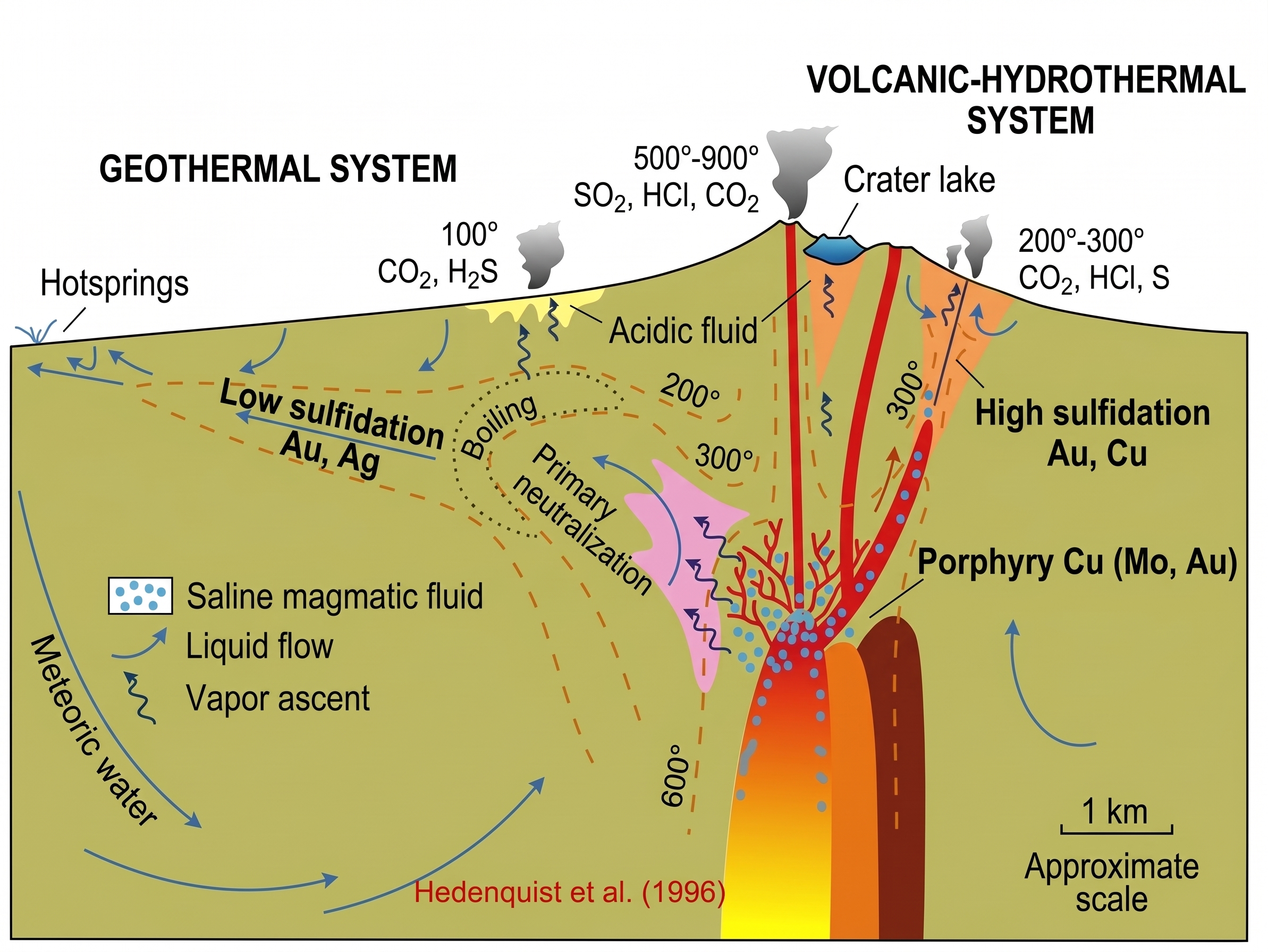
The largest sources of copper, molybdenum, and rhenium are porphyry copper deposits. Due to rapid depletion of outcropping resources, exploration should focus on identification of deep hidden stockwork deposits in the crust (Comte et al., 2023). Detection of hidden ore deposits is based on geochemical pathfinders and vectoring, which allows one to determine the direction and distance to the mineralized zone according to spatial distribution of trace elements in alteration halos. Deep-oriented exploration requires accurate detection methodologies due to subtle signatures left by magmatic-hydrothermal fluids.
The success of geochemical vectoring depends on understanding of hydrothermal alteration zones surrounding a porphyry copper system. Typically, the latter feature a central potassic alteration zone, which gradually changes into phyllic and argillic zones towards peripheral extensive propylitic zones. Trace elements show systematic behavior in these zones depending on the fluid temperature. For instance, the element Sr demonstrates deficiency in propylitic and argillic rocks but can accumulate in advanced argillic zones (Hikov, 2013). Awareness of general chemical gradients is the first step for determining a deep target.
In conventional lithogeochemical vectoring, whole-rock analysis is used to track volatile and fluid mobile elements. The elements As, Sb, Tl, and Li are transported for great distances from the intrusive body, creating broad distal halos that spread horizontally and vertically over several kilometers above a deep ore deposit. However, Cu and Mo precipitate near the source of magmatic fluids. Comparison of ratios between distal mobile elements and proximal elements enables to determine relative position in the hydrothermal system.
While whole-rock geochemistry is still useful, it can be reduced by baseline variations in host rocks. Therefore, modern exploration methods are based on mineral chemistry with focus on individual alteration minerals (chlorite and epidote) of the common propylitic halo. Previously “green rocks” have been viewed as geochemically homogeneous; however, advanced mass spectrometry shows that trace elements demonstrate systematic zoning in chlorite and epidote (Pacey et al., 2020). These alteration minerals reflect magmatic-hydrothermal fluids and serve as geochemical compasses to target the ore deposit (Pacey et al., 2020).
Chemistry of propylitic minerals provides clear vectors to the deposit core. Epidote demonstrates the increase of elements Ti, As, Sb, and V toward the porphyry center and the increase of Ba distally (Pacey et al., 2020). Chlorite is also sensitive to temperature gradients, which is reflected in the increase of Ti concentration towards the mineralization center and enrichment of Li and Co distally. Furthermore, decrease in silicon content and Fe/(Fe+Mg) ratio corresponds to the proximity to the ore-forming center (Li et al., 2024).
In conclusion, the discovery of deep porphyry copper deposits requires a shift from simple whole-rock anomalies to sophisticated mineral-chemistry vectoring. Thanks to pathfinders that are embedded in ubiquitous alteration minerals, namely Ti and V as proximal indicators and Li and Ba as distal indicators, explorers can estimate accurately the distance and direction to hidden ore deposits. While the number of surface discoveries decreases, micro-geochemical footprints remain the most scientific pathfinders.
References
Comte, D., Palma, G., Vargas, J., Calle-Gardella, D., Peña, M., García-Fierro, S., D’Andres, J., Roecker, S., & Pichott, S. (2023). Imaging the subsurface architecture in porphyry copper deposits using local earthquake tomography. Scientific Reports, 13. https://doi.org/10.1038/s41598-023-33820-w
Hikov, A. (2013). Geochemistry of hydrothermally altered rocks from the Asarel porphyry copper deposit, Central Srednogorie. Geologica Balcanica, 42, 3–28. https://doi.org/10.52321/geolbalc.42.1-3.3
Li, F., Tang, J., Song, Y., Li, S., Tang, P., Li, H., Yang, H., Wang, Q., Wang, Y., Danzeng, Z., Li, Y., Li, J., Li, H., & Dong, Y. (2024). Major elements geochemistry of chlorite in different ore deposits and its genesis and exploration significance: a case study from Naruo porphyry Cu deposit in Duolong ore district, Tibet. Frontiers in Earth Science, 12. https://doi.org/10.3389/feart.2024.1378820
Pacey, A., Wilkinson, J. J., & Cooke, D. R. (2020). Chlorite and Epidote Mineral Chemistry in Porphyry Ore Systems: A Case Study of the Northparkes District, New South Wales, Australia. Economic Geology, 115(4), 701–727. https://doi.org/10.5382/econgeo.4700