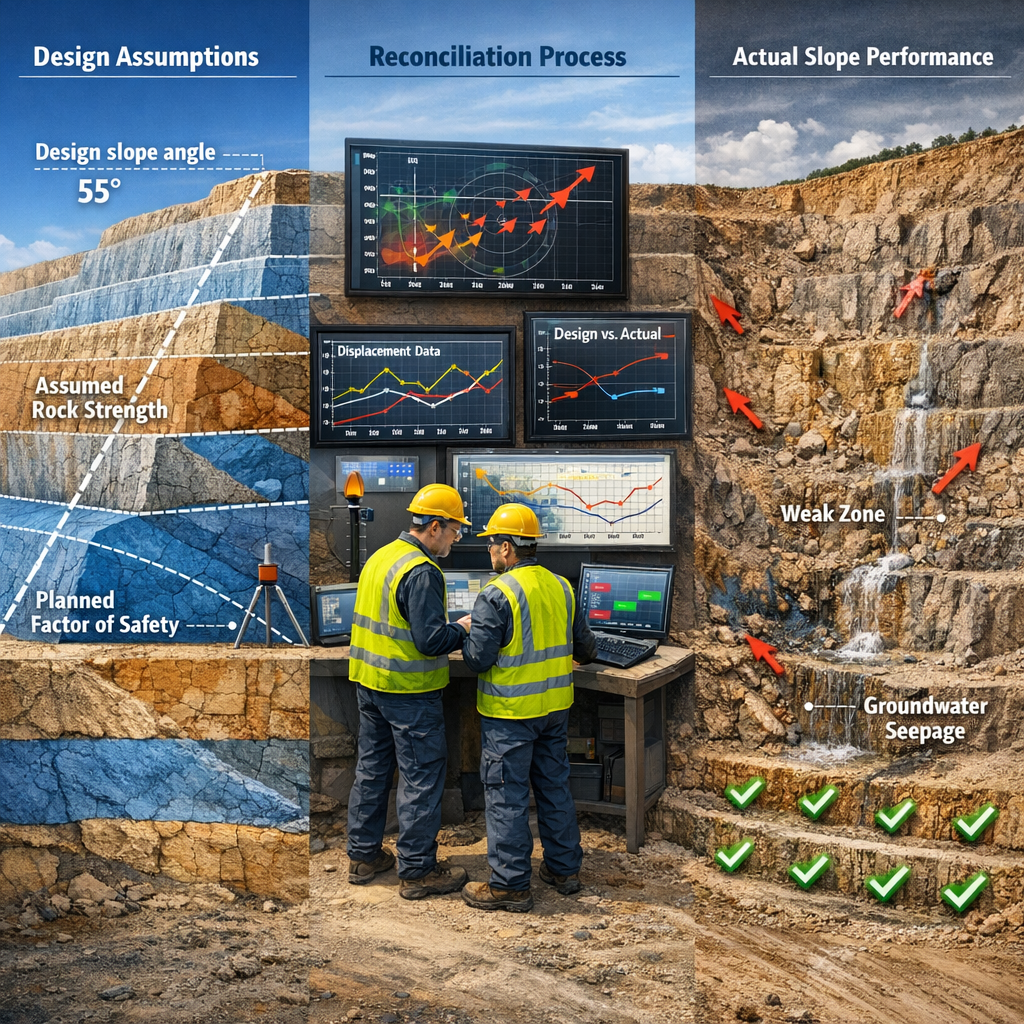
Geotechnical engineering is, by its very nature, uncertain. In both open-pit mining and civil engineering, slope design is predicated on predictive models, which in turn are informed by limited borehole data, laboratory testing, and idealized geological assumptions. The process of geotechnical reconciliation, which entails a systematic comparison between predicted design performance and real-world behavior, represents the feedback loop that ultimately ensures safety, economic viability, and operational sustainability.
Bridging design and reality
The value of reconciliation, therefore, lies in its ability to validate or calibrate the Ground Model. Initial designs often assume a Factor of Safety (FoS) predicated on rock mass strength and pore water pressures. However, as mining progresses, exposed geology often exhibits complexities such as persistent jointing or groundwater inflows, which were not anticipated during the feasibility stage.
As Sainsbury and Sainsbury (2021) note, reconciliation is not an afterthought but an integral component in risk management. By comparing anticipated deformation rates with real-time monitoring data, such as radar or piezometers, engineers can ascertain whether the slope behaves linearly or is trending towards a state of progressive failure.
Enhancing safety and risk mitigation
The most immediate benefit of reconciliation, therefore, is the avoidance of catastrophic failure. Slope stability is a dynamic process, which changes with seasonal rainfall, blasting vibrations, and geometric steepening. Paredes et al. (2022) note that reconciliation allows for back-analysis of localized instabilities. In cases where a minor bench-scale failure does occur, reconciling it against design parameters allows for adjustments to be made to the design parameters for the life of the mine, thereby avoiding the risk of multi-bench failures.
Moreover, the inclusion of Probability of Failure (PoF) in reconciliation processes has gained traction in recent years. Romer et al. (2023) argue that reconciling real-world behavior against probabilistic models represents a more nuanced risk assessment than traditional deterministic approaches.
Economic optimization
Reconciliation is equally a tool for financial efficiency. Over-designed slopes (too shallow) result in excessive waste stripping and lost revenue, while under-designed slopes (too steep) lead to costly cleanup and equipment damage.
| Benefit Category | Impact of reconciliation |
| Operational | Minimizes unplanned downtime due to wall instability. |
| Financial | Optimizes the “Stripping Ratio” by allowing for steeper, yet safe, angles. |
| Technical | Refines the geotechnical database for future projects in similar lithologies. |
Recent research by Venter et al. (2024) highlights that mines utilizing rigorous reconciliation protocols can increase slope angles by as little as 2⁰ to 3⁰, which often translates to millions of dollars in saved excavation costs without compromising the global stability of the pit.
Conclusion
Geotechnical reconciliation acts as a link between theoretical soil and rock mechanics, and empirical field observations. It changes monitoring data from a primarily reactive warning system into a proactive design tool. As industrial operations are extended to greater depths and more complex environments, the continuous matching of design expectations with observed performance remains the ultimate criterion for sustainable engineering.
References
Paredes, P., Tapia, A., & Walker, R. (2022). Integration of back-analysis and slope performance reconciliation in large open pits. Journal of Rock Mechanics and Geotechnical Engineering, 14(3), 745-758.
Romer, N., Lorig, L., & Jakubec, J. (2023). Moving beyond the Factor of Safety: Probabilistic reconciliation in deep open-pit mines. Geotechnical and Geological Engineering, 41(5), 2910-2925.
Sainsbury, B. L., & Sainsbury, D. P. (2021). Practical applications of slope performance reconciliation in fractured rock masses. International Journal of Mining Science and Technology, 31(2), 189-204.
Venter, J., Crouse, A., & Miller, S. (2024). Economic impacts of geotechnical design reconciliation in the modern mining cycle. Mining Engineering Quarterly, 56(1), 12-28.