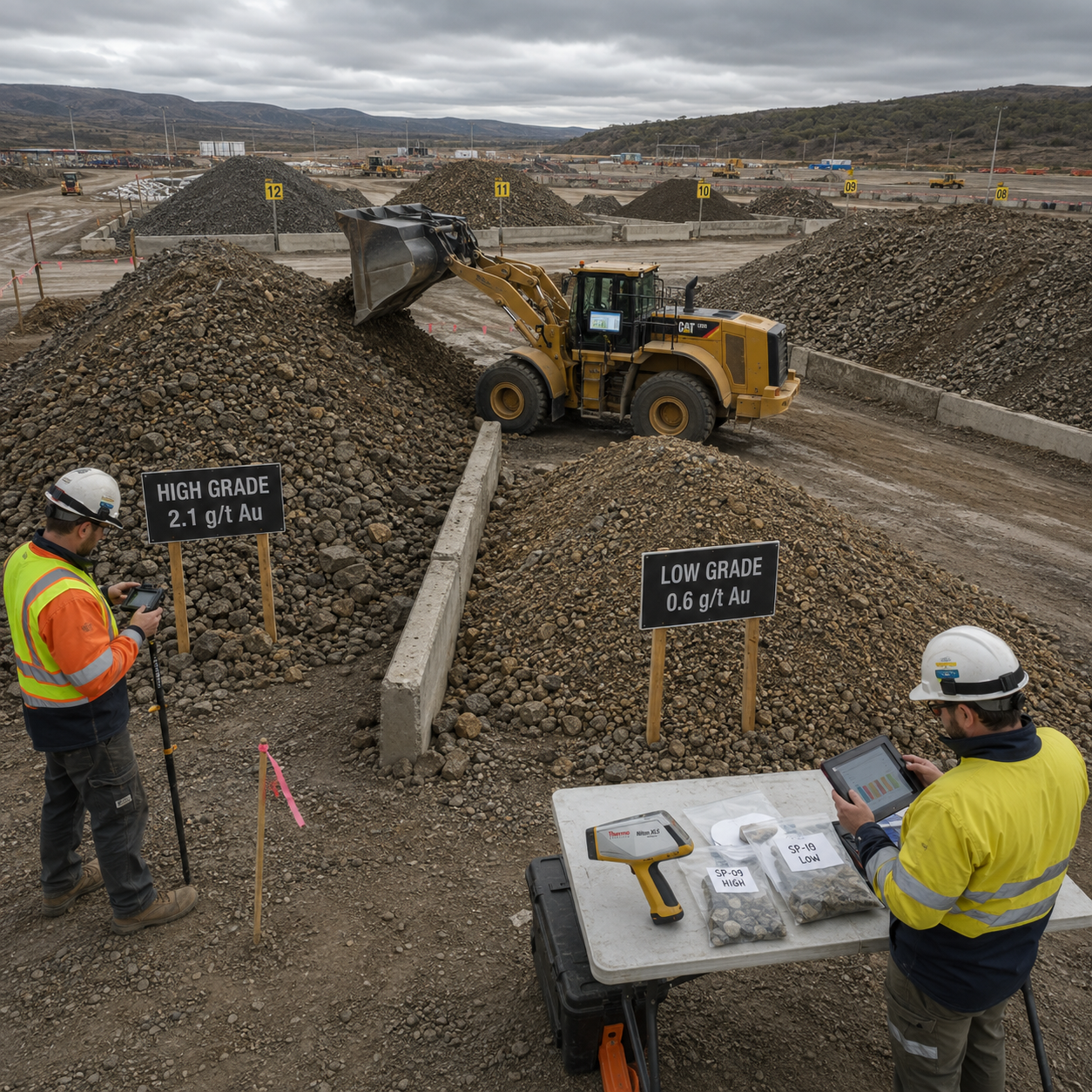
Stockpile management plays a key role in sustaining the economic efficiency of extracted ore. Two major phenomena should be considered in the context of stockpile management. First, there is stockpile segregation. This phenomenon involves the spontaneous sorting of stockpiles according to the size of the particles. Another phenomenon to consider is grade dilution. It means mixing waste of lower grade with higher quality ore, thus diminishing the total grade of the mill feed. These two issues need to be tackled to maximize the production while minimizing expenses.
Stockpile segregation is determined largely by the particle behavior during stocking. As a result of ore stocking, fine particles accumulate near the central zone where ore is dumped while the bigger particles roll down the slopes and gather on the periphery. Research based on discrete element simulation showed that segregation strongly depended on the proportion of coarse/fine particles and height of the feeder (Gómez et al., 2022). Traditional conical stockpiling leads to segregation and results in heterogeneous stockpiles.
These differences are the very cause of grade dilution. When extraction of ore is made from a sorted stockpile, the composition of the feed sent to the milling circuit experiences strong fluctuation between the fine and course ore content. Such differences play a major part in determining the cut-off grade of ore and its processing, while, in some instances, the presence of waste inclusions turns out to be quite unexpected (Sotoudeh et al., 2024). As a result of non-uniform extraction of ore, the initial grade of the product will drop due to surges of barren rocks or fine material that hinder the achievement of proper blending conditions.
An effective measure for avoiding grade dilution would be applying a high-grade metal account system. High-quality grade control implies classification of materials based on bulk density measurement, moisture assessment, and volume calculation (Ghorbani et al., 2020). In case strict classifications of ore grades before placing them in stockpiles are established, then certain types of ore should be directed to certain zones. This allows preventing blending of ore with waste products structurally.
In addition to accounting procedures, optimization of physical stacking and reclaim methods is imperative for avoiding any spontaneous segregation. No one shall build conical piles of large dimensions. Rather, one should use layered stocking with the help of radial or telescopic conveyors which will form chevron patterns ensuring that particles of all sizes are uniformly distributed through the whole pile. At the next stage when reclamation is carried out, material is reclaimed perpendicularly from the said layers in order to take from it simultaneously coarse edges and fine centers. Thus, such a constant mixing operation prevents segregation because of stacking.
To sum it up, management of the process of segregation in stockpiles to avoid grade dilution calls for combining physical material management with accounting metallurgy. The ideal way is to stop using archaic conical stacking in favor of more technologically advanced method of stocking to physically confine particles to moving separately from each other. With the combination of those physical procedures along with the precise grade control and metal accounting processes, operations will be able to have constant comminution feed and economic value preserved.
References
Ghorbani, Y., Nwaila, G. T., & Chirisa, M. (2020). Systematic Framework toward a Highly Reliable Approach in Metal Accounting. Mineral Processing and Extractive Metallurgy Review, 43, 664–678. https://doi.org/10.1080/08827508.2020.1784164
Gómez, R., Skrzypkowski, K., Moncada, M., Castro, R., & Lazo, R. (2022). Segregation Modeling in Stockpile Using Discrete Element Method. Applied Sciences, 12, 12449. https://doi.org/10.3390/app122312449
Sotoudeh, F., Nehring, M., Kizil, M., Knights, P., & Mousavi, A. (2024). The effect of stope size and cut-off grade on the design and scheduling of an underground mining operation in the presence of a pre-concentration system. International Journal of Mining, Reclamation and Environment, 39, 110–122. https://doi.org/10.1080/17480930.2024.2387989