
Sign In


Forgot Password?

Don't have account, Sign Up Here

Forgot Password

Lost your password? Please enter your email address. You will receive a link and will create a new password via email.


Have an account? Sign In Now

Sorry, you do not have permission to Add a Post, You must login to Add a Post.


Forgot Password?

Need An Account, Sign Up Here

Sorry, you do not have permission to add Article.


Forgot Password?

Need An Account, Sign Up Here

Please briefly explain why you feel this Post should be reported.

Please briefly explain why you feel this Comment should be reported.

Please briefly explain why you feel this user should be reported.

Mining Doc Logo Mining Doc Logo Mining Doc Logo
Sign InSign Up

Mining Doc

Mining Doc Navigation

  • Home
    • About
    • Contact us
  • Mining articles
  • Online Courses
Search
Sign up

Mobile menu

Close
join for free
  • Home
  • Online courses
  • Case study
  • Mining Community
  • Solutions listing
    • Lase Solutions
    • O-PitBlast Solutions
    • Continuous Mining
    • Longwall mining
    • Geosight Scanners
    • LoopX AI
    • Terafil solutions
    • Blasting solutions
    • Geotechnical
    • Submersible Pumps
    • Mine rescue system
    • Ore sorting
    • Whittle Consulting Solutions
  • Add Blog
  • Feed
  • User Profile
  • Posts
    • New Posts
    • Trending Posts
    • Must read Posts
    • Hot Posts
  • Polls
  • Badges
  • Home
    • About
    • Contact us
  • Mining articles
  • Online Courses

Mining Doc Latest Posts

Mining Doc
  • 0
  • 0
Mining DocExplainer
Added: September 15, 20262026-09-15T05:26:53-04:00 2026-09-15T05:26:53-04:00In: Geology

What's the correct method for logging RQD and core recovery to ensure defensible geotechnical domain models?

  • 0
  • 0

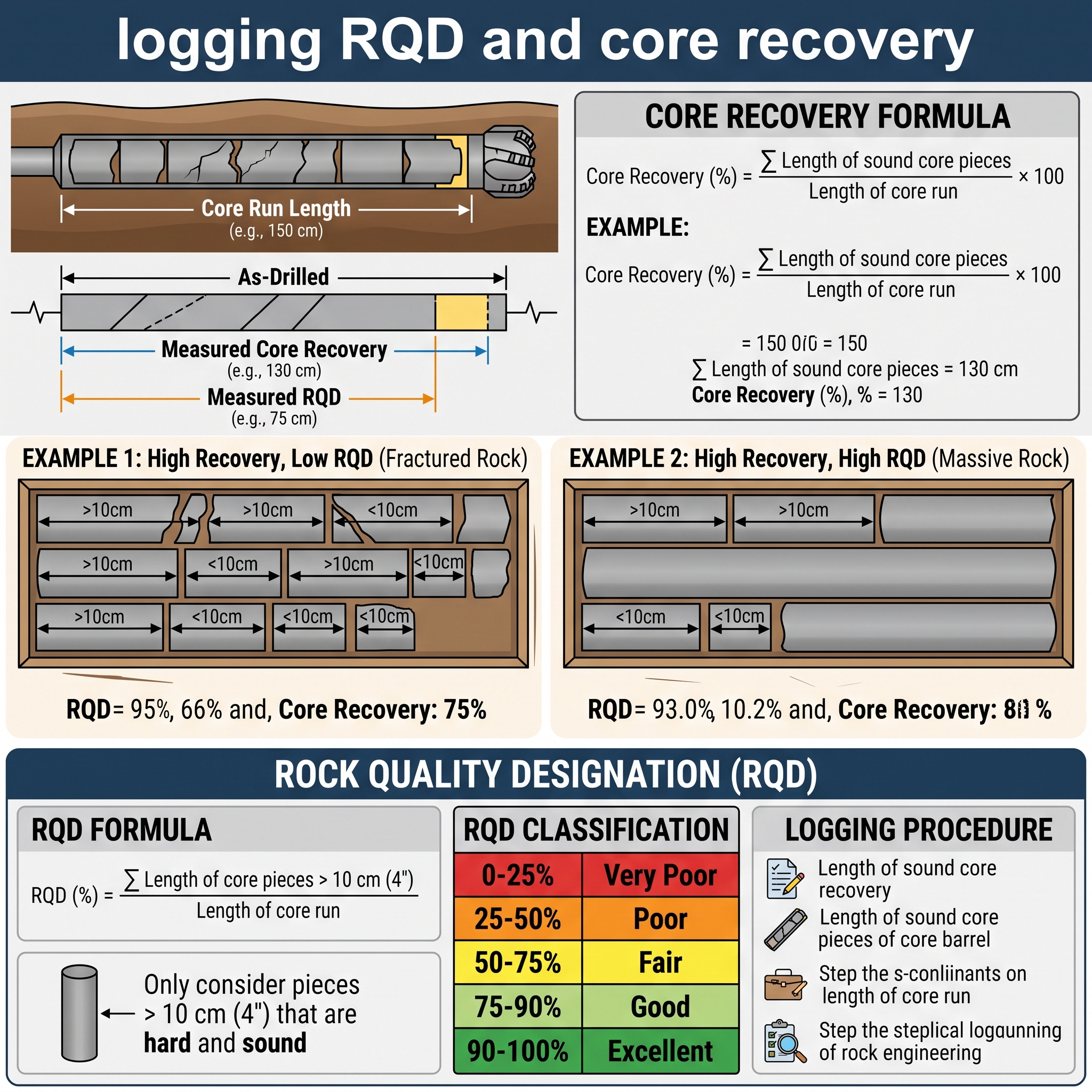
The formulation of credible geotechnical models is based on very accurate characterization of sites, which is achieved through diamond drill core logging. In the process, two very important indices need to be identified – Total Core Recovery (TCR) and Rock Quality Designation (RQD). TCR refers to the ratio of the length of recovered rock core compared to the total length of drilled material of a particular run. RQD is an advanced index of core recovery representing the ratio of the length of intact rock fragments larger than 10 cm to the length of a drill run. These indices are the foundation of modern rock mass classification systems (Narimani et al., 2025).

The proper method of logging TCR starts with careful treatment of core material. Before taking measurements, drilling block markers should be checked in order to provide a precise account of the depth of drilling. The logger needs to assemble core very carefully, considering any spaces created by drill water eroding soft material. The value of TCR is found by dividing the length of recovered rock by the run length expressed in percentage. Accurate logging of TCR will allow engineers to identify zones of core loss, which is evidence of geological faults.

The conformity to the basic RQD definition is necessary to create consistent domain models. Only the core sections which are solid, intact, and longer than 10 cm in the core direction are taken into account when calculating the RQD value (Pells et al., 2017). The core segments which are highly weathered, weathered to the degree of soil, or crumbling at hand pressure cannot be accounted for RQD despite being longer than 10 cm. Such approach will make RQD calculation better reflect mechanical competence.

One of the primary sources of error in core logging that negatively impacts the credibility of geotechnical models is the misidentification of fracture types. RQD must account only for natural geological discontinuities like joints, bedding planes, and shear zones. The fractures caused by drilling, manipulation or release of stresses called mechanical breaks should be ignored. The appropriate practice is the physical reconstruction of mechanically broken fragments. If the reconstructed fragment is longer than 10 cm, it is regarded as an intact section.

The accurate logging of cores is central to the validity of geotechnical domain models in 3D form. The field logging of core data forms the basis of rock mass classification using empirical tools such as the RMR and GSI models (Somodi & Vásárhelyi, 2023). When the cores are logged accurately, the engineers are able to create geotechnical domains representing zones of similar geomechanical behavior. Inaccurate logging causes false variability which makes the domain models invalid for the design of critical pit slope or underground excavations (Eggers, 2016).

In summary, the correct method of logging the RQD and core recovery depends on standardization and accurate reassembling of cores as well as differentiation between natural and mechanical fractures. Geotechnical domain models cannot be made scientifically through core logging based on subjective opinions.

References

Eggers, M. (2016). Engineering geological modelling for pit slope design in the porphyry copper-gold deposits of Southeast Asia. Proceedings of the First Asia Pacific Slope Stability in Mining Conference, 49–82. https://doi.org/10.36487/acg_rep/1604_0.4_eggers

Narimani, S., Davarpanah, S. M., Bar, N., & Vásárhelyi, B. (2025). Analyzing Drill Core Logging Using Rock Quality Designation–60 Years’ Experience from Modifications to Applications. Applied Sciences, 15(3), 1309. https://doi.org/10.3390/app15031309

Pells, P. J., Bieniawski, Z. T., Hencher, S. R., & Pells, S. E. (2017). Rock quality designation (RQD): time to rest in peace. Canadian Geotechnical Journal, 54(6), 825–834. https://doi.org/10.1139/cgj-2016-0012

Somodi, G., & Vásárhelyi, B. (2023). Borehole Analysis with the Modification of RQD Value. Geotechnics, 3(4), 1017–1032. https://doi.org/10.3390/geotechnics3040055

What's the correct method for logging RQD and core recovery to ensure defensible geotechnical domain models?
0
  • 0 0 Comments
  • 41 Views
  • 30 Reactions
  • 0 Followers
  • 0
    • Report
  • Share
    Share
    • Share on Facebook
    • Share on Twitter
    • Share on LinkedIn
    • Share on WhatsApp

Related Posts

  • What's the practical workflow for using portable XRF data in the field without compromising assay-grade decisions?
  • What geochemical pathfinder elements are most reliable for vectoring toward a porphyry copper center at depth?
  • How to distinguish between primary and remobilized structural controls when mapping a shear-hosted gold deposit?

You must login to add an Comment.


Forgot Password?

Need An Account, Sign Up Here
aalan

Sidebar

Sponsored Ads

aalan
  • Recent
  • Mining ERP: Bridging the Gap Between Planned and Actual Costs
    • On: September 14, 2026

    Mining ERP: Bridging the Gap Between Planned and Actual Costs

  • Ore Crushing Plant for Mountain Mines: Managing Access, Transport, and Production
    • On: September 12, 2026

    Ore Crushing Plant for Mountain Mines: Managing Access, Transport, and ...

  • How Does the Crushing Chamber Design of Aggregate Crushing Equipment Affect Output and Finished Product Quality?
    • On: September 12, 2026

    How Does the Crushing Chamber Design of Aggregate Crushing Equipment ...

  • How Can Mine Construction Teams Reduce Rework During Fast-Track Projects?
    • On: September 8, 2026

    How Can Mine Construction Teams Reduce Rework During Fast-Track Projects?

  • The Mine in Your Pocket: Why Mobile ERP Is Reshaping Mining Operations
    • On: September 8, 2026

    The Mine in Your Pocket: Why Mobile ERP Is Reshaping ...

  • How Concrete Is Used in Crusher and Screening Plant Foundations at Guatemalan Mines
    • On: September 4, 2026

    How Concrete Is Used in Crusher and Screening Plant Foundations ...

  • Portable Crusher Plant for Hard Rock Mines: How to Design the Crushing Circuit Before Grinding
    • On: September 3, 2026

    Portable Crusher Plant for Hard Rock Mines: How to Design ...

Go to Home page to view more

Top Members

Olena Skyba

Olena Skyba

  • 150 Posts
  • 2 Comments
Pundit
Marcial

Marcial

  • 91 Posts
  • 0 Comments
Enlightened
Jean Marais (Sanodea Group)

Jean Marais (Sanodea Group)

  • 26 Posts
  • 0 Comments
Beginner
Trending on Mining Doc

Trending Communities

Fixed Plant General Information Geology Mining Case Studies Mining Doc Documentary Mining Engineering Mining Events Mining Finance and Economy Mining Human Resources Mining Industry Research Mining Operations Mining Software Solutions Mining Sustainability Mining Technology Solutions Mobile Plant Equipment

Explore

  • Home
  • Online courses
  • Case study
  • Mining Community
  • Solutions listing
    • Lase Solutions
    • O-PitBlast Solutions
    • Continuous Mining
    • Longwall mining
    • Geosight Scanners
    • LoopX AI
    • Terafil solutions
    • Blasting solutions
    • Geotechnical
    • Submersible Pumps
    • Mine rescue system
    • Ore sorting
    • Whittle Consulting Solutions
  • Add Blog
  • Feed
  • User Profile
  • Posts
    • New Posts
    • Trending Posts
    • Must read Posts
    • Hot Posts
  • Polls
  • Badges

Footer

Mining Doc

Join our community and connect with other people in the Mining industry for knowledge sharing.

Legal Stuff

  • Privacy Policy
  • Terms of Service

Help

  • Support
  • FAQs
  • How to add new content and how to promote a content
  • Compliance and guidelines
  • Subscribe to Mining Doc

Follow

© 2026 Mining Doc. All Rights Reserved