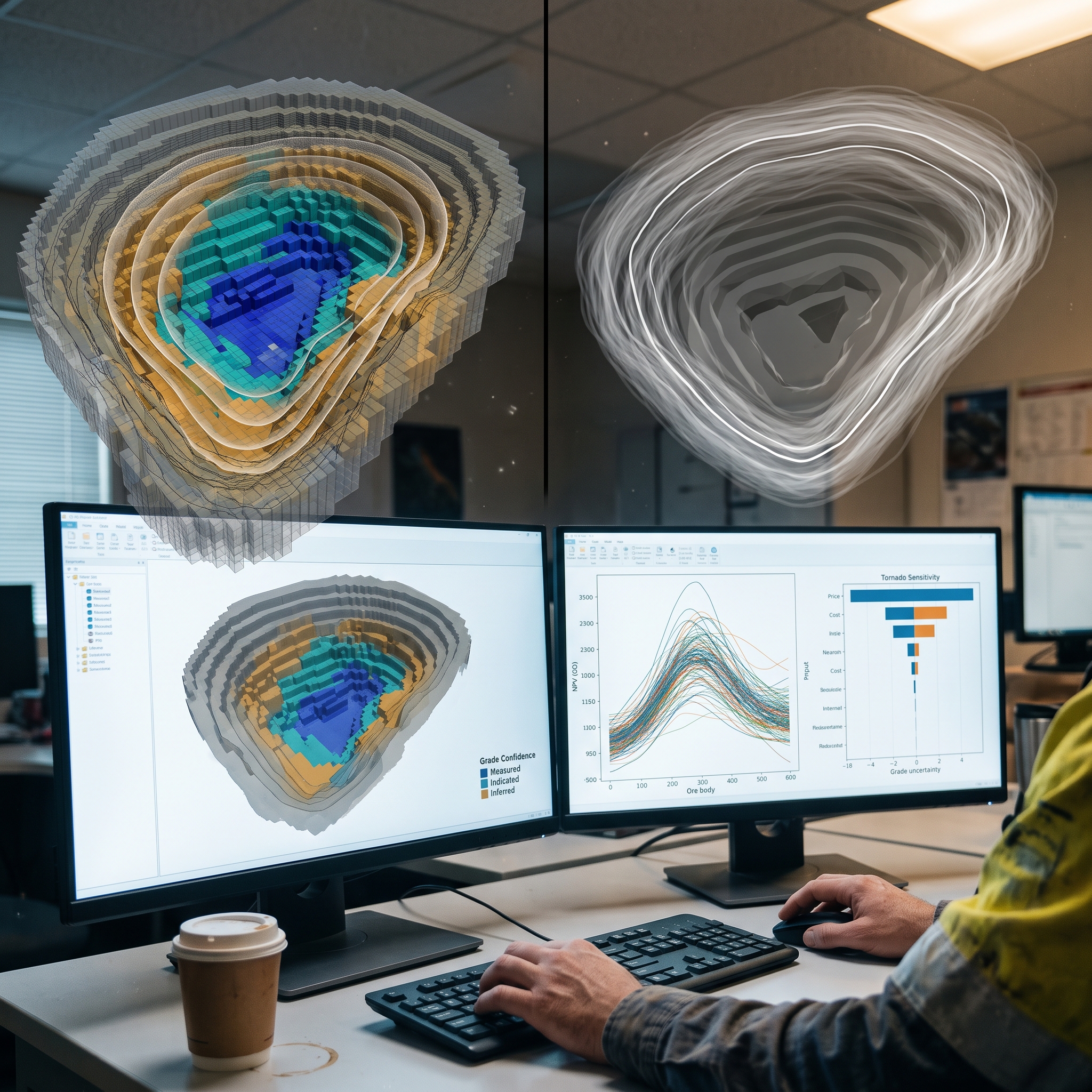
Uncertainty in geology can be defined as the inherent insufficiency of information about the extent and grade of the mineral deposit due to insufficient sampling. The optimization of a pit involves the numerical calculation of the optimal boundaries of the pit and the schedule of extraction that would maximize the NPV of the project. The accurate representation of this geological uncertainty is vital because optimization entirely depends on the accuracy of geological inputs.
Traditionally, the mining sector has been using deterministic approaches to model geological inputs. The engineers have used interpolation techniques to create a single smoothed block model of the orebody and then used it as an input to traditional optimization techniques. Unfortunately, such an approach does not consider the spatial uncertainty of the deposit. Using just one orebody is likely to produce wrong estimates of the mineral content and ignore the supply risk (Jiang & Dimitrakopoulos, 2024). Therefore, the deterministic plans are often fragile because even small changes in these assumptions produce infeasible plans and losses for the company.
The methodology that is best suited for geological modeling is geostatistical stochastic simulation, where the creation of one single smoothed average model is not done but rather a variety of equally likely realizations of the orebody are created. The simulations create the natural variation that is present in the geological data. As such, it allows the mine planners to look at several different scenarios that will allow the pit optimization algorithm to consider the true risks associated with each of the geological realizations of the deposit.
Once the geological realizations have been created, their implementation in the pit optimization algorithm is achieved through Simultaneous Stochastic Optimization (SSO). Unlike other approaches to mineral planning, the SSO combines all the components of the mineral value chain in one mathematical model (LaRoche-Boisvert & Dimitrakopoulos, 2021). The use of the stochastic integer programming method in the optimization process allows taking advantage of the synergies of different mining components. Furthermore, the supply risk is actively managed through multiple simulated block models.
The practical benefits of applying stochastic modeling for the inputs to pit optimization are many. Using the geological variation along with other parameters, such as changes in the mineral price, it is possible for the planners to generate very resilient strategic mine plans (Baek et al., 2016). Since the application of stochastic approach helps the miners account for the risks associated with failure to reach the production targets via penalties included in the objective function, the methods are often found to unlock additional economic value, thus giving a substantially higher NPV than those obtained using deterministic optimization schedules (LaRoche-Boisvert & Dimitrakopoulos, 2021).
To conclude, the proper modeling of geological uncertainty should be regarded as a crucial paradigm shift from deterministic to stochastic approaches. By generating different scenarios of the orebody and optimizing all of them simultaneously, it is possible for the mining experts to effectively manage risks and increase the value of their assets.
References
Baek, J., Choi, Y., & Park, H. (2016). Uncertainty representation method for open pit optimization results due to variation in mineral prices. Minerals, 6(1), 17. https://doi.org/10.3390/min6010017
Jiang, Y., & Dimitrakopoulos, R. (2024). An application of simultaneous stochastic optimisation on an open-pit copper mining complex with supply, recovery, and market uncertainties. International Journal of Mining, Reclamation and Environment, 39(1), 74–92. https://doi.org/10.1080/17480930.2024.2381904
LaRoche-Boisvert, M., & Dimitrakopoulos, R. (2021). An application of simultaneous stochastic optimization at a large open-pit gold mining complex under supply uncertainty. Minerals, 11(2), 172. https://doi.org/10.3390/min11020172