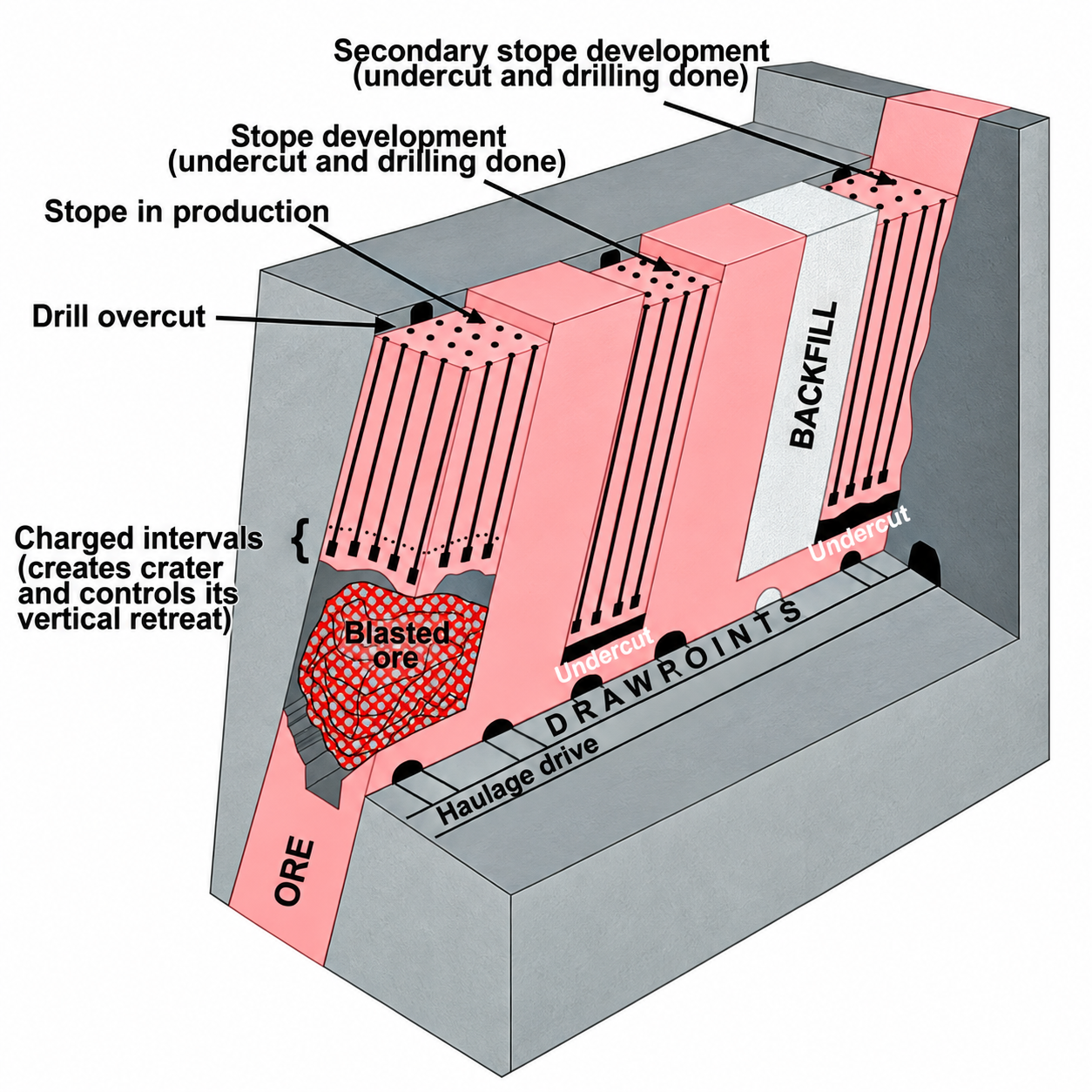
VCR mining is considered an advanced type of underground mining process whereby economically viable mineral deposits are extracted through efficient and safe mining while protecting the workforce from being exposed to unsupported open stopes. The mining process is widely used in the case of steeply dipping massive orebodies. There are three major aspects associated with VCR mining, which can be summarized by the acronym VCR itself, namely (1) vertical or nearly vertical nature of the orebody, (2) crater blasting based on Livingston’s theory of cratering, and (3) upward retreat mining. Unlike traditional linear shear blasting, the process involves explosives that are applied horizontally.
The construction of a VCR (ventilation-controlled) stope requires an overcut level as well as an undercut level as part of its development process. An underground drill rig creates a set of vertical blastholes, normally 165 millimeters in diameter, connecting the overcut directly to the undercut. Miners use powerful explosive charges, which have length-to-diameter ratios not higher than six-to-one, at appropriate burial depth in blastholes. High-density water gel or aluminum slurry explosives produce shockwaves, thus breaking the rock blocks horizontally, between three to five meters thick, below to the undercut. Heavy Load-Haul-Dump trucks extract the excavated volume of rock debris from the draw points after every explosion. Extraction happens progressively and sequentially, starting from the last top crown sill before the empty stope gets filled with paste or consolidated rock fill.
VCR stoping cannot be successfully used in relation to particular deposit configuration and host-rock mechanics. Ore bodies need to have steeper dipping more than 45 degrees, as well as wide width that should be at least from 12 to 15 meters or even larger. The mineralized body and adjacent wall rocks need to have high compressive strength, which is usually higher than 14,000 psi, in order to provide for stope stability during mining operations. The main practical application of this technique includes bulk primary stoping and pillar extraction at deep base metal mines. VCR stoping is being used in copper operations in Zambian Copperbelt such as Mindola and Nkana mines.
There are many advantages that can be derived from VCR mining in comparison with conventional underground stoping systems. All drilling, hole surveying, and blasting are done exclusively from the overcut level, thus making it unnecessary to enter the dangerous open stopes. The raise boring and slot cutting is not required in VCR mining, which leads to decreased development time and initial investment. Spherical charges allow for better distribution of blasting energy, providing uniform fragmentation of the ore and less blocking of draw points. The precise control of blast outlines provides for low dilution and overbreak, which allows achieving high productivity per unit cost.
VCR stoping is a highly effective, bulk mining technique that safely combines the principle of gravity ore recovery with modern crater blasting physics. Its use in deep underground mining has improved extraction rates and raised the bar for geotechnical ground control. As mining goes ever deeper and into increasingly stressed conditions around the world, VCR will remain an important stoping technique for competent ores.