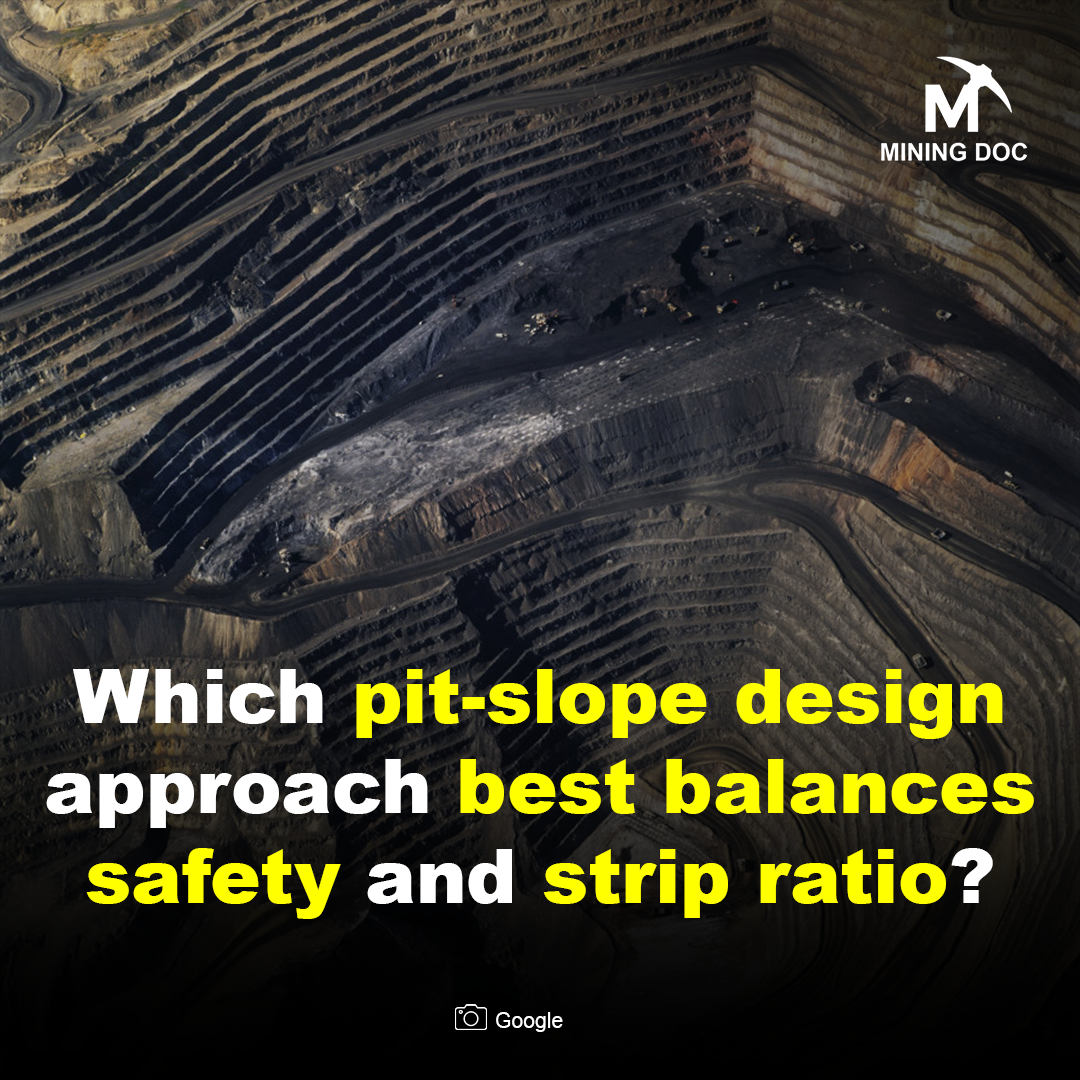
In open-pit mining, increasing pit slope angles can significantly reduce the strip ratio by limiting waste removal and enhancing economic performance; however, steeper slopes also increase the risk of instability.
To balance these competing factors, an optimal slope design adopts a multi-scale, probabilistic approach.
This process begins with geotechnical domain characterization, followed by kinematic and limit equilibrium analyses at the bench and inter-ramp scales, and numerical modeling at the overall slope scale, to achieve acceptable stability criteria typically factors of safety of 1.3–1.5 or probabilities of failure below 10–15%.(Principles and Methods for Designing Open-Pit Mining Limits – Yantai Gaea Rock Split Machinery Technology Co.,Ltd, n.d.).
As described in Guidelines for Open Pit Slope Design (Read & Stacey, 2009), this method integrates site-specific rock mass characteristics, structural conditions, and hydrogeological factors to develop zoned slope designs that optimize ore recovery while maintaining long-term slope stability. (Guidelines for Open Pit Slope Design, n.d.)
Finally, the goal of modern slope design is not the highest safety factor, but the optimum risk—balancing the cost of potential failure against the massive economic gain of a reduced strip ratio
Reference
Guidelines for Open Pit Slope Design. (n.d.). Routledge & CRC Press. Retrieved January 19, 2026, from https://www.routledge.com/Guidelines-for-Open-Pit-Slope-Design/Read-Stacey/p/book/9780415874410
Principles and Methods for Designing Open-Pit Mining Limits—Yantai Gaea Rock Split Machinery Technology Co.,Ltd. (n.d.). Retrieved January 19, 2026, from https://www.stonedemolition.com/news/principles-and-methods-for-designing-open-pit-mining-limits