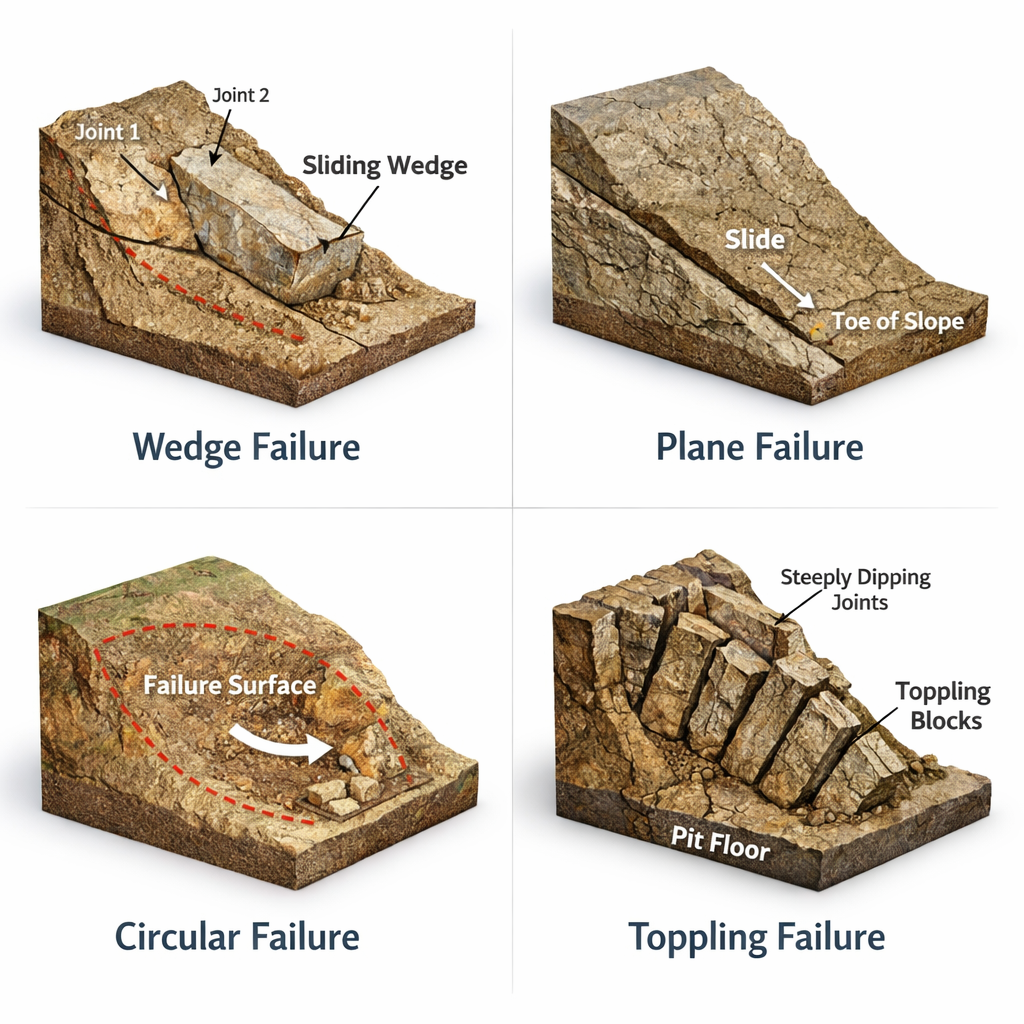
In open-pit mining, the stability of excavated slopes is a critical factor for operational safety and economic viability. Failure occurs when the driving forces, such as gravity and water pressure, exceed the shear strength of the rock or soil mass (Alemayehu et al., 2025). Understanding the specific failure mechanisms and implementing robust mitigation strategies is essential for managing these risks.
Common failure mechanisms
The most frequent failure modes are largely determined by the geological structure and material properties of the slope:
- Wedge failure: often cited as the most common and hazardous mode, it occurs when two or more discontinuities (such as joints or faults) intersect to form a tetrahedral block that slides out of the slope face under gravity (Kolapo et al., 2022).
- Plane failure: this involves a rock mass sliding along a single, relatively flat discontinuity that strikes parallel to the slope face and “daylights” at the toe (Kolapo et al., 2022).
- Circular failure: typical in highly weathered rock or soil-like materials, the failure surface follows a curved path. It is common in homogeneous rock masses where individual structures do not dominate the stability (Chen et al., 2023).
- Toppling failure: this occurs in slopes with steeply dipping, columnar rock units that overturn forward toward the pit floor due to gravity or water infiltration (Alemayehu et al., 2025).
Mitigation and control strategies
Mitigation involves a combination of engineering design and proactive monitoring:
- Geometric optimization: reducing the overall slope angle or bench height is a primary method to increase the Factor of Safety (FoS). For instance, decreasing a slope angle from 70° to 26° can drastically improve stability in weak geological environments (Alemayehu et al., 2025).
- Water management: groundwater is a major trigger for instability by increasing pore water pressure and reducing shear strength. Installing piezometers for monitoring and implementing drainage systems to lower water levels are vital (Chen et al., 2023; Gao et al., 2024).
- Monitoring technologies: modern mines utilize real-time monitoring, such as Slope Stability Radar (SSR) and terrestrial laser scanners, to detect early-warning signals like accelerating displacement.
- Blasting control: implementing pre-split blasting techniques helps minimize back-break and blast-induced damage to the remaining rock wall, maintaining its inherent strength.
References
Alemayehu, E., Chala, E. T., Jilo, N. Z., Tiyasha, T., & Moges, B. (2025). Optimizing design and stability of open pit slopes in Tolay coal mine, Ethiopia. Scientific Reports, 15. https://doi.org/10.1038/s41598-025-86034-7
Chen, T., Shu, J., Han, L., Tovele, G. S. V., & Li, B. (2023). Landslide mechanism and stability of an open-pit slope: The Manglai open-pit coal mine. Frontiers in Earth Science, 10. https://doi.org/10.3389/feart.2022.1038499
Gao, Y., Li, J., Yang, T., Meng, L., Deng, W., & Zhang, P. (2024). Formation of pit lake and slope stability following mine closure: a case study of Fushun West Open-pit Mine. Geomatics, Natural Hazards and Risk, 15(1). https://doi.org/10.1080/19475705.2024.2340612
Kolapo, P., Oniyide, G. O., Said, K. O., Lawal, A. I., Onifade, M., & Munemo, P. (2022). An Overview of Slope Failure in Mining Operations. Mining, 2(2), 350–384. https://doi.org/10.3390/mining2020019