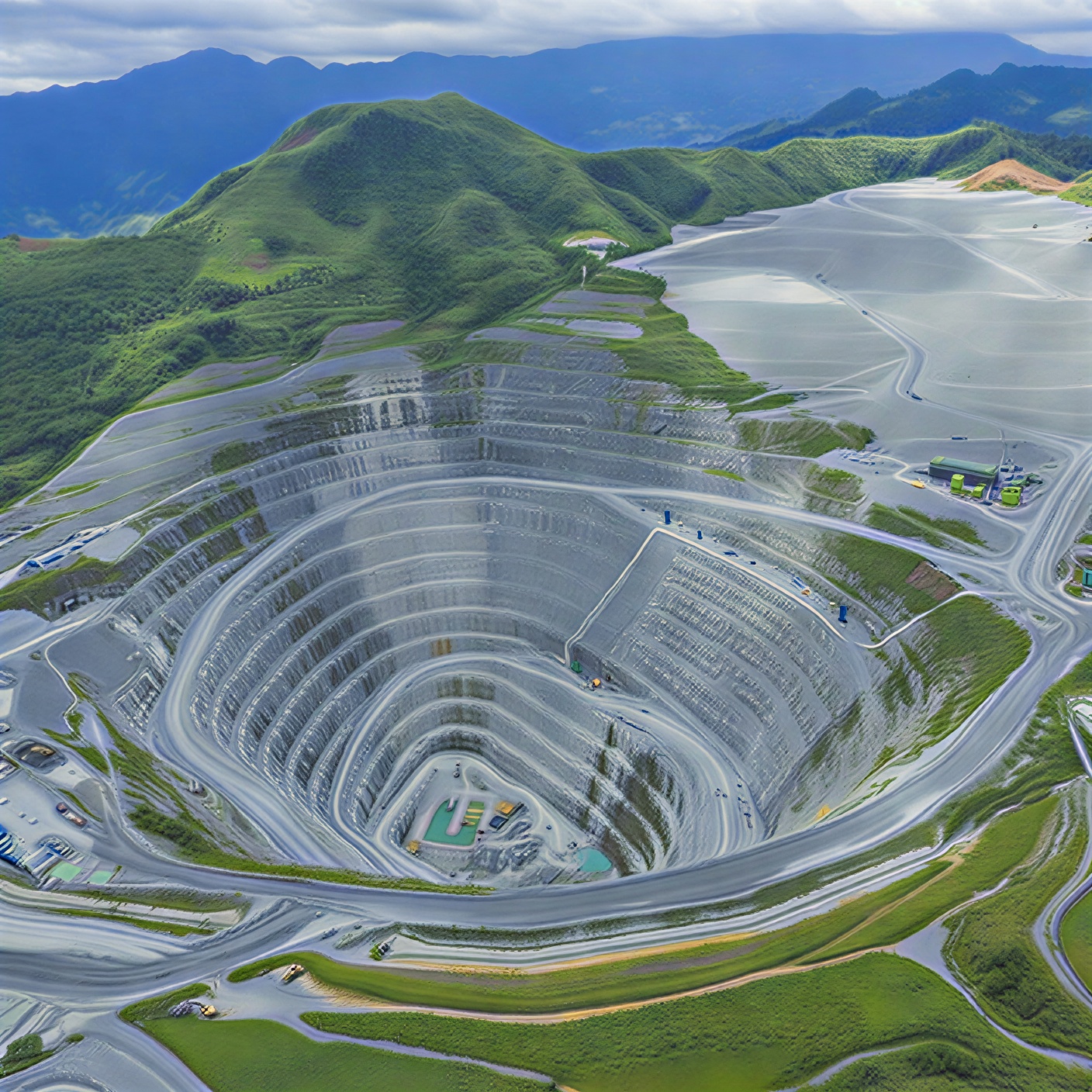
Optimization algorithms are fundamental to strategic mine planning, primarily used to define the Ultimate Pit Limit (UPL); the boundary that maximizes the total economic value of an open-pit mine (Esmaeil et al., 2018; Xu et al., 2024). These algorithms process a three-dimensional block model where each discrete block contains geological and economic data, such as ore grade, density, and extraction costs (Ares et al., 2022). By evaluating these blocks, the algorithms determine which material should be extracted and which should remain as waste, effectively balancing profitability against physical constraints like safe slope angles (Petrov et al., 2017).
Key algorithmic approaches
The two most prominent methodologies in the industry are the Floating Cone (FC) and Lerchs-Grossmann (LG) algorithms:
- Floating Cone (FC): this is a heuristic or “quasi-optimization” method (Xu et al., 2024). It operates by placing an inverted cone over each profitable block; if the total value of all blocks within that cone is positive, they are marked for extraction (Ares et al., 2022). While valued for its simplicity and speed, the standard FC method often fails to find the true mathematical optimum because it cannot account for the “joint support” problem, where multiple cones might be profitable only when considered together (Hay et al., 2019).
- Lerchs-Grossmann (LG): this is a rigorous algorithm based on graph theory (Ares et al., 2022). It models the deposit as a directed graph where nodes represent blocks and edges represent mining dependencies (slope constraints). The UPL is found by solving for the maximum weight closure of the graph (Petrov et al., 2017; Hay et al., 2019). Unlike the floating cone, the LG algorithm is mathematically proven to return the truly optimal pit shell for a given economic scenario (Hay et al., 2019; Candido et al., 2013).
Beyond simple profit maximization, modern adaptations of these algorithms now integrate complex variables such as ecological costs, slope safety reinforcement, and geological uncertainty to ensure long-term project sustainability (Xu et al., 2024; Markovic et al., 2025).
References
Ares, G., Castañón Fernández, C., Álvarez, I. D., Arias, D., & Díaz, A. B. (2022). Open pit optimization using the floating cone method: A new algorithm. Minerals, 12(4), 495. https://doi.org/10.3390/min12040495
Candido, M. T., Peroni, R. d. L., & Hilário, D. (2013). Impact in long-term planning of optimization algorithms and mineral deposit geometry. Rem: Revista Escola de Minas, 66(1), 105–110. https://doi.org/10.1590/s0370-44672013000100014
Esmaeil, R., Ehsan, M., Reza, S., & Mehran, G. (2018). Optimized algorithm in mine production planning, mined material destination, and ultimate pit limit. Journal of Central South University, 25(6), 1475–1488. https://doi.org/10.1007/s11771-018-3841-5
Hay, E., Nehring, M., Knights, P., & Kizil, M. S. (2019). Determining the optimal orientation of ultimate pits for mines using fully mobile in-pit crushing and conveying systems. Journal of the Southern African Institute of Mining and Metallurgy, 119(11), 949–960. https://doi.org/10.17159/2411-9717/104-252-1/2019
Markovic, P., Stevanovic, D., Kolonja, B., Slavkovic, D., & Krzanovic, D. (2025). A hybrid model for risk-based strategic planning in open-pit mining: Integrating deterministic, stochastic, and ISO 31000 approaches. Applied Sciences, 15(5), 2500. https://doi.org/10.3390/app15052500
Petrov, D. V., Vasiliev, P. V., Mikhelev, V. M., Muromtcev, V. V., & Batischev, D. S. (2017). Using parallel computing in modeling and optimization of mineral reserves extraction systems. Journal of Fundamental and Applied Sciences, 9(1S), 939–947. https://doi.org/10.4314/jfas.v9i1s.747
Xu, X., Zhu, Z., Ye, L., Gu, X., Wang, Q., Zhao, Y., Liu, S., & Zhao, Y. (2024). Ultimate pit limit optimization method with integrated consideration of ecological cost, slope safety and benefits: A case study of Heishan open pit coal mine. Sustainability, 16(13), 5393. https://doi.org/10.3390/su16135393