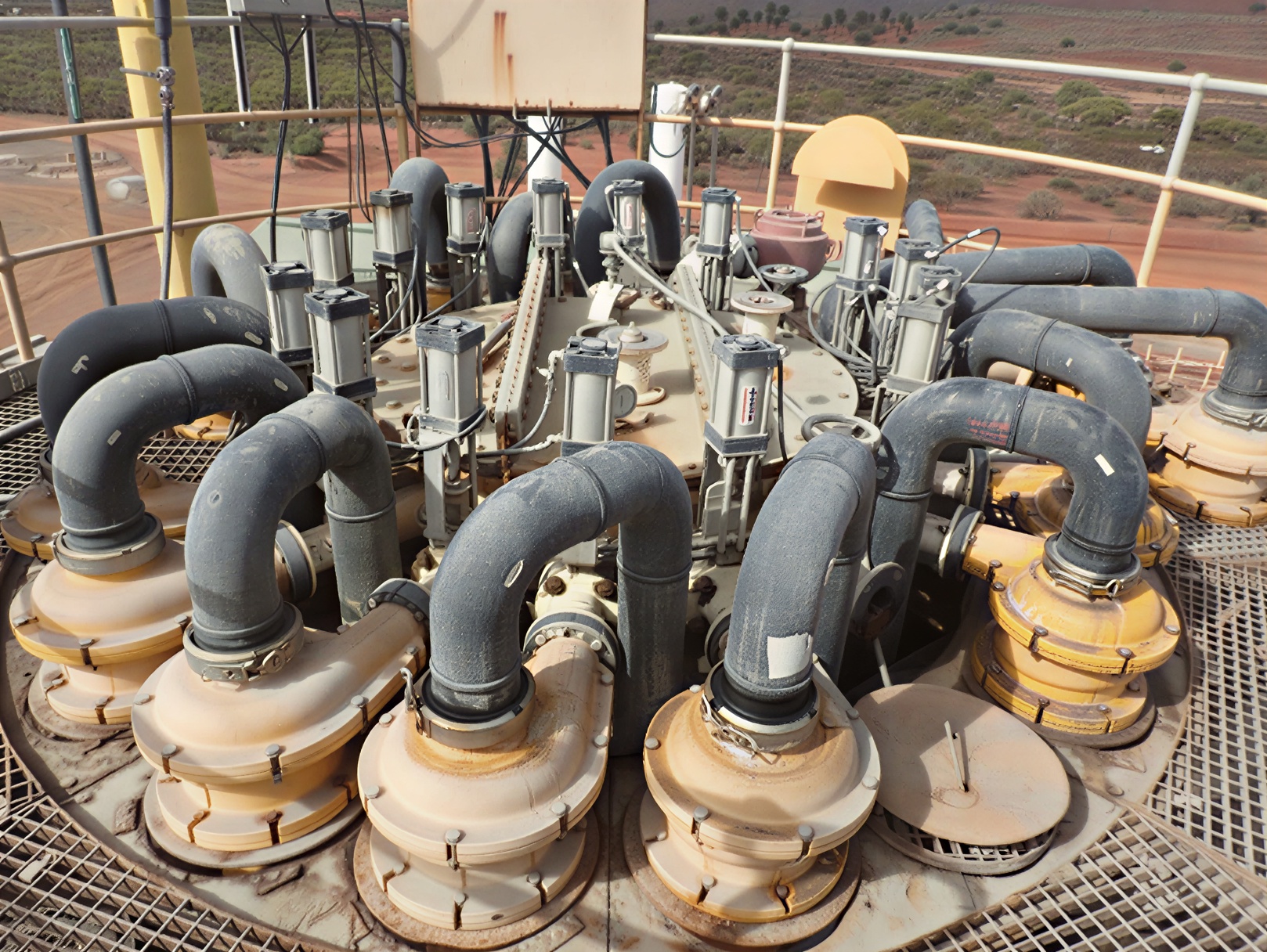
Classification efficiency is a critical determinant of grinding circuit performance, directly impacting energy consumption, throughput, and downstream recovery. Hydrocyclones remain the most widely used classifiers in mineral processing due to their robustness and low maintenance requirements, yet their inherent inefficiency—particularly the bypass of fines to the underflow—significantly limits circuit capacity (Jankovic & Valery, 2013).
Recent developments in semi-inverted (SIV) hydrocyclones offer substantial efficiency gains. Research by Jokovic et al. (2025) demonstrated that SIV hydrocyclones achieve water recovery to underflow (Rf) below 10% with sharpness parameters (α) of approximately 6, comparable to fine screening performance. This improved classification enabled 25–91% higher circuit throughput at equivalent product P80, with batch grinding tests showing up to 45% reduction in size-specific energy for generating material below 75 µm.
The cylinder-to-cone ratio (CCR) significantly influences classification performance. Numerical simulations by E et al. (2025) revealed that decreasing CCR from 9:1 to 1:9 reduces cut size from 30.4 μm to 16.4 μm and sharpens separation, with Ecart probable decreasing from 9.5 μm to 6.1 μm. Lower CCR enhances tangential velocity and pressure gradients while stabilizing the air core, reducing particle misplacement.
The integration of high-frequency screens with hydrocyclones in hybrid configurations consistently outperforms hydrocyclone-only circuits. In an industrial zinc operation, the HC+HFS configuration produced a narrower product size distribution with reduced overgrinding, directly benefiting flotation recovery (Kopparthi et al., 2025; Delboni Junior, as cited in Bergerman & Delboni, 2024). Similarly, incorporating high-pressure grinding rolls (HPGRs) to reduce feed size enables finer media and improved classification, achieving 21.44% energy savings in tungsten processing (Wu et al., 2025).
Optimizing cyclone classification requires a holistic approach combining advanced equipment design, geometric optimization, and strategic circuit configuration to maximize grinding efficiency and downstream metallurgical performance.
References
Bergerman, M. G., & Delboni, H. (2024). Comparing the performance of hydrocyclones and high-frequency screens in an industrial grinding circuit: Part I—Size separation assessments. Minerals, 14 (7), 707.
E, D., Hu, H., Tan, C., Zhang, Y., Xu, G., Cui, J., Zou, R., Yu, A., & Kuang, S. (2025). Numerical study of the effect of cylinder-to-cone ratio on the classification performance in hydrocyclones. Powder Technology, 454, 120736.
Jankovic, A., & Valery, W. (2013). Closed circuit ball mill – Basics revisited. Minerals Engineering, 43-44, 148–153.