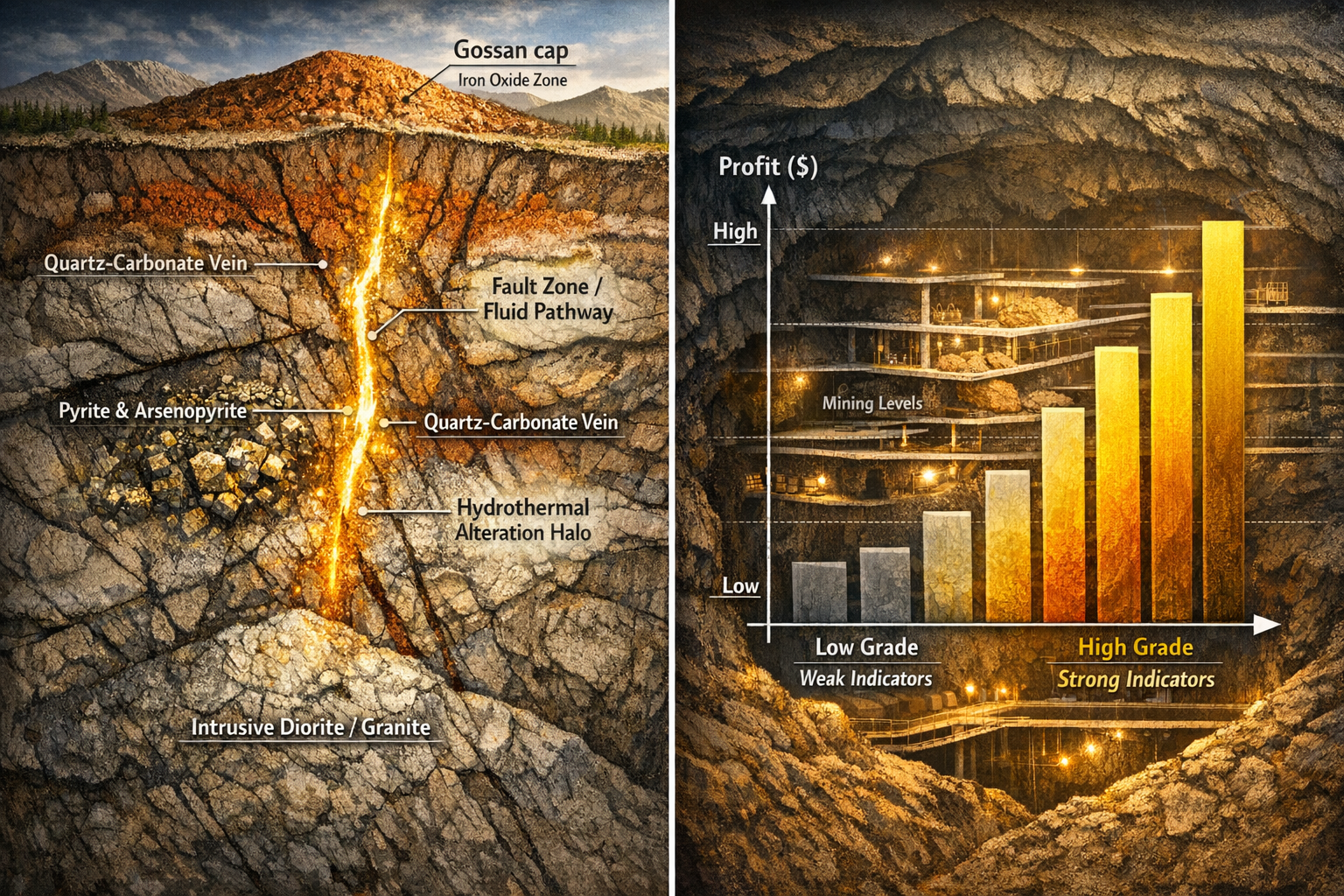
The discovery of viable gold deposits is seldom a simple matter of encountering the metal in its pure form. Rather, geoscientists must function as detectives, interpreting a specific assemblage of structural, mineralogical, and geochemical “clues” that indicate the presence of a gold-bearing hydrothermal system.
Gold deposits, particularly orogenic and Carlin-type varieties, are fundamentally dictated by structural deformation. Mineralization typically clusters within fault and shear zones, where the intense physical grinding of rock creates pathways for gold-rich fluids to circulate (Li et al., 2022). As these hot fluids interact with the surrounding rock, they leave behind distinct alteration halos. Indicators such as silicification (the introduction of silica) and sulfidation (the replacement of minerals by sulfides) are primary targets for exploration. In sediment-hosted systems, the “decalcification” of carbonate minerals is often the most reliable sign that mineralizing fluids once flowed through the area (Kerr, 2005).
Certain minerals act as reliable proxies for gold. The most significant of these are specific sulfide assemblages; gold is frequently locked within or sits alongside arsenopyrite and arsenian pyrite (Nikiforova, 2022). Beyond sulfides, secondary minerals like tourmaline, scheelite, and magnetite serve as effective tracers in orogenic gold districts. Recent advances even allow geologists to analyze the trace element chemistry of magnetite, specifically its chromium and manganese levels, to differentiate between productive hydrothermal veins and barren magmatic rocks (Grzela et al., 2019).
On a broader scale, geochemical “halos” allow geologists to narrow their search area before drilling. Because gold is chemically mobile, it is often accompanied by “pathfinder elements” like arsenic (As), sulfur (S), and antimony (Sb) (Kerr, 2005). In regions like the Yellowknife greenstone belt, As and S remain the most consistent indicators of proximity to a deposit (Langlois, 2021). Furthermore, cutting-edge techniques now enable the detection of gold nanoparticles within drainage sediments, providing a high-tech way to trace anomalies back to their primary source (Li et al., 2022).
References
Grzela, D., Beaudoin, G., & Bédard, É. (2019). Tourmaline, scheelite, and magnetite compositions from orogenic gold deposits and glacial sediments of the Val-d’Or district (Québec, Canada): Applications to mineral exploration. Journal of Geochemical Exploration, 206, 106355. https://doi.org/10.1016/j.gexplo.2019.106355
Kerr, A. (2005). GEOLOGY AND GEOCHEMISTRY OF UNUSUAL GOLD MINERALIZATION IN THE CAT ARM ROAD AREA, WESTERN WHITE BAY: PRELIMINARY ASSESSMENT IN THE CONTEXT OF NEW EXPLORATION MODELS. https://www.semanticscholar.org/paper/GEOLOGY-AND-GEOCHEMISTRY-OF-UNUSUAL-GOLD-IN-THE-CAT-Kerr/54ca700b83e50e9c969db6227cc47733429e2f0e
Langlois, L. A. (2021). Indicators of gold mineralization in the Yellowknife greenstone belt: A lithogeochemistry and mineralogy study. https://doi.org/10.7939/r3-wvp3-zx38
Li, R., Wang, X., Zhang, B., Liu, Q., Chi, Q., Meng, Y., & Xiong, Y. (2022). Identifying the source of gold geochemical anomalies in Jiaodong, eastern China: Tracking the occurrence of gold nanoparticles in a metallogenic system. Frontiers in Earth Science, 10. https://doi.org/10.3389/feart.2022.1008133
Nikiforova, Z. (2022). Mineralogical Criteria for the Prediction of Gold Mineralization in the Structures of the Siberian Craton. Minerals, 12(6). https://doi.org/10.3390/min12060694