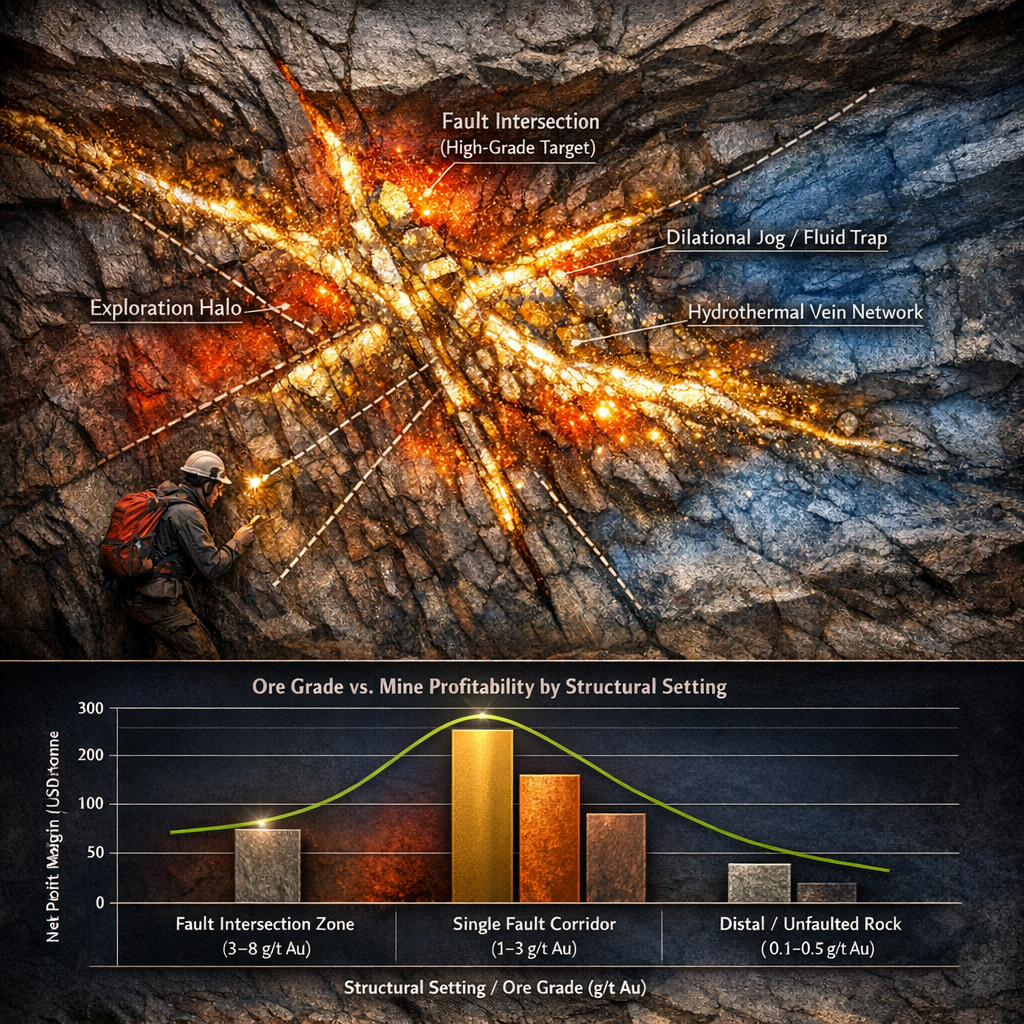
Fault systems are far more than mere fractures in the earth; they are the fundamental architectural blueprints that dictate where mineral deposits reside. Within the modern “mineral systems” framework, geologists view these structures through three critical lenses: as high-permeability conduits for fluid migration, as structural traps for ore deposition, and as windows into the broader geodynamic forces at play (Hronsky & Groves, 2008).
The plumbing of the crust
Deep-seated or transcrustal fault systems function as the primary plumbing of the lithosphere. They provide the necessary escape routes for hydrothermal fluids and magmas to ascend from the lower crust or mantle toward the surface (Jiang et al., 2022). These zones often maintain steep, high-angle orientations that focus the flow of mineralizing solutions into concentrated areas (Piquer Romo et al., 2019). This process is rarely static; instead, it relies on “fault-valve” behavior—the episodic reactivation of a fault that creates transient bursts of permeability. This repetitive cycling is vital for sustaining the large-scale hydrothermal activity required to form significant ore bodies (Codeço et al., 2022).
Strategic targeting in exploration
To narrow down a vast landscape into a viable drilling target, explorationists search for specific structural “sweet spots” where mineralizing efficiency is highest:
- Structural intersections: where different fault sets cross, such as a northwest-striking fault meeting a northeast-striking one, the resulting “damage zone” features intense fracturing. These complex hubs are often the birthplaces of “giant” deposits, particularly porphyry copper systems (Piquer Romo et al., 2019).
- Dilational jogs: these are geometric offsets in a fault line that pull apart during movement. The resulting localized vacuum acts as a low-pressure “sink,” drawing in fluids and triggering the rapid precipitation of minerals (Bierlein et al., 2008).
- Permeability contrasts: by mapping alteration halos against fault geometry, geologists can predict whether a deposit has been truncated, shifted, or hidden beneath younger cover (Brimhall et al., 2005).
Ultimately, the art of structural targeting lies in distinguishing “fertile” faults from barren ones. By analyzing kinematic history and structural density, geologists can pinpoint the precise locations where the earth’s internal plumbing was most efficient at delivering wealth (Bierlein et al., 2008).
References
Bierlein, F. P., Fraser, S. J., Brown, W. M., & Lees, T. (2008). Advanced methodologies for the analysis of databases of mineral deposits and major faults. Australian Journal of Earth Sciences, 55(1), 79–99. https://doi.org/10.1080/08120090701581406
Brimhall, G. H., Dilles, J. H., & Proffett, J. M. (2005). The Role of Geologic Mapping in Mineral Exploration. Wealth Creation in the Minerals Industry, 221-241. https://doi.org/10.5382/sp.12.11
Codeço, M. S., Weis, P., & Andersen, C. (2022). Numerical Modeling of Structurally Controlled Ore Formation in Magmatic‐Hydrothermal Systems. Geochemistry, Geophysics, Geosystems, 23(3). https://doi.org/10.1029/2021gc010302
Hronsky, J. M. A., & Groves, D. I. (2008). Science of targeting: definition, strategies, targeting and performance measurement. Australian Journal of Earth Sciences, 55(1), 3-12. https://doi.org/10.1080/08120090701581356
Jiang, W., Duan, J., Doublier, M., Clark, A., Schofield, A., Brodie, R. C., & Goodwin, J. (2022). Application of multiscale magnetotelluric data to mineral exploration: an example from the east Tennant region, Northern Australia. Geophysical Journal International, 229(3), 1628-1645. https://doi.org/10.1093/gji/ggac029
Piquer Romo, J. M., Yáñez, G., Rivera, O., & Cooke, D. (2019). Long-lived crustal damage zones associated with fault intersections in the high Andes of Central Chile. Andean Geology, 46(2), 223. https://doi.org/10.5027/andgeov46n2-3106