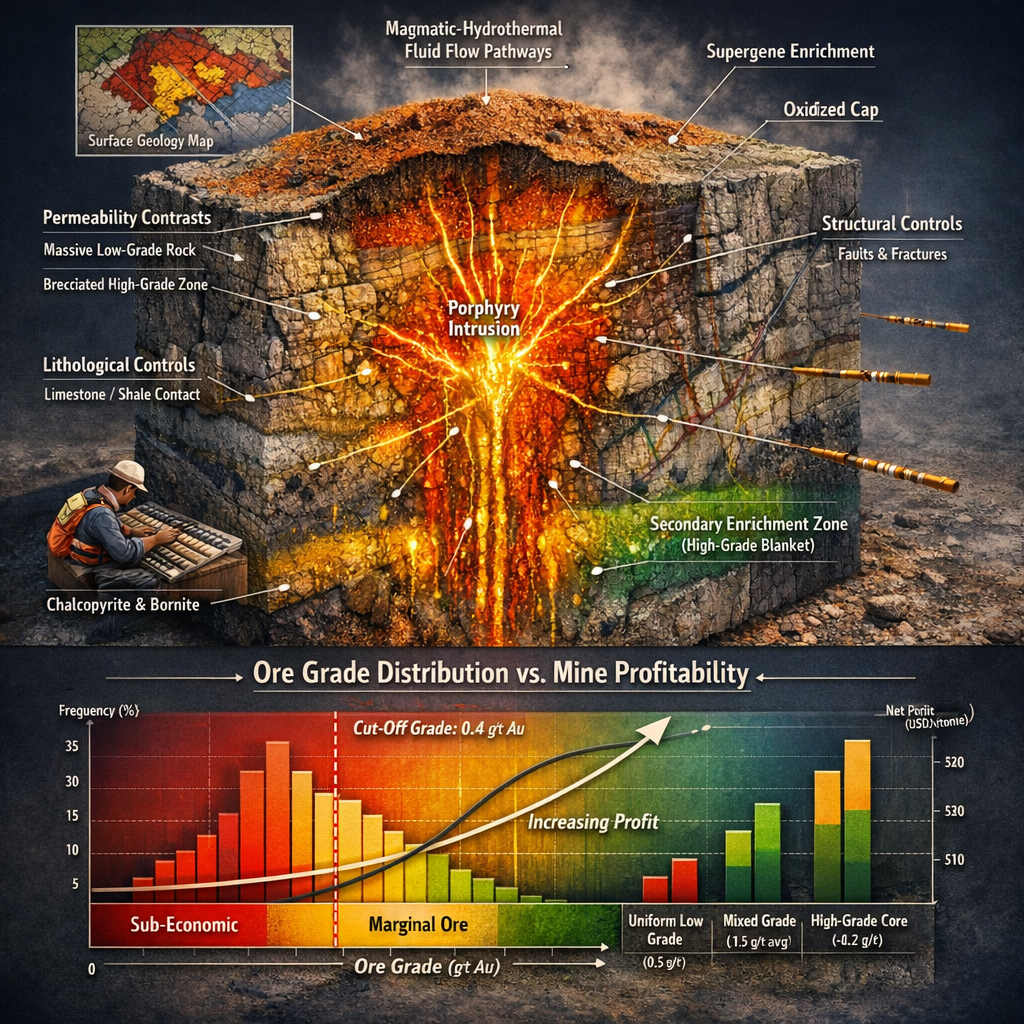
The geologist truly comprehends the variability of ore grades within a single deposit by regarding the Earth’s crust as a dynamic laboratory in which fluid flow and chemical processes converge. He conceptualizes a mineral deposit as a building: the lithology constitutes its structural framework, the geological structures serve as the conduits, and the geochemical shifts, namely fluctuations in pressure and temperature, act as the mechanisms that dictate precisely where the enrichment of ore will accumulate.
The power of structural focusing
Ore grade is seldom distributed evenly across a fault zone. Instead, metals tend to accumulate in structural traps, which are specific geometric anomalies born from tectonic stress.
- Dilation joints: when crustal forces pull rock units apart, they create localized zones of low pressure. This vacuum effectively “sucks” mineral-rich hydrothermal fluids into the voids, concentrating the grade.
- Fault intersections: these are the “hotspots” of geology. Where two faults cross, the resulting intense fracturing provides a high-permeability pathway, often forming vertical “pipes” of exceptionally high-grade mineralization (Mazzarini et al., 2019).
Chemical precipitation and “flash” events
Beyond physical space, the distribution of grade is a historical record of sudden chemical transitions. When a superheated, pressurized fluid carrying dissolved gold or copper encounters a sudden drop in pressure—often upon hitting a fault—it can undergo boiling or flashing. In an instant, the fluid loses its ability to carry the metal, causing the minerals to “crash” out of the solution and form narrow, high-tenor veins (Codeço et al., 2022).
Zonation and alteration halos
In complex systems like Porphyry deposits, grades typically follow a concentric architecture. The core may be saturated with copper and gold, while the peripheral “halos” transition into lead or zinc as the fluids cool. This predictable sequence occurs because different metals precipitate at specific temperature thresholds (Criss, 2015). By mapping alteration minerals, such as specific clays or garnets, geologists can treat the surrounding rock like a compass, pointing them toward the high-grade heart of the system.
References
Codeço, M. S., Weis, P., & Andersen, C. (2022). Numerical modeling of structurally controlled ore formation in magmatic‐hydrothermal systems. Geochemistry, Geophysics, Geosystems, 23(1). https://doi.org/10.1029/2021gc010302
Criss, R. E. (2015). Use of geochemical and geophysical techniques to characterize and prospect for geothermal resources and hydrothermal ore deposits. Journal of Earth Science, 26(1), 73–77. https://doi.org/10.1007/s12583-015-0510-6
Mazzarini, F., Musumeci, G., Viola, G., Garofalo, P. S., & Mattila, J. (2019). Structural and lithological control on fluid circulation, dilation and ore mineralization (Rio Albano mine, Island of Elba, Italy). Journal of Structural Geology, 126, 210–230. https://doi.org/10.1016/j.jsg.2019.06.012