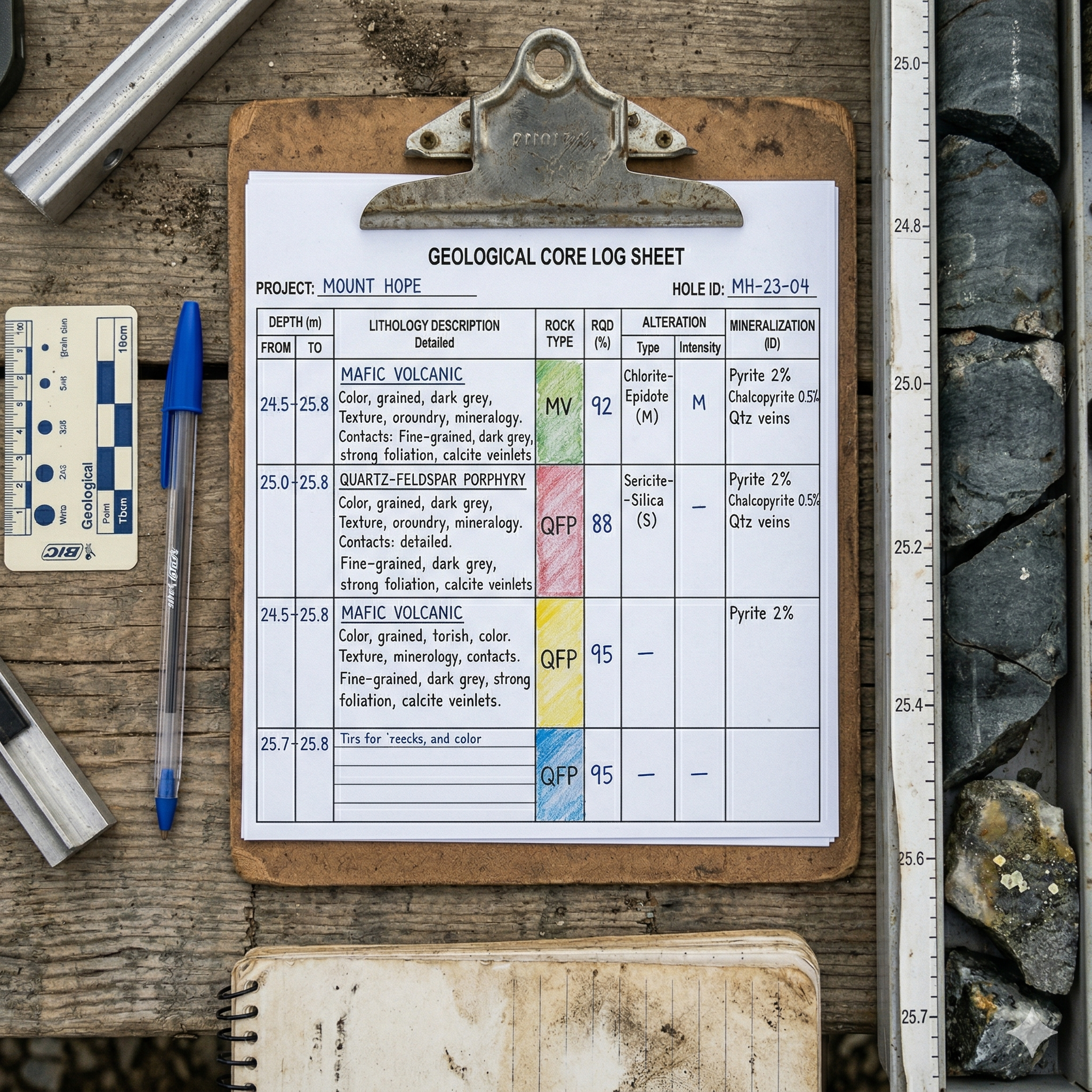
The interpretation of drill core logs is a fundamental process in mineral exploration, serving as the primary bridge between raw subsurface data and the development of 3D resource models. To accurately determine ore continuity and grade distribution, geologists must synthesize lithological, structural, and geochemical data from the core (Kramer Bernhard et al., 2020).
The first step in determining continuity is establishing the geological framework. Lithological logging identifies the host rocks and alteration zones, while structural analysis, particularly using oriented core, is vital for understanding the 3D geometry of the deposit (Kramer Bernhard et al., 2020). By measuring the orientation of planar features such as veins, faults, and stratigraphic layering, geologists can predict how mineralized zones extend into the surrounding volume (Kramer Bernhard et al., 2020).
Ore continuity is not just about the presence of minerals but also the physical integrity of the rock mass. Two critical metrics are:
- Core Recovery (CR): the percentage of recovered core relative to the total length drilled. High recovery ensures that the samples are representative of the in-situ grade (Narimani et al., 2025).
- Rock Quality Designation (RQD): a quantitative measure of intact core pieces longer than 10 cm. RQD serves as a key indicator of jointing density and rock mass quality, which can influence the spatial distribution of hydrothermal fluids and subsequent mineralization (Narimani et al., 2025).
Grade distribution is determined by integrating visual mineralogical observations with geochemical assays. Methods used to classify and calculate these resources range from geometric approaches (measuring distances between drill holes) to variogram-based methods, which mathematically model the spatial continuity of mineral grades (MDPI, 2025).
Advanced techniques now incorporate Machine Learning (ML) to analyze drill core images, automating the prediction of mineralogy and lithology (Günther, 2025). This reduces human error and provides a more consistent dataset for interpreting how grade fluctuates across a deposit. Ultimately, the synthesis of oriented structural data, geotechnical metrics like RQD, and precise assaying allows for the creation of robust models that define the economic viability of an ore body.
References
Günther, F. (2025). Machine learning for drill core image analysis: A review. Diva-portal.org. https://www.diva-portal.org/smash/get/diva2:2011262/FULLTEXT01.pdf
Kramer Bernhard, J., Barnett, W., Uken, R., & Myers, R. (2020). Chapter 7: Structural analysis of drill core for mineral exploration and mining: Review and workflow toward domain-based 3-D interpretation. Applied Structural Geology of Ore-Forming Hydrothermal Systems, 215–245. https://doi.org/10.5382/rev.21.07
MDPI AG. (2025). Advances in geological resource calculations, incorporating new parameters for optimal classification. Applied Sciences, 15(17), 9828. https://doi.org/10.3390/app15179828
Narimani, S., Davarpanah, S. M., Bar, N., & Vásárhelyi, B. (2025). Analyzing drill core logging using rock quality designation–60 years’ experience from modifications to applications. Applied Sciences, 15(3), 1309. https://doi.org/10.3390/app15031309