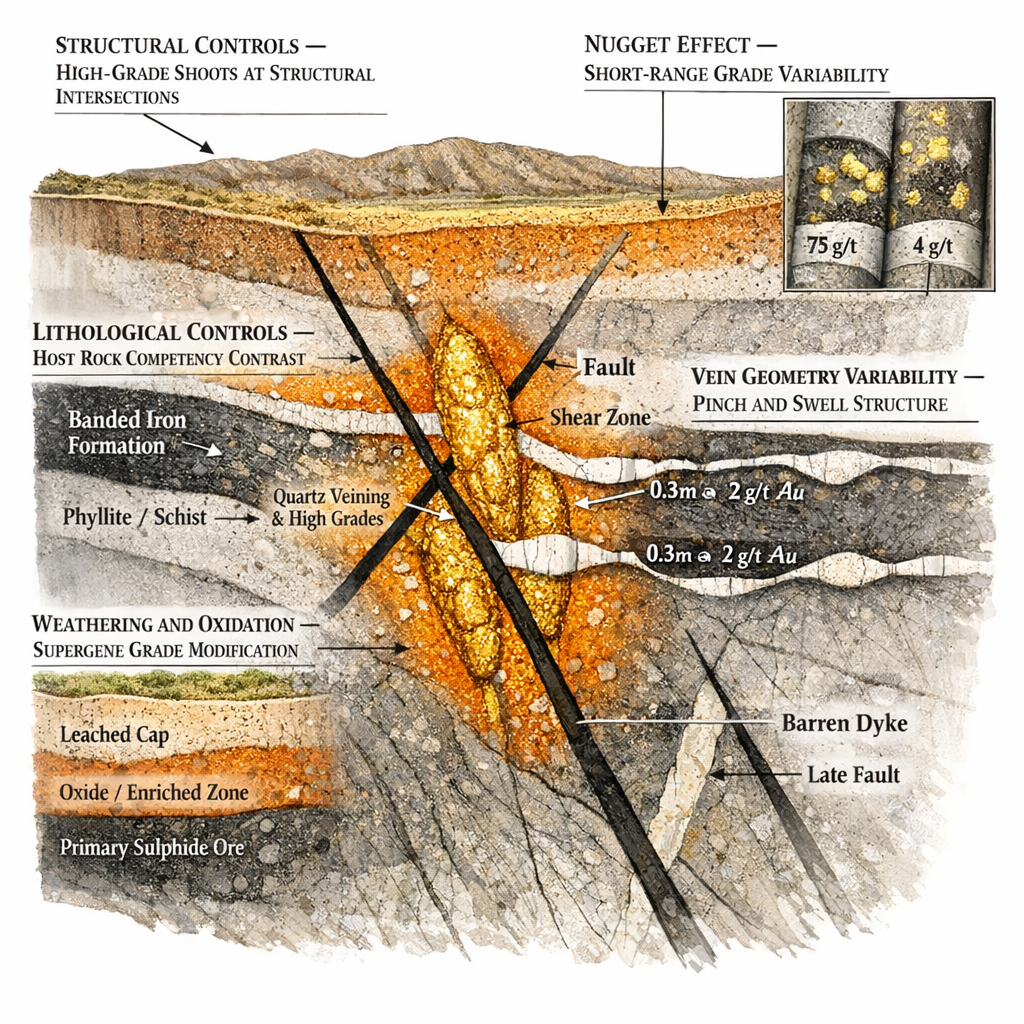
The variation in grade within a gold ore body is influenced by the genesis of the deposit itself. Gold is typically deposited through hydrothermal fluids flowing through fractures and faults in the host rock, and this results in rapid fluctuations in grade based on whether or not these structural features exist and intersect.
The influence of structural controls can have a major impact on grade variation. High-grade gold deposits frequently occur in shoots or vein swarms, as well as at intersections where there was significant flow, whereas the adjacent rock will yield significantly less in terms of gold content. This leads to highly variable sample values even when taken from a relatively small distance apart.
Variability is further influenced by changes in host rock type. While some types of rocks are more prone to being affected by mineralization, and others can actually hinder mineral deposition, this can lead to zones of higher mineralization in altered rock.
Variability also results from chemical and physical processes that occur at the time of formation of ores. Changes in pressure, boiling, cooling, and chemical reactions between fluids and rocks can cause gold to precipitate suddenly, making grades inconsistent and extremely high locally. In some mineralizations, overprinting processes at a later stage could cause the gold to shift position again and thus further affect the grade distribution.
Texture becomes an important consideration, particularly when gold mineralization occurs as coarse gold deposits. Where gold occurs in the form of coarse gold rather than being uniformly distributed, sampling will most probably miss the coarse gold deposit. The result will be extremely high variation in gold grades from sample to sample.
The first way that mining minimizes grade variation is through grade control. Drilling for grade control, mapping on the faces, and detailed geological logs assist in establishing ore boundaries prior to mining. Selective mining follows to minimize dilution and loss of ore.
The last control point is the process itself. Stockpiling, blending, sorting, and geometallurgy are some of the methods used by mines in their effort to achieve feed uniformity and ensure that the plant is operating under optimal conditions according to the characteristics of the ore and its recovery process.