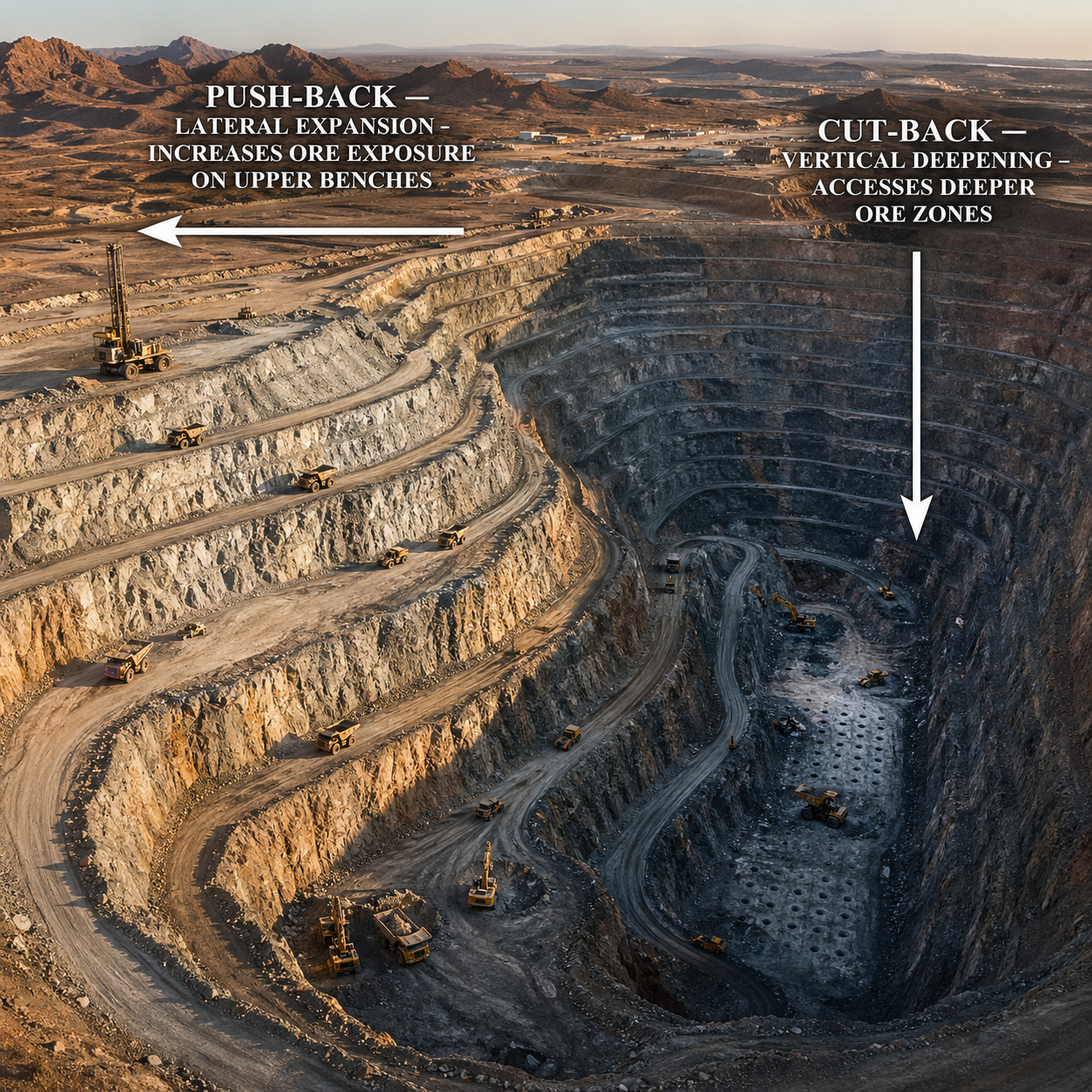
“Push back” and “cut back” are terms that are sometimes applied almost synonymously in open-pit mine planning, but, strictly speaking, push back means “a phase of mining planned for implementation at a certain time” whereas cut back is often a reference to the actual process of moving the pit wall closer to the ore body. In other words, push back is an organized mining phase while cut back describes the cutting or extension of the pit wall into the ore body that results in such a phase.
When sequencing an open pit mine, the pit is generally not extracted directly to its ultimate limits. Rather, a mine plan will involve dividing the total pit into sections that can be handled safely and economically.
A push back, then, is simply a sequencing unit. It is a contiguous phase of mining operations within a larger mine that can be mined in an orderly fashion based on safe slope angles and ease of access.
It should be noted that the cutback is more typically an expansion of the pit through the use of waste and ore from one pit wall or pit face in order to gain access to the lower layers of ore.
It should be noted that in technical and industrial terminology, particularly in the context of both coal mining and open-pit mining operations, the term “cut-back” is used to refer to the actual mining operation by which the boundary line is expanded either inwards or outwards in order to gain access to new ore zones.
As mentioned before, pushbacks and cutbacks are fundamentally different because pushbacks represent a plan, whereas cutbacks involve the implementation of this plan.
The purpose of selecting the pushbacks in question is primarily due to economic and geological reasons. They serve to allow for the extraction of ore to commence sooner, not trap the operation in a mining dead-end, and ensure that ore faces are accessible.
The main reason for conducting cutbacks is to create an operational pit that meets certain criteria and requirements.
The other perspective to consider would be that a push-back might incorporate several cutbacks or be implemented by means of a number of cut-back operations. This explains why in some sources one may find pushbacks, phases, stages, and cut-backs as being used almost interchangeably despite the fact that miners always employ the term “push-back” as being applicable to sequencing blocks only.
The terminology varies in terms of its use by companies, commodities, and regions. While some engineers might refer to a particular stage of mine expansion as being a cut-back, others would call it a push-back, but from the perspective of engineering the more accurate difference between the two terms is that push-back focuses on sequencing, while cut-back focuses on physical movement of the pit walls.
The easiest way of distinguishing between the two terms is to state that pushback is the mining stage specified in the overall life-of-mine plan, while cut-back refers to the way of implementing that particular stage.