
Sign In


Forgot Password?

Don't have account, Sign Up Here

Forgot Password

Lost your password? Please enter your email address. You will receive a link and will create a new password via email.


Have an account? Sign In Now

Sorry, you do not have permission to Add a Post, You must login to Add a Post.


Forgot Password?

Need An Account, Sign Up Here

Sorry, you do not have permission to add Article.


Forgot Password?

Need An Account, Sign Up Here

Please briefly explain why you feel this Post should be reported.

Please briefly explain why you feel this Comment should be reported.

Please briefly explain why you feel this user should be reported.

Mining Doc Logo Mining Doc Logo Mining Doc Logo
Sign InSign Up

Mining Doc

Mining Doc Navigation

  • Home
    • About
    • Contact us
  • Mining articles
  • Online Courses
Search
Sign up

Mobile menu

Close
join for free
  • Home
  • Online courses
  • Case study
  • Mining Community
  • Solutions listing
    • Lase Solutions
    • O-PitBlast Solutions
    • Continuous Mining
    • Longwall mining
    • Geosight Scanners
    • LoopX AI
    • Terafil solutions
    • Blasting solutions
    • Geotechnical
    • Submersible Pumps
    • Mine rescue system
    • Ore sorting
    • Whittle Consulting Solutions
  • Add Blog
  • Feed
  • User Profile
  • Posts
    • New Posts
    • Trending Posts
    • Must read Posts
    • Hot Posts
  • Polls
  • Badges
  • Home
    • About
    • Contact us
  • Mining articles
  • Online Courses

Mining Doc Latest Posts

Mining Doc
  • 0
  • 0
Mining DocExplainer
Added: May 6, 20262026-05-06T04:36:10-04:00 2026-05-06T04:36:10-04:00In: Geology

What is the difference between primary, secondary, and supergene mineralisation and how does it affect processing?

  • 0
  • 0

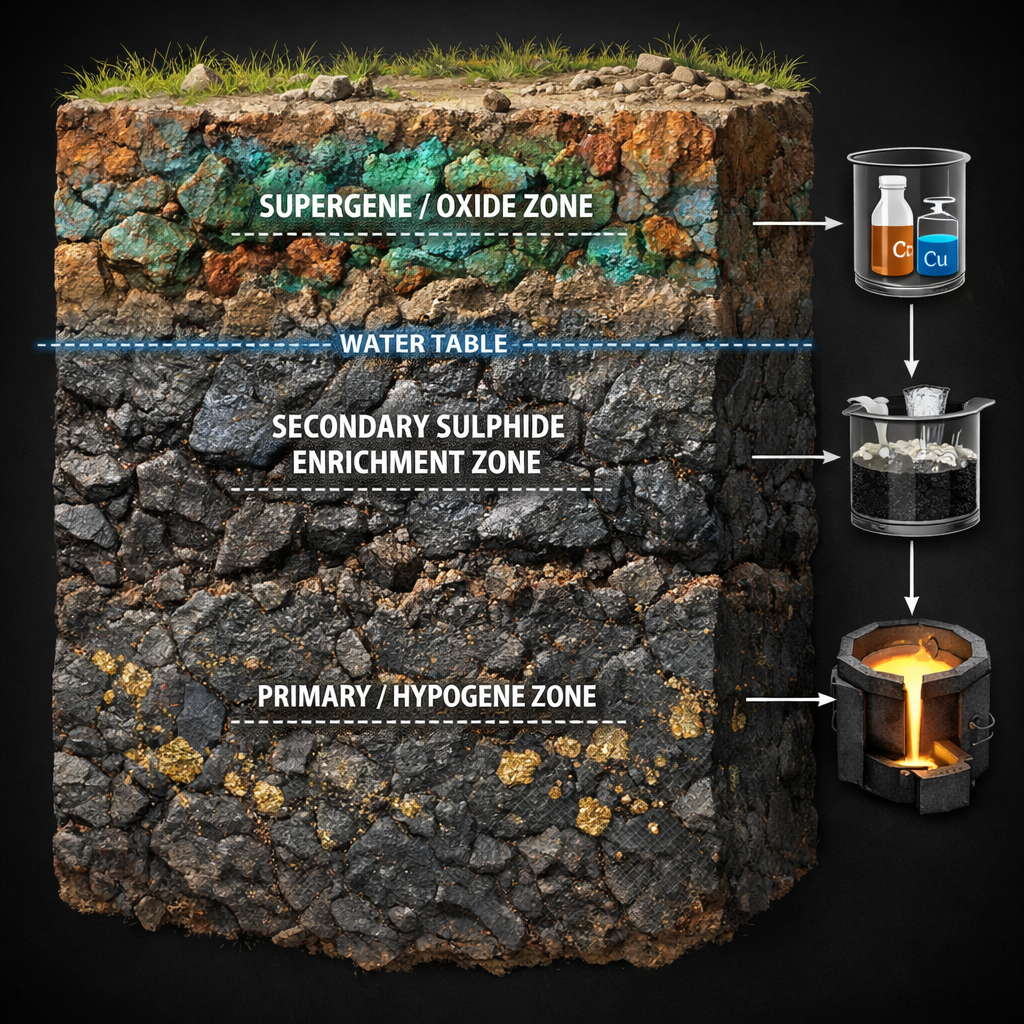
The primary stage of mineralization is an early stage of ore formation due to the rising of hot aqueous fluids deep underground and results in the formation of hypogene ore minerals. The secondary mineralization is a subsequent stage wherein the earlier formed ore minerals are subjected to alteration and redeposit by fluid circulation closer to the surface; this is often referred to as supergene mineralization or supergene enrichment.

Simply put, primary ore refers to unaltered deposits containing mostly sulfide compounds of the primary minerals, such as chalcopyrite, pyrite, sphalerite, and galena, among other similar minerals. Secondary ore formation involves the reformation of minerals through chemical processes, resulting in different ores, like chalcocite, covellite, bornite, malachite, azurite, cerussite, and anglesite.

Supergene mineralisation normally occurs in a weathering profile situated above and adjacent to the water table level. Oxygenated water oxidises sulfides at the upper horizon, liberates metal ions that migrate downward until reduction conditions occur, allowing precipitation in the enriched horizon below the oxidation horizon. The enriched horizon is significantly enriched with payable metal content compared to the initial ore because of metal enrichment in a small horizon from the larger rock mass.

Primary mineralisation versus supergene mineralisation is significant because of their distinct behaviour in processing operations. Primary sulfides may be processed using conventional crushing, grinding, and froth flotation techniques, while supergene minerals such as oxides and enriched sulfides may be subjected to heap leaching, among other processes. In the case of copper, oxide minerals and enriched minerals in some cases may be readily processed through leaching techniques.

Processing control depends on mineralogy rather than on grade. If secondary minerals increase the grade, liberate the ore, or make it more leachable, they increase recoveries. However, secondary minerals can also affect adversely the processing of an ore by making it mixed oxide-sulfide or metallurgically complex because of supergene oxidation despite its upgrade. Thus, special procedures will have to be adopted for such deposits, including special treatment routes or blending operations.

To sum up, while primary mineralization refers to the original ore formation at the depths below surface, supergene mineralization is referred to as near-surface mineralization caused by weathering or groundwater action. It should also be mentioned that primary ores are usually treated via sulfide processing, whereas supergene ores are more valuable for processing by leaching.

What is the difference between primary, secondary, and supergene mineralisation and how does it affect processing?
0
  • 0 0 Comments
  • 26 Views
  • 26 Reactions
  • 0 Followers
  • 0
    • Report
  • Share
    Share
    • Share on Facebook
    • Share on Twitter
    • Share on LinkedIn
    • Share on WhatsApp

Related Posts

  • What are the key indicators of a potentially economic skarn deposit during early-stage exploration?
  • What is the difference between primary, secondary, and supergene mineralisation and how does it affect processing?
  • What is the significance of the ore-waste boundary contact and how is it determined in the field?

You must login to add an Comment.


Forgot Password?

Need An Account, Sign Up Here
aalanaalan

Sidebar

  • Recent
  • Mastering On-Site Processing: A Strategic Guide to the Mobile Crushing Plant
    • On: April 28, 2026

    Mastering On-Site Processing: A Strategic Guide to the Mobile Crushing ...

  • From One Truck to Thousands: The Global Rise of Autonomous Mining
    • On: April 28, 2026

    From One Truck to Thousands: The Global Rise of Autonomous ...

  • Powering Remote Construction: A Guide to the Diesel Concrete Mixer
    • On: April 24, 2026

    Powering Remote Construction: A Guide to the Diesel Concrete Mixer

  • Different Types of Batching Plant Supporting Large-Scale Mining Infrastructure Projects
    • On: April 24, 2026

    Different Types of Batching Plant Supporting Large-Scale Mining Infrastructure Projects

  • Maximizing On-Site Efficiency with the Right Mobile Crusher Machine
    • On: April 21, 2026

    Maximizing On-Site Efficiency with the Right Mobile Crusher Machine

  • Sustainability in Mining: Eco-Friendly Batching and the Ready Mix Concrete Plant Cost of Compliance
    • On: April 21, 2026

    Sustainability in Mining: Eco-Friendly Batching and the Ready Mix Concrete ...

  • What Factors Do Peruvian Mining Companies Consider When Purchasing Crushing Plants?
    • On: April 20, 2026

    What Factors Do Peruvian Mining Companies Consider When Purchasing Crushing ...

Go to Home page to view more

Top Members

Olena Skyba

Olena Skyba

  • 150 Posts
  • 2 Comments
Pundit
Marcial

Marcial

  • 91 Posts
  • 0 Comments
Enlightened
Jean Marais (Sanodea Group)

Jean Marais (Sanodea Group)

  • 25 Posts
  • 0 Comments
Beginner
Trending on Mining Doc

Trending Communities

Fixed Plant General Information Geology Mining Case Studies Mining Doc Documentary Mining Engineering Mining Events Mining Finance and Economy Mining Human Resources Mining Industry Research Mining Operations Mining Software Solutions Mining Sustainability Mining Technology Solutions Mobile Plant Equipment

Explore

  • Home
  • Online courses
  • Case study
  • Mining Community
  • Solutions listing
    • Lase Solutions
    • O-PitBlast Solutions
    • Continuous Mining
    • Longwall mining
    • Geosight Scanners
    • LoopX AI
    • Terafil solutions
    • Blasting solutions
    • Geotechnical
    • Submersible Pumps
    • Mine rescue system
    • Ore sorting
    • Whittle Consulting Solutions
  • Add Blog
  • Feed
  • User Profile
  • Posts
    • New Posts
    • Trending Posts
    • Must read Posts
    • Hot Posts
  • Polls
  • Badges

Footer

Mining Doc

Join our community and connect with other people in the Mining industry for knowledge sharing.

Legal Stuff

  • Privacy Policy
  • Terms of Service

Help

  • Support
  • FAQs
  • How to add new content and how to promote a content
  • Compliance and guidelines
  • Subscribe to Mining Doc

Follow

© 2026 Mining Doc. All Rights Reserved

