
Sign In


Forgot Password?

Don't have account, Sign Up Here

Forgot Password

Lost your password? Please enter your email address. You will receive a link and will create a new password via email.


Have an account? Sign In Now

Sorry, you do not have permission to Add a Post, You must login to Add a Post.


Forgot Password?

Need An Account, Sign Up Here

Sorry, you do not have permission to add Article.


Forgot Password?

Need An Account, Sign Up Here

Please briefly explain why you feel this Post should be reported.

Please briefly explain why you feel this Comment should be reported.

Please briefly explain why you feel this user should be reported.

Mining Doc Logo Mining Doc Logo Mining Doc Logo
Sign InSign Up

Mining Doc

Mining Doc Navigation

  • Home
    • About
    • Contact us
  • Mining articles
  • Online Courses
Search
Sign up

Mobile menu

Close
join for free
  • Home
  • Online courses
  • Case study
  • Mining Community
  • Solutions listing
    • Lase Solutions
    • O-PitBlast Solutions
    • Continuous Mining
    • Longwall mining
    • Geosight Scanners
    • LoopX AI
    • Terafil solutions
    • Blasting solutions
    • Geotechnical
    • Submersible Pumps
    • Mine rescue system
    • Ore sorting
    • Whittle Consulting Solutions
  • Add Blog
  • Feed
  • User Profile
  • Posts
    • New Posts
    • Trending Posts
    • Must read Posts
    • Hot Posts
  • Polls
  • Badges
  • Home
    • About
    • Contact us
  • Mining articles
  • Online Courses

Mining Doc Latest Posts

Mining Doc
  • 0
  • 0
Mining DocExplainer
Added: May 6, 20262026-05-06T04:41:47-04:00 2026-05-06T04:41:47-04:00In: Geology

What are the key indicators of a potentially economic skarn deposit during early-stage exploration?

  • 0
  • 0

In the early stages of prospecting for economically viable skarn deposits, what is generally used as the indication of potential deposits is not an individual clue but the combination of several clues, namely intrusion geology, alteration features, pathfinder geochemistry, and geophysics. Since skarns tend to be zoned, the most productive method of prospecting would be to trace alterations distally and then follow the zoning closer to the intrusion-contact zone.

The first factor of significance for economically valuable skarn deposits is good geology. That would be an intrusive rock formation, ideally a calc-alkaline or metalliferous pluton, in contact with highly reactive carbonate formations, such as limestone and dolostone. The key here is that skarn mineralization is formed through the process of interaction between heat and fluids from the intrusion with the wall-rock material; hence, contact zones, faults, and other areas with increased permeability are significant controls on ore deposits. The presence of marble, skarnoids, hornfels, or other reaction structures indicates great prospectivity.

The second sign is the existence of skarn minerals and zoning. Big skarn deposits tend to have a near zone that is rich in garnets, a far zone with pyroxenes, and other types of minerals such as wollastonite, vesuvianite, or rhodonite at the edge of the marble. Practically, finding coarse garnets, clinopyroxenes, magnetite, epidotes, actinolites, and wollastonite in altered limestones is better evidence than minor and sporadic mineralization because they show a true metasomatic deposit instead of contact metamorphism. Also, distal signs such as bleaching, escape features, and isotopic haloes are helpful clues to trace ore deposits.

The third sign relates to geochemistry. Specific metal signatures depend on the deposit type; however, elements like Cu, Au, Fe, W, Zn, Pb, Ag, Mn, As, Bi, Te, Co, and Ni may be relevant. Metal zoning ratios are important in defining the center of ore deposits from their peripheries. Therefore, a strong multi-element anomaly in soils, rock chips, float, and channel samples is more promising when it occurs with the existence of skarn mineralization and the intruding body contact. In gold skarn deposits, for instance, elements like As, Bi, Te, Co, Cu, Zn, or Ni can be especially relevant.

Fourthly, we have geophysics. Some of the skarn deposits, particularly those containing high amounts of iron and copper, can generate magnetic, gravitational, resistivity, and IP signatures that distinguish them from other rocks in the area. Magnetic responses are an indication of magnetite-rich skarn, whereas a chargeable signature would denote a zone of sulfides; however, low and medium resistivity might imply altered or mineralized contact zones. The application of geophysics should be accompanied by geological and geochemical data, since a single anomaly on its own may not be enough to rank a target.

Lastly, we need to look for scale and continuity. An economic skarn deposit will usually contain alteration halos, a number of mineralized lenses or zones, and/or a number of structures controlling mineralization. Indicators of continuity would include linear exposure along the contact, stacked zones of replacement, excellent dip continuity, and repeat development of skarn zones along favorable horizons. Clearly, a skarn showing well-defined zonation over meters and even hundreds of meters will be better than a random occurrence of garnets and magnetites.

From an exploration point of view, the best skarn prospects in their early stage of development are the ones where everything aligns together; these include altered carbonate country rocks, a favorable intrusion, skarn minerals, metal anomalies, and geophysical indicators. It is a good principle that if a skarn prospect shows strong alteration, good zoning, consistent chemistry, and geophysical continuity, then the skarn prospect becomes more economical.
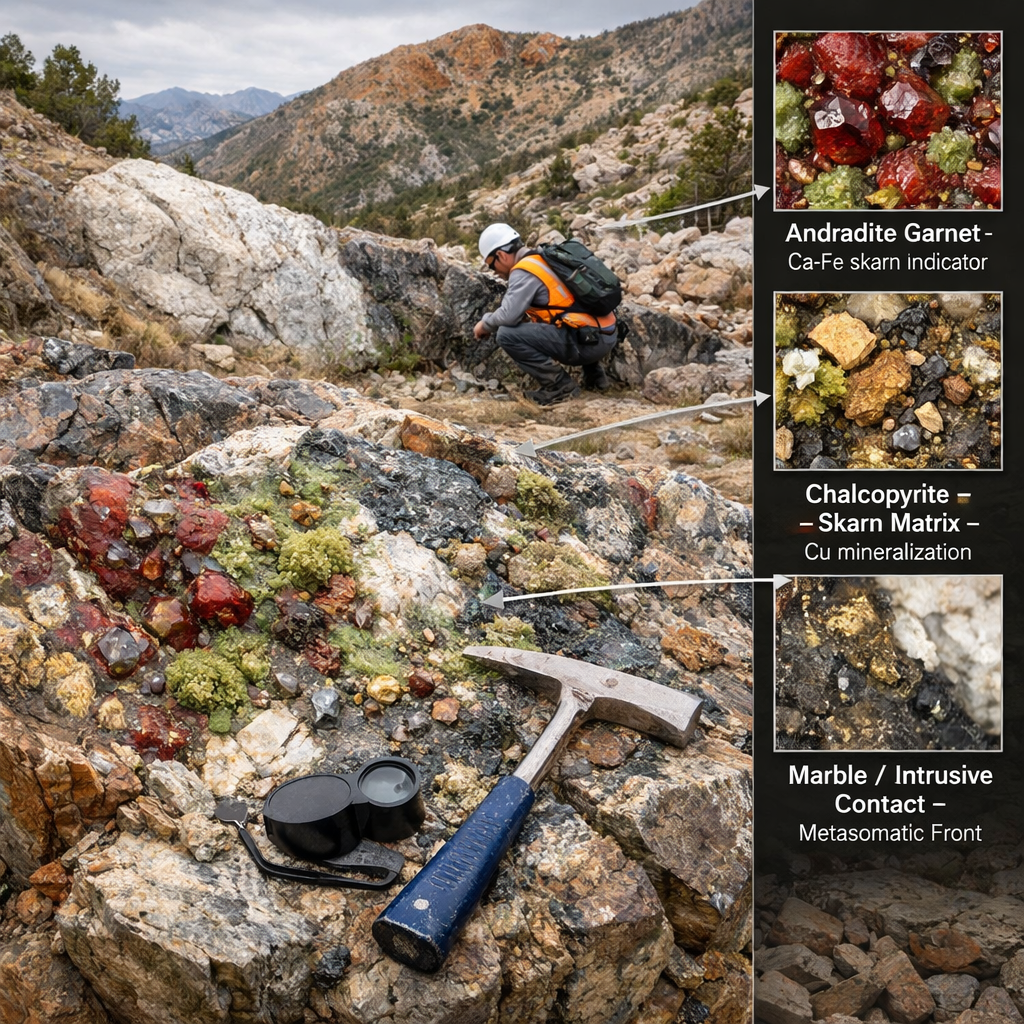

What are the key indicators of a potentially economic skarn deposit during early-stage exploration?
0
  • 0 0 Comments
  • 21 Views
  • 21 Reactions
  • 0 Followers
  • 0
    • Report
  • Share
    Share
    • Share on Facebook
    • Share on Twitter
    • Share on LinkedIn
    • Share on WhatsApp

Related Posts

  • What is the difference between primary, secondary, and supergene mineralisation and how does it affect processing?
  • What is the difference between primary, secondary, and supergene mineralisation and how does it affect processing?
  • What is the significance of the ore-waste boundary contact and how is it determined in the field?

You must login to add an Comment.


Forgot Password?

Need An Account, Sign Up Here
aalanaalan

Sidebar

  • Recent
  • Mastering On-Site Processing: A Strategic Guide to the Mobile Crushing Plant
    • On: April 28, 2026

    Mastering On-Site Processing: A Strategic Guide to the Mobile Crushing ...

  • From One Truck to Thousands: The Global Rise of Autonomous Mining
    • On: April 28, 2026

    From One Truck to Thousands: The Global Rise of Autonomous ...

  • Powering Remote Construction: A Guide to the Diesel Concrete Mixer
    • On: April 24, 2026

    Powering Remote Construction: A Guide to the Diesel Concrete Mixer

  • Different Types of Batching Plant Supporting Large-Scale Mining Infrastructure Projects
    • On: April 24, 2026

    Different Types of Batching Plant Supporting Large-Scale Mining Infrastructure Projects

  • Maximizing On-Site Efficiency with the Right Mobile Crusher Machine
    • On: April 21, 2026

    Maximizing On-Site Efficiency with the Right Mobile Crusher Machine

  • Sustainability in Mining: Eco-Friendly Batching and the Ready Mix Concrete Plant Cost of Compliance
    • On: April 21, 2026

    Sustainability in Mining: Eco-Friendly Batching and the Ready Mix Concrete ...

  • What Factors Do Peruvian Mining Companies Consider When Purchasing Crushing Plants?
    • On: April 20, 2026

    What Factors Do Peruvian Mining Companies Consider When Purchasing Crushing ...

Go to Home page to view more

Top Members

Olena Skyba

Olena Skyba

  • 150 Posts
  • 2 Comments
Pundit
Marcial

Marcial

  • 91 Posts
  • 0 Comments
Enlightened
Jean Marais (Sanodea Group)

Jean Marais (Sanodea Group)

  • 25 Posts
  • 0 Comments
Beginner
Trending on Mining Doc

Trending Communities

Fixed Plant General Information Geology Mining Case Studies Mining Doc Documentary Mining Engineering Mining Events Mining Finance and Economy Mining Human Resources Mining Industry Research Mining Operations Mining Software Solutions Mining Sustainability Mining Technology Solutions Mobile Plant Equipment

Explore

  • Home
  • Online courses
  • Case study
  • Mining Community
  • Solutions listing
    • Lase Solutions
    • O-PitBlast Solutions
    • Continuous Mining
    • Longwall mining
    • Geosight Scanners
    • LoopX AI
    • Terafil solutions
    • Blasting solutions
    • Geotechnical
    • Submersible Pumps
    • Mine rescue system
    • Ore sorting
    • Whittle Consulting Solutions
  • Add Blog
  • Feed
  • User Profile
  • Posts
    • New Posts
    • Trending Posts
    • Must read Posts
    • Hot Posts
  • Polls
  • Badges

Footer

Mining Doc

Join our community and connect with other people in the Mining industry for knowledge sharing.

Legal Stuff

  • Privacy Policy
  • Terms of Service

Help

  • Support
  • FAQs
  • How to add new content and how to promote a content
  • Compliance and guidelines
  • Subscribe to Mining Doc

Follow

© 2026 Mining Doc. All Rights Reserved

