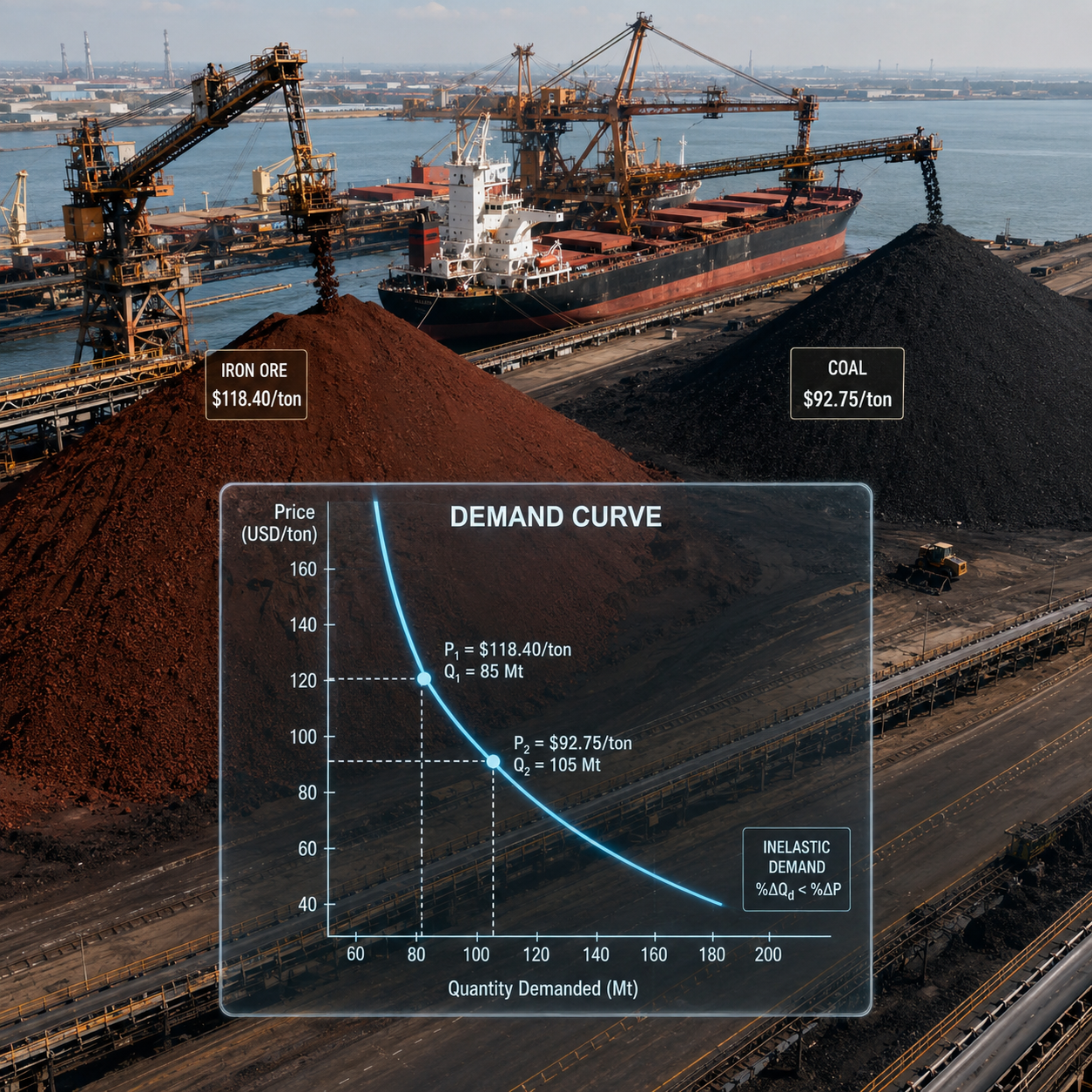
Elasticity of demand is very important for bulky products such as iron ore and coal due to the fact that elasticity will determine how prices, revenue, taxes, and other policies can influence their demand. In fact, both products usually have quite low demand elasticity in the short term; therefore, substantial price fluctuations lead to rather small percentage changes in the quantity demanded.
First of all, elasticity shows producers and legislators how consumers react to price fluctuations. Thus, regarding iron ore, according to one literature review, some research found out that demand elasticities of iron ore are equal to -0.2 to -0.3. At the same time, for coal, one literature research on China’s provinces revealed that coal’s demand was getting more price elastic by 2012 with elasticities of -0.3 to -0.7 during two-year period. Therefore, demand for these products is somewhat elastic, however, much less elastic than demand for manufactured products.
Second, elasticity has significant revenue considerations. For instance, inelasticity implies that an increase in prices can lead to increases in total revenue since the fall in quantities is lower than the increase in prices. It is particularly relevant in bulk commodity markets where even a slight shift in demand results in very large volume shifts due to the size of the initial quantities involved. Elasticity, therefore, means that when demand increases, there would be increased risks that high prices would result in reduced revenue.
The third reason why elasticity is relevant is because of the importance of bulk commodity markets in international business and economic policy. For instance, iron ore demand is connected to steel production while coal is used for generating electricity and heat. As such, it would mean that there are fewer substitutes available for use by consumers. This would imply that supply factors or policies would lead to larger price increases while demand elasticity policies would be more effective. The Chinese study, for example, acknowledges that elasticity improves price-based policies’ effectiveness.
Fourth, elasticity of demand plays an essential role in terms of taxation and subsidies. When the demand for a commodity is inelastic, sellers have the option of passing on a higher percentage of their expenses to consumers. In the case of an elastic market, consumers will be reducing their demands much faster than sellers. For coal, the issue relates to how carbon pricing and fuel taxes work in relation to subsidy elimination policies. The reason why governments examine the elasticity of demand is because it enables them to create royalty systems and environmental fees that will affect the economy differently.
The fifth consideration is that the concept of elasticity is crucial in determining the future demand for mining ventures and how to plan accordingly. If the demand is inelastic, then the quantity demanded can be expected to remain relatively stable despite changes in prices, making growth and investments in the sector more feasible. However, in situations where the demand gradually changes to become elastic due to changes in buyer behavior and technology, then demand risk is much higher.
In summary, elasticity is relevant in many other ways, which makes it even more important. For the producer, the concept influences pricing, hedging, capacity, and exporting decisions. Similarly, from the government perspective, it affects royalty, taxation, carbon management, and transition policies. Simply put, the reason why these materials are referred to as “big” is because of their economic importance based on their inelastic demand.