Cut-off grade is the standard for distinguishing economic ore from waste (Liu et al., 2023). Waste, on the other hand, is accumulated in stockpiles that have low grades. The price cycles for commodities, or market value changes, determine if the stockpile is an asset or liability.
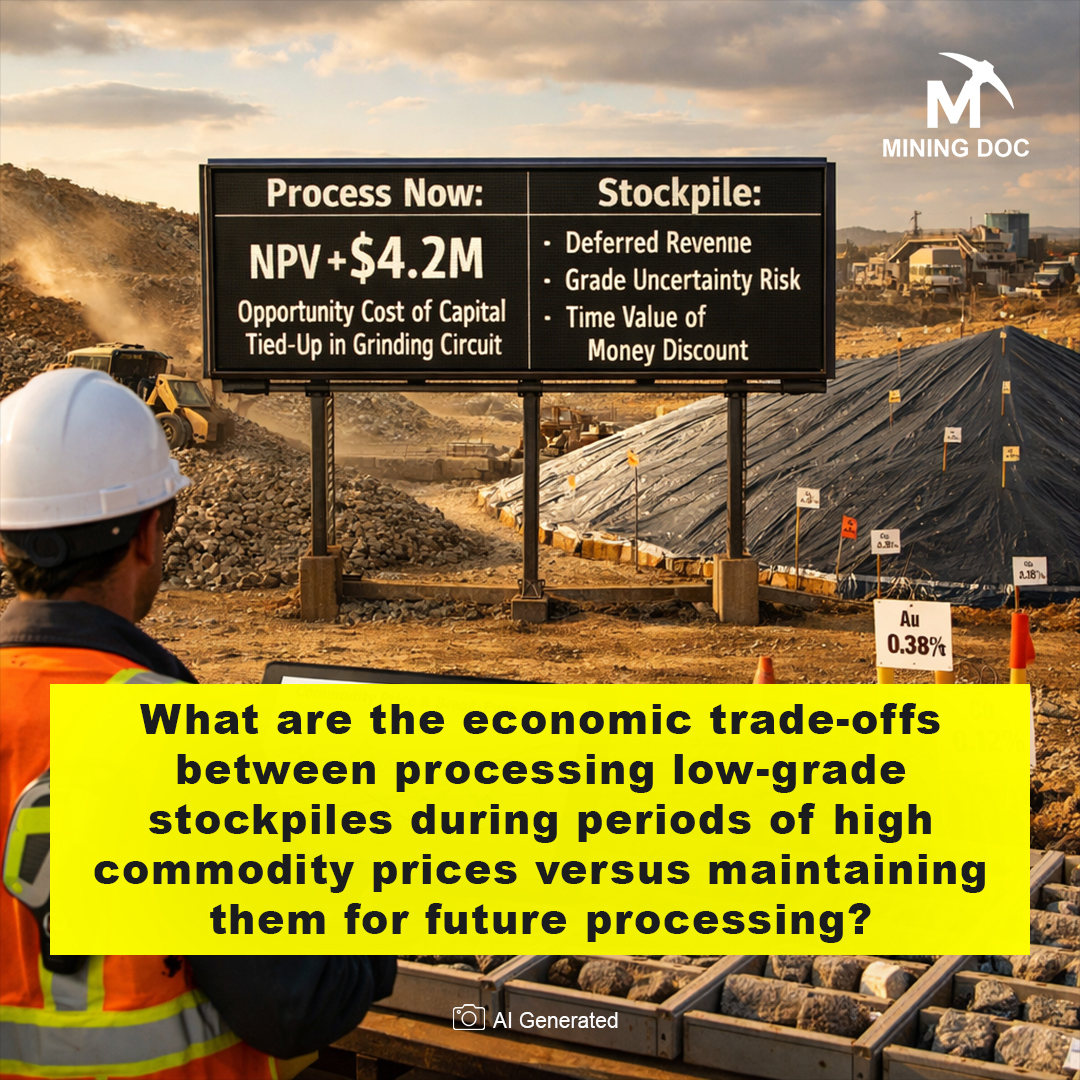
When commodity prices are high, it makes sense to process low-grade stockpiles. High prices reduce the cut-off grade and convert uneconomic waste rock into economic ore. Processing the stockpiles at high prices increases margins, thus increasing the cash flow and NPV. It is because of economic depletion, which means that market prices determine when processing will be economically feasible (Lèbre & Corder, 2015).
Nevertheless, immediate processing comes with significant opportunity costs relating to the capacity of the mill. Processing plants have throughput constraints. When poor-quality piles replace newly mined rich ores during times of peak capacity, then the overall profitability from processing falls. One must strike a balance between the rate of mining and the efficiency of using machines to maximize benefit while not choking up the plant (Arteaga et al., 2017).
On the other hand, storing low-grade piles for subsequent processing becomes a buffer. Storing such material helps maintain the mill’s throughput during later phases of the life-of-mine after exhausting the reserves of rich materials. The application of stochastic optimization shows that efficient scheduling of material transfer from the pit, storage, and processing plants helps manage the risks and create maximal value for the mining operation (Levinson & Dimitrakopoulos, 2019).
However, postponing processing poses financial and technical risks. Delayed storage means delayed cash flows on the expectation that future prices will offset the cost of operation. In addition, although multiple-stage mining might classify this material into reserves, physical deterioration such as ore oxidation may lead to lower recovery rates in the future and increase the complexity of operations (Wellmer & Scholz, 2018).
In essence, whether to process the low-grade stockpile when prices are high or to store it is a fine balancing act. One loses future benefits from current actions, while the other is risky yet offers an insurance for the future. Managing this problem calls for dynamic models that would be able to change the cutoff policies.
References
Arteaga, F., Nehring, M., & Knights, P. (2017). The equipment utilisation versus mining rate trade-off in open pit mining. International Journal of Mining, Reclamation and Environment, 32(4), 495–518. https://doi.org/10.1080/17480930.2017.1306674
Lèbre, É., & Corder, G. (2015). Integrating Industrial Ecology Thinking into the Management of Mining Waste. Resources, 4(4), 765–786. https://doi.org/10.3390/resources4040765
Levinson, Z., & Dimitrakopoulos, R. (2019). Simultaneous stochastic optimisation of an open-pit gold mining complex with waste management. International Journal of Mining, Reclamation and Environment, 34(6), 415–429. https://doi.org/10.1080/17480930.2019.1621441
Liu, D., Li, G., Hu, N., Xiu, G., & Ma, Z. (2023). Optimization of the cut-off grade for underground polymetallic mines. Gospodarka Surowcami Mineralnymi – Mineral Resources Management. https://doi.org/10.24425/gsm.2019.128198
Wellmer, F.-W., & Scholz, R. (2018). What Is the Optimal and Sustainable Lifetime of a Mine? Sustainability, 10(2), 480. https://doi.org/10.3390/su10020480