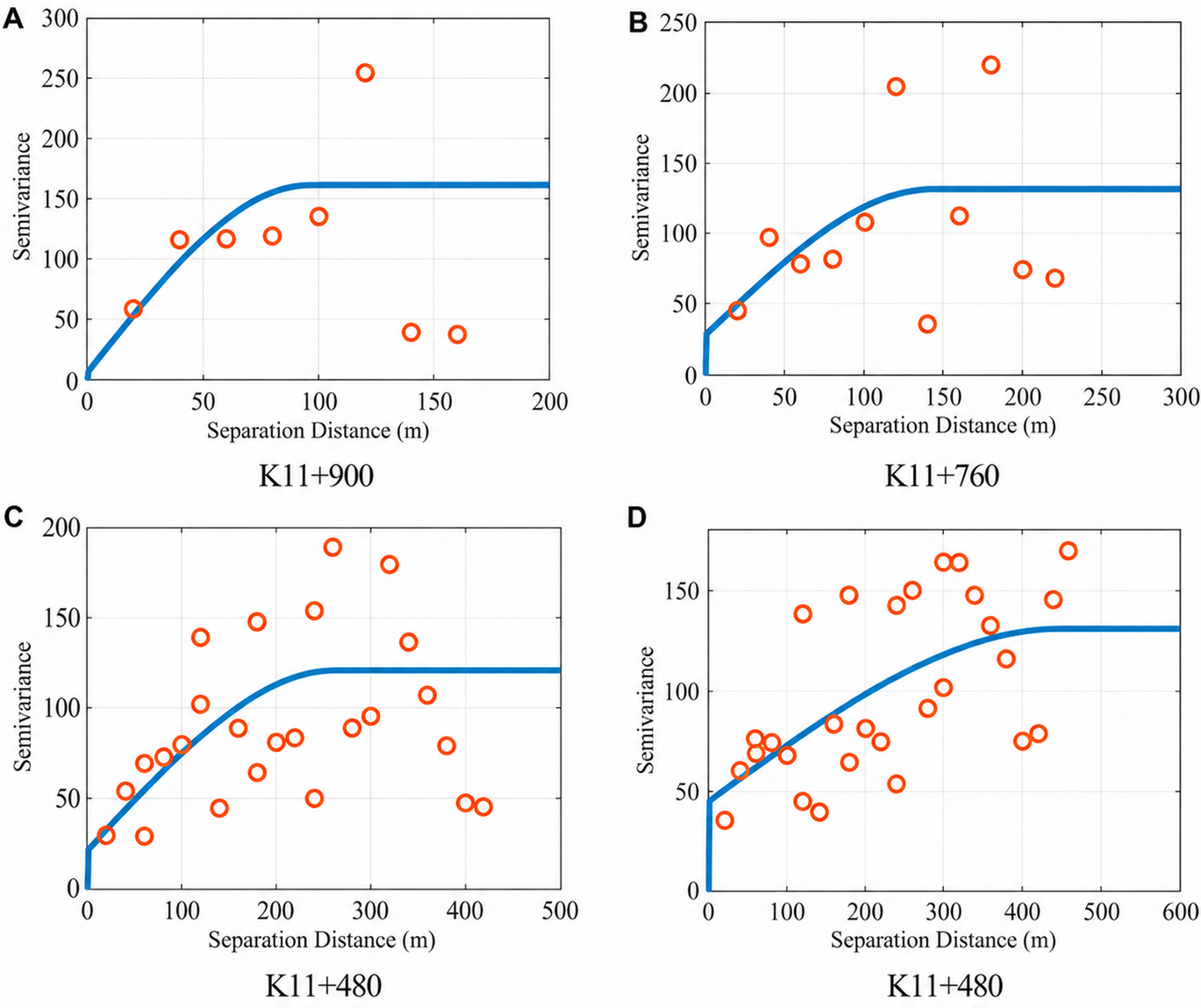
Complex gold deposits require effective geostatistical procedures to determine the viability of the resource. First, let’s define key terms. Variogram modelling evaluates spatial correlation and measures mathematical decline in similarity between samples with increasing distance. Kriging is one such interpolation method that employs variogram modelling to provide the best linear unbiased estimate for unsampled data points (Shamsi et al., 2021). The term ‘structural complexity’ describes geological structures, including extreme folding, faulting, or veining, that significantly affect continuity.
The first stage of such estimates is developing a geological model from exploratory data analysis. Drillholes need to be composited to standard lengths to maintain consistency in volumetric support within the ore body. Because the structural factors control hydrothermal fluid movement and subsequent gold mineralization, the deposit needs to be divided into domains based on structural similarity. The hard boundary domaining ensures that there is no mathematical mixing of distinct populations of the data, ensuring that high-grade gold is not spread out into barren rock.
In these confined domains, geological applications employ the use of variogram modeling as a tool for measuring spatial continuity. This involves determining the semivariogram variance of data pairs at a certain vector separation referred to as h. Mathematically, this is represented as ϒ(h). This data is fitted with a theoretical semivariogram curve (Buelga Díaz et al., 2022). The final output of this process generates a variogram characterized by three major values: nugget effect (intrinsic variability or measurement errors), sill (total variance on the plateau), and range (maximal distance of spatial correlation).
The complex deposits generate unique estimation issues since gold mineralization does not occur isotropically. For this case, a technique called dynamic anisotropy is utilized in modeling. Unlike traditional methods that employ a fixed search ellipse, dynamic anisotropy enables rotation of the search ellipse and variogram axis to perfectly match the folding of mineralized zones (Afonseca & Costa, 2021). The technique offers an accurate estimation of spatial continuity in line with deposit geometry.
After successful modelling of the spatial structure, kriging is employed to predict the gold grade of each volumetric block. Ordinary kriging is common because it provides optimal estimations by providing statistical weightage of close samples depending only on the characteristics of the variogram (Maniteja et al., 2025). In the case of highly skewed gold deposits with a few extreme outliers, indicator kriging can also be implemented as a non-linear geostatistical technique to estimate the probability of a block crossing the economic cut-off grade of gold.
Lastly, after completing the block model, thorough validations have to be done to ensure its use in further mining activities. Professionals make use of geostatistical cross-validation, graphical comparison of swath maps with original data, and global statistical validations to establish the authenticity of the estimated grades. This process, when done effectively, can change a collection of random geological intercepts into a tool for efficiently mining gold.
References
Afonseca, B. d. D., & Costa, J. F. C. L. (2021). Dynamic anisotropy and non-linear geostatistics supporting short term modelling of structurally complex gold mineralization. REM – International Engineering Journal, 74(2), 199–207. https://doi.org/10.1590/0370-44672020740034
Buelga Díaz, A., Castañón Fernández, C., Ares, G., Prieto, D. A., & Álvarez, I. D. (2022). RecMin Variograms: Visualisation and Three-Dimensional Calculation of Variograms in Block Modelling Applications in Geology and Mining. International Journal of Environmental Research and Public Health, 19(19), 12454. https://doi.org/10.3390/ijerph191912454
Maniteja, M., Samanta, G., Gebretsadik, A., Tsae, N. B., Rai, S. S., Fissha, Y., Okada, N., & Kawamura, Y. (2025). Advancing Iron Ore Grade Estimation: A Comparative Study of Machine Learning and Ordinary Kriging. Minerals, 15(2), 131. https://doi.org/10.3390/min15020131
Shamsi, R., Dehghani, H., Jalali, M., & Jodeiri Shokri, B. (2021). Ore grade estimation using the imperialist competitive algorithm (ICA). Arabian Journal of Geosciences, 14(14). https://doi.org/10.1007/s12517-021-07808-7