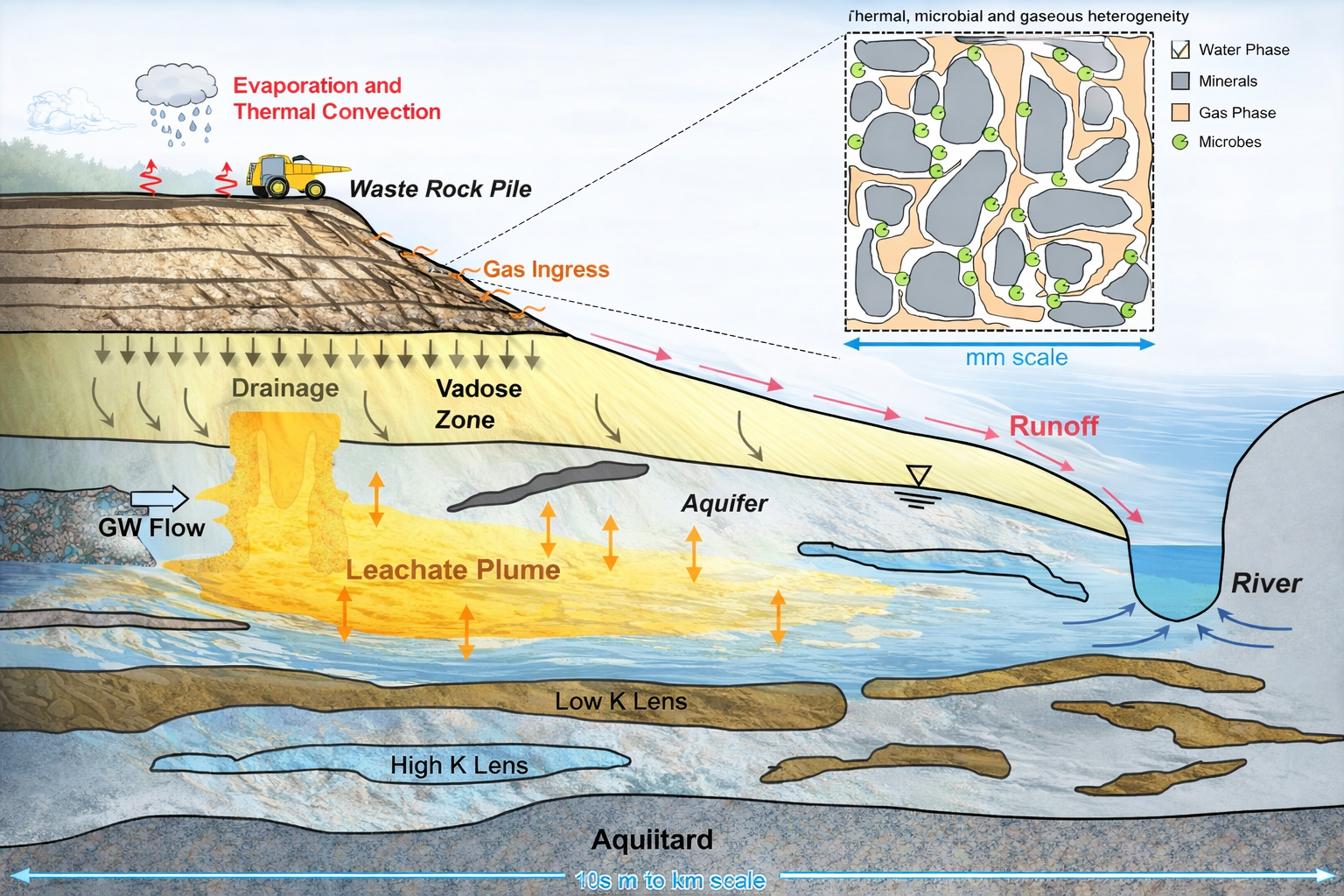
Acid Rock Drainage is one of the environmental problems in the mining industry that involves acidic, metallic runoff. The problem arises when the waste rock that contains metals such as pyrite is exposed to the atmosphere and meets both air and water, leading to oxidation reactions. For there to be proper prediction of acid rock drainage, proper geochemical techniques need to be employed in managing the waste rock dumps.
The basis of the prediction of acid rock drainage depends on the geochemical static test. Tests such as Acid Base Accounting and Net Acid Generation are carried out to examine the presence of acid-producing sulphides and neutralizing carbonate minerals. These particular tests help to identify the potential acid-producing nature of the waste rock dump, and whether it will cause acid rock drainage or not (Sylvain et al., 2024).
Although static testing is important, it does not factor in rates of reaction and mineral liberation, usually resulting in exaggerated results for chemical predictions in the long term (Sylvain et al., 2024). As such, dynamic testing using techniques such as column leaching and humidity cell is performed next. This test provides valuable information concerning the kinetics of oxidation, the chemistry of the leachates, and the exact time needed for the onset of ARD.
The complete description of the ARD problem leads to engineering interventions to resolve this environmental challenge. In this instance, source control is vital, and the intervention that takes center stage is encapsulation. This technique entails covering the pyritic material with a cover of non-permeable materials such as compacted clay and geomembrane materials. The aim here is to block the entry of water and oxygen into the system through the creation of an effective cover over the system, effectively preventing oxidation (Hamanaka et al., 2024).
Furthermore, geochemical management techniques will be incorporated into the building process of the dump. The mixing technique refers to the proper inclusion of the acid-forming waste rocks along with those materials which have a high acid-neutralization capability, for instance, limestone or carbonates (Hamanaka et al., 2024). Through optimal proportioning, the pH level inside the waste rock dump will be balanced so that the acidic water formation does not occur during the operation period.
Thus, it becomes clear that the control over the sulphide-containing waste rock is only achievable through the combination of several tools. By means of applying proper and accurate predictive modeling (from initial static assessment up to complex kinetic weathering) and mitigation measures, such as encapsulation or geochemical mixing, it is possible to minimize the environmental effect of the mining company.
References
Hamanaka, A., Sasaoka, T., Shimada, H., et al. (2024). Mitigation of Acid Mine Drainage Using Blended Waste Rock in Near-Equatorial Climates—Geochemical Analysis and Column Leaching Tests. Physchem, 4, 470–482. https://doi.org/10.3390/physchem4040033
Sylvain, K., Pabst, T., & Demers, I. (2024). Improving the re-use potential of reactive waste rock using sieving: a laboratory geochemical study. Environmental Science and Pollution Research, 31, 55490–55506. https://doi.org/10.1007/s11356-024-34679-8