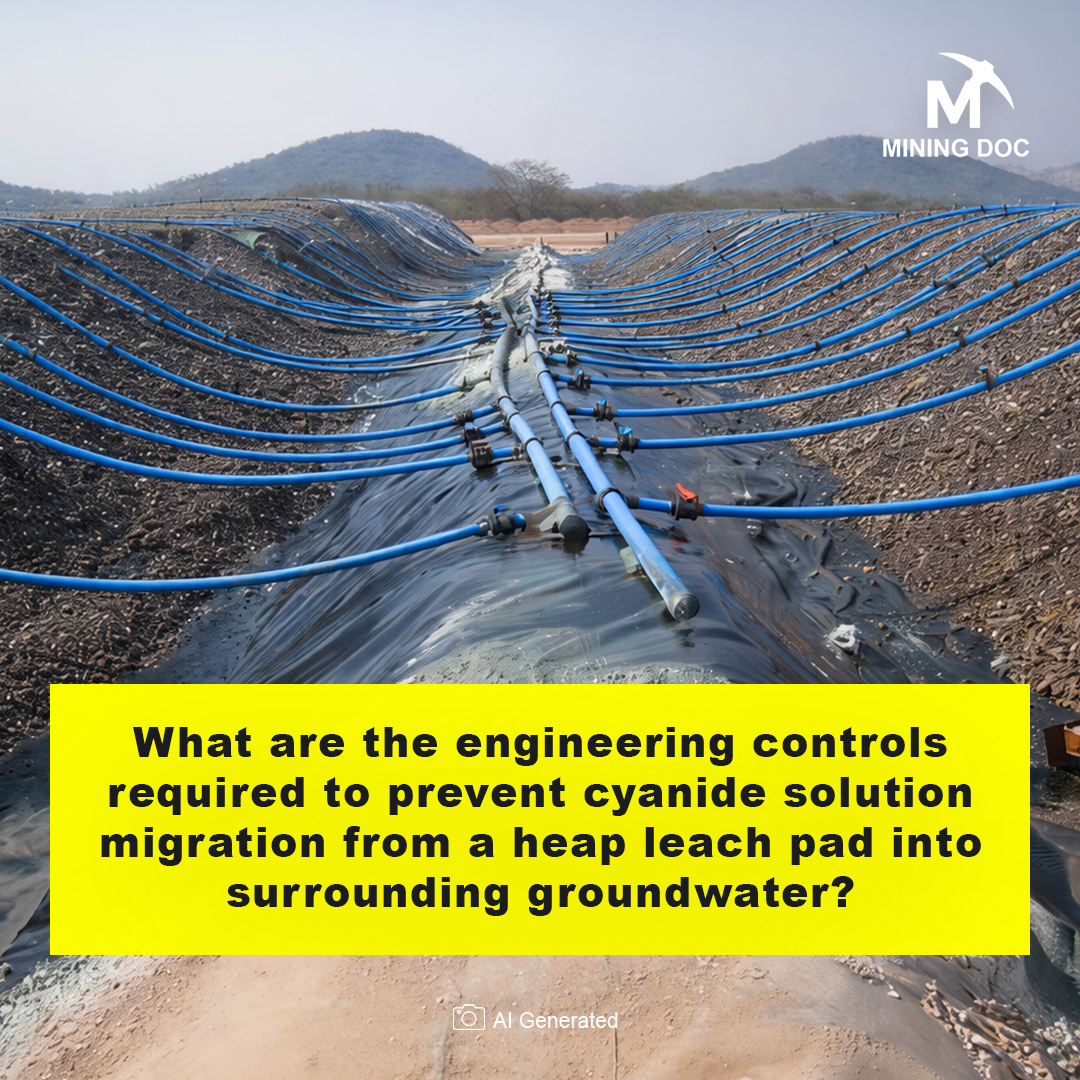
Heap leaching is the process of accumulating crushed ores on a containment pad and spraying the chemical solution on them. The cyanide solution is a very powerful lixiviant used to dissolve valuable metals such as gold or silver. Migration is the unintentional movement of this dangerous solution to the subsoil and groundwater areas.
The keyway of preventing migration is by using a composite lining system installed at the bottom of the pad. This usually involves the installation of a compacted and impermeable clay layer on top of the geomembrane. The most common type of geomembrane used in the industry is the High-Density Polyethylene (HDPE) geomembrane owing to its density and chemical resistant properties. Research indicates that the HDPE liners are highly durable and can withstand chemical attacks and extreme temperatures of the pad up to 70 degrees Celsius.
Since the heavy load of ore may sometimes penetrate even the strongest liners, a Leak Detection and Collection System (LCRS) is an important back-up system. The LCRS system operates just below the main liner and consists of a highly porous drainage layer and perforated piping. In case the cyanide liquid penetrates through the upper HDPE liner, the LCRS collects and channels the liquid to the sumps, thus preventing its further penetration downwards.
Surface water management is done to ensure that there is no hydraulic saturation of the pad. The higher the pressure of water on the liner, which is referred to as hydraulic head, the greater the risk of leakage. Therefore, engineers construct a number of stormwater diversion ditches to channel rainwater away from the heap. In addition to that, the containment ponds used for holding pregnant and barren cyanide are designed using dual liners and restricted freeboards.
Environment monitoring entails the establishment of comprehensive groundwater monitoring systems. The hydrogeologist sets up deep groundwater monitoring wells downstream of the leach pad to monitor the quality of the water. This monitoring system acts as an early warning system, which enables mine owners to detect cyanide in small amounts. This means that even when there is a small leakage, it will be detected and contained immediately.
In summary, the prevention of cyanide leaching calls for the use of an extensive and rigorous defense-in-depth system. By means of combining permanent HDPE lining, quick detection of any leakage, proper regulation of surface waters, and constant monitoring of the groundwater quality, it is possible to successfully isolate dangerous lixiviants. Implementation of this system together with conducting environmental impact assessments related to cyanidation process will secure groundwater safety and ensure ecological stability.