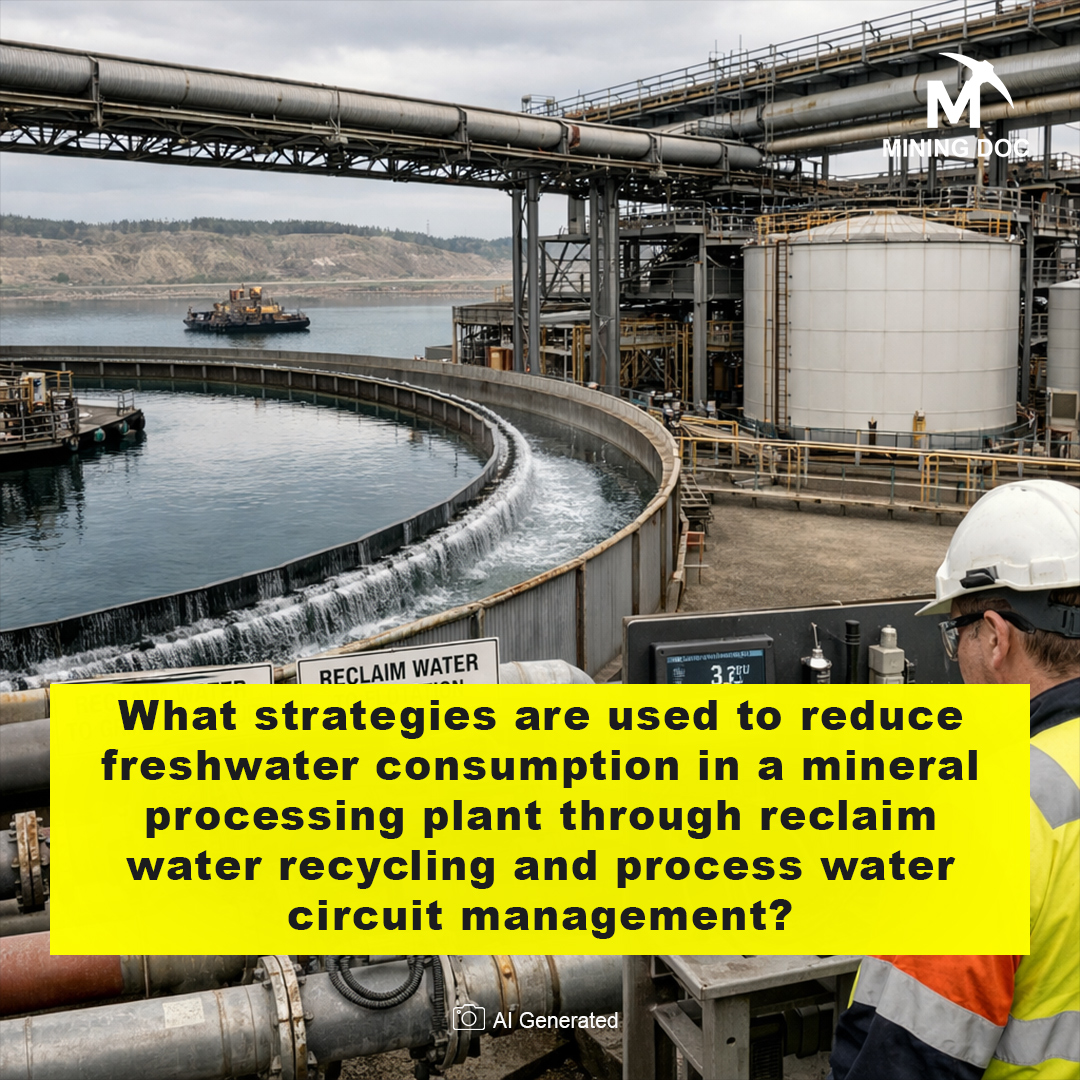
The freshwater use in mineral processing is the amount of the natural surface or groundwater that is used to separate and enrich valuable minerals from the ore. To save water, facilities resort to water recycling through the reclaim process. Besides, the process water circuits are associated with the intelligent distribution and treatment of the water in the loop system.
The mining sector is increasingly becoming environmentally conscious, particularly in arid areas, where water availability is the main limiting factor. The high demands for the water lead not only to increased costs but also to depletion of the local aquatic life. Therefore, the implementation of sustainable water saving techniques is an ecological and economical necessity.
The key method of curbing water demands of natural origin largely depends on water recycling using innovative tailings management. The application of thickened tailings (TT) and paste tailings (PT) approaches allows for quick recovery of water after the beneficiation process and direct reuse at the processing plant (Fabian et al., 2015). Such an approach makes it possible to avoid excess water discharging into the tailings ponds and reduces both evaporation and seepage losses of water.
Process water circuit management serves as an additional tool in water savings through running one or several closed water loops. Nevertheless, the constant recycling of up to 90% of process water in the flotation circuit may result in a complicated accumulation of dissolved ions, flotation reagents, and microbiota (Bomberg et al., 2024). Thus, process water circuit management must constantly control physical and chemical parameters like pH and redox potential to eliminate negative effects on the efficiency of mineral extraction.
Modern mineral processing plants, in view of the complex chemical composition of the closed loop recycling process, have started applying innovative technologies for water purification during processing. New technologies allow continuous purification of highly saline or contaminated flows using specially designed membranes and electrochemical methods (Villa Gomez et al., 2024). Thus, through the effective purification from impurities, these systems provide the necessary water quality to conduct froth flotation.
To sum up, the drastic reduction of the freshwater utilization in mineral processing requires a multidimensional strategy. Through combining the use of reclaimed water coming from the tailings, along with process water circuit management, and using membrane filtration, mining companies will be able to minimize the usage of natural water sources.
References
Bomberg, M., Miettinen, H., & Kinnunen, P. (2024). Seasonal variation in metabolic profiles and microbial communities in a subarctic ore processing plant. Environmental Microbiology Reports, 16. https://doi.org/10.1111/1758-2229.13284
Fabian, K., Jacobs, M., Hooshiar, A., & Ngwenya, E. (2015). The impacts of using thickened tailings on water management and CAPEX of tailings storage facilities. Proceedings of the International Seminar on Paste and Thickened Tailings, 535–546. https://doi.org/10.36487/acg_rep/1504_41_fabian
Villa Gomez, D., Whitworth, A. J., Vaughan, J., Sultana, U., Ledezma, P., & Parbhakar-Fox, A. (2024). Review on Developments in Technologies for Critical Metal Recovery from Mining and Processing Wastes. Mineral Processing and Extractive Metallurgy Review, 1–20. https://doi.org/10.1080/08827508.2024.2408015