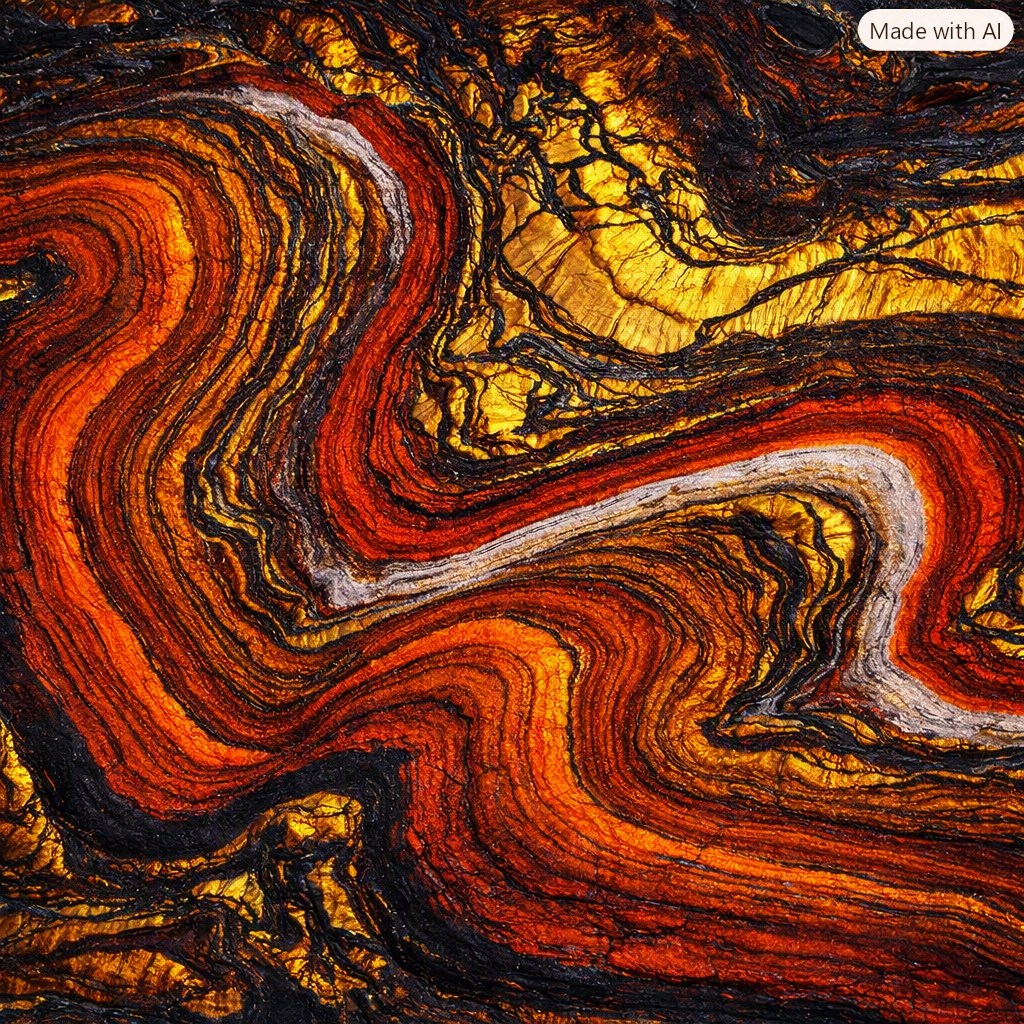
In the field of mining, the estimation of deposit size and quality plays a vital role. A Banded Iron Formation (BIF) is defined as a type of sedimentary rock composed of bands of iron-bearing materials and silica. This rock is one of the major iron resources across the globe. The assessment of BIF deposits entails classifying mineral resources based on geological assurance in three categories; Inferred, Indicated, and Measured. A Measured resource has the highest level of confidence, since it is backed by dense data that confirms the continuity of geological and grade. On the other hand, Indicated resource is defined as an area which continuity can be assured reasonably but not with the same degree of confidence.
The upgrade of Indicated resource to Measured is influenced by the mitigation of geological risk factors. Geological risk refers to the uncertainties associated with physical nature of the ore body like its boundaries and grade. Classification systems take into account this risk to assess operational risks. According to Rocha and Bassani (2023), effective classification is dependent on multi-level processes which include the quantification of data quantity, geological attributes, and spatial consistency.
The first important risk factor in terms of geology, which differentiates these two categories of resources in BIF deposits, is continuity. Despite being large stratiform deposits, BIFs may go through complicated processes of tectonic deformations like folding and shear faulting. In case of Indicated resources, there is information from the spacing of drill holes for the identification of a general trend of structure but not of local complexities. As for Measured resources, information density should be enough to confirm structural changes and ensure continuous spatial continuity of iron mineralization without any unexpected fault displacements.
Another important risk factor is continuity of grade and grade estimation variance. BIF deposits usually have variable content of impurities, such as phosphorus, alumina, and silica, influencing the economic value of the ore. In case of Indicated resource, it is risky to make a grade interpolation between points because of the high kriging variance. For Measured resources, there should be close spacing of samples reducing the grade variance to the minimum.
The process of quantifying the risks associated with the geological factors is now increasingly carried out by means of geostatistical simulations. This methodology enables geologists to model uncertainties of multiple deposit realizations. As noted by Afzal et al. (2023), geostatistical techniques help in resource classification due to the assessment of estimation variance and uncertainties of block models. In particular, it is possible to model the uncertainty of geological contacts in order to set appropriate thresholds that convert a block into the Measured one.
In sum, the identification of a Measured resource from the Indicated one in a BIF deposit depends on overcoming structural complexities and determining grade continuity. The strict approach towards assessing the above risks defines the progression from initial economic feasibility studies to mine design. It is necessary to reduce the level of geological uncertainty using geostatistical techniques and extensive sampling in order to obtain the expected results of the operation.
Image credits: Xuan-Ce Wang (Available here: https://www.linkedin.com/pulse/fluid-characteristics-structural-controls-archean-banded-xuan-ce-wang-66gzc/)
References
Afzal, P., Gholami, H., Madani, N., Yasrebi, A., & Sadeghi, B. (2023). Mineral Resource Classification Using Geostatistical and Fractal Simulation in the Masjed Daghi Cu–Mo Porphyry Deposit, NW Iran. Minerals, 13, 370. https://doi.org/10.3390/min13030370
Rocha, V., & Bassani, M. A. A. (2023). Practical application of a multi-layer scorecard workflow (MLSW) for comprehensive mineral resource classification. Applied Earth Science: Transactions of the Institutions of Mining and Metallurgy, 132, 216–226. https://doi.org/10.1080/25726838.2023.2244775