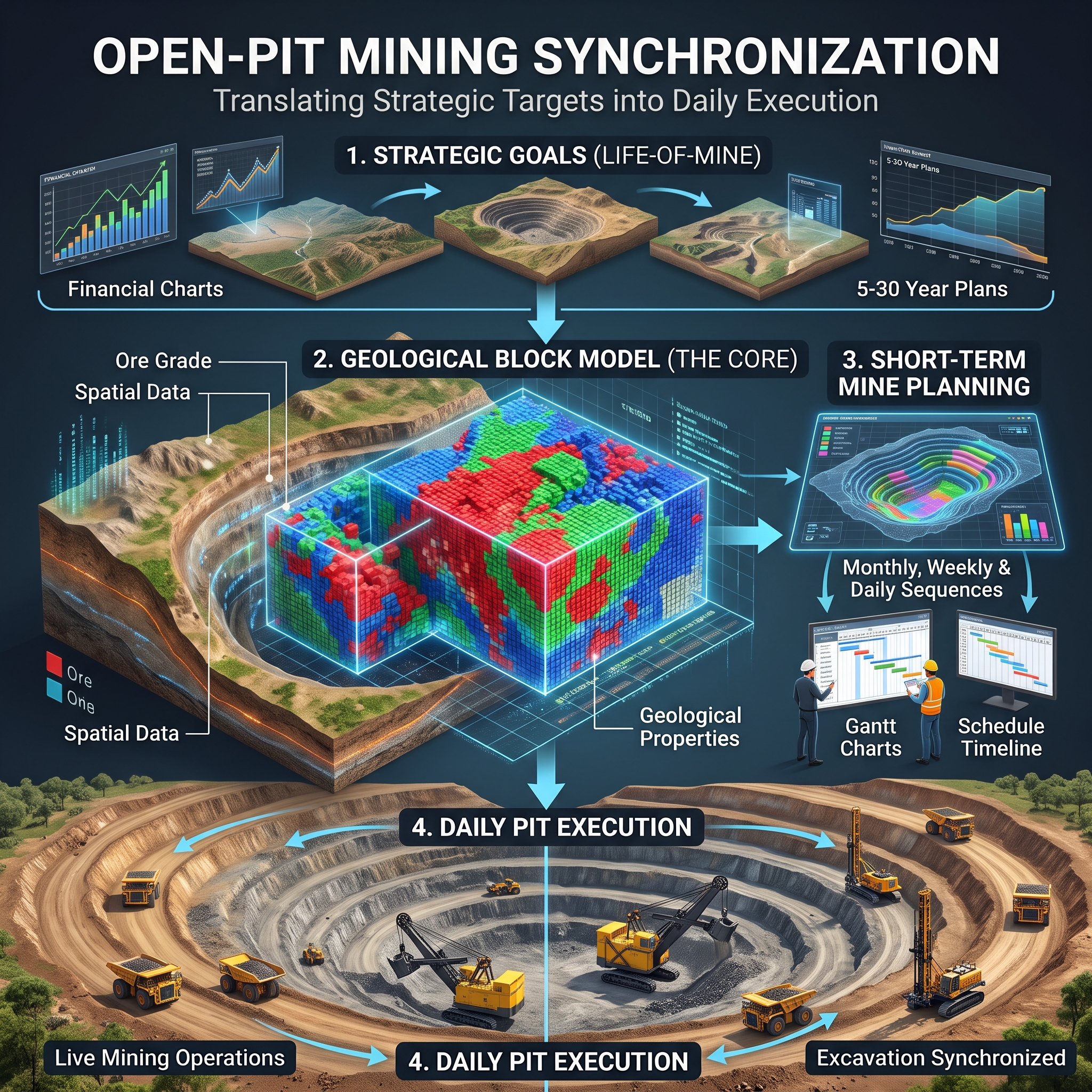


Open-pit mining operations require precise synchronization between strategic Life-of-Mine targets and daily pit execution. Short-term mine planning serves as the operational mechanism that translates long-term financial goals into achievable daily, weekly, and monthly extraction sequences. At the core of this operational process sits the geological block model.
A geological block model is defined as a three-dimensional digital representation of an orebody that discretises a mineral deposit into structured blocks, assigning estimated metal grades, rock types, density, and geometallurgical attributes through geostatistical interpolation or simulation techniques. Short-term mine planning decisions encompass operational scheduling and sequencing choices executed across shift, daily, weekly, or monthly horizons, typically up to three months, to satisfy processing plant feed requirements, allocate fleet equipment, and maintain stable active mining faces while respecting long-term pushback designs. Updated geological block models bridge the gap between strategic valuation and tactical pit execution.
Dig-limits, or mining polygons, represent practical extraction boundaries drawn on bench levels that cluster individual geological blocks into contiguous mining cuts to respect loader maneuverability, prevent dilution, and separate ore from waste. Short-term block models incorporate high-density operational sampling data, including blast-hole assays and reverse circulation drilling results, to refine grade estimates ahead of excavation.
High-resolution spatial grade data allows planners to establish optimized material destinations, routing high-grade ore to mills, medium-grade material to stockpiles, low-grade ore to heap leach pads, and barren rock to waste dumps. Automated clustering algorithms aggregate block units into smooth diglines. This spatial optimization minimizes ore loss and misclassification risks, ensuring that processing facilities receive a uniform chemical feed.
Goal programming and mixed-integer programming constitute multi-objective mathematical optimization techniques used in mine scheduling to balance conflicting operational targets—such as tonnage production, grade bounds, bench slope limits, and equipment mobility—by minimising deviations from planned targets. Traditional linear schedules often produce scattered block selection patterns across multiple working levels, which forces excavators and haul trucks to relocate frequently.
Integration of active bench constraints within goal programming models restricts the maximum number of working levels open during any scheduling interval. This restriction establishes contiguous extraction sequences and reduces inter-bench equipment relocations by up to thirty-six percent. Spatial precedence constraints further guarantee bench face stability, optimize truck-shovel cycle times, lower fuel consumption, and preserve continuous exposed ore for subsequent production periods.
Stochastic simulation generates multiple equiprobable block realizations to quantify grade variability, whereas mine reconciliation systematically compares short-term block models against long-term resource estimates and processing plant outputs using metrics such as the F1 reconciliation factor. Deterministic kriging models smooth grade extreme values and fail to capture localized spatial uncertainty.
Stochastic block models evaluate grade distributions across simulated realizations, enabling planners to select digline boundaries that maximize occurrence probability while reducing financial risk. Quantitative simulation also anticipates throughput bottlenecks before field execution. Systematic reconciliation reporting compares short-term model depletions against long-term baselines to recalibrate dilution factors, adjust moisture assumptions, and enhance future planning accuracy.
Geological block models provide the spatial foundation and quantitative rigor necessary to guide daily grade control, ensure operational continuity, and manage geological risk in open-pit surface mining. Short-term planning models transform static resource databases into dynamic decision-support systems that align pit-floor fleet dispatching with long-term asset value.