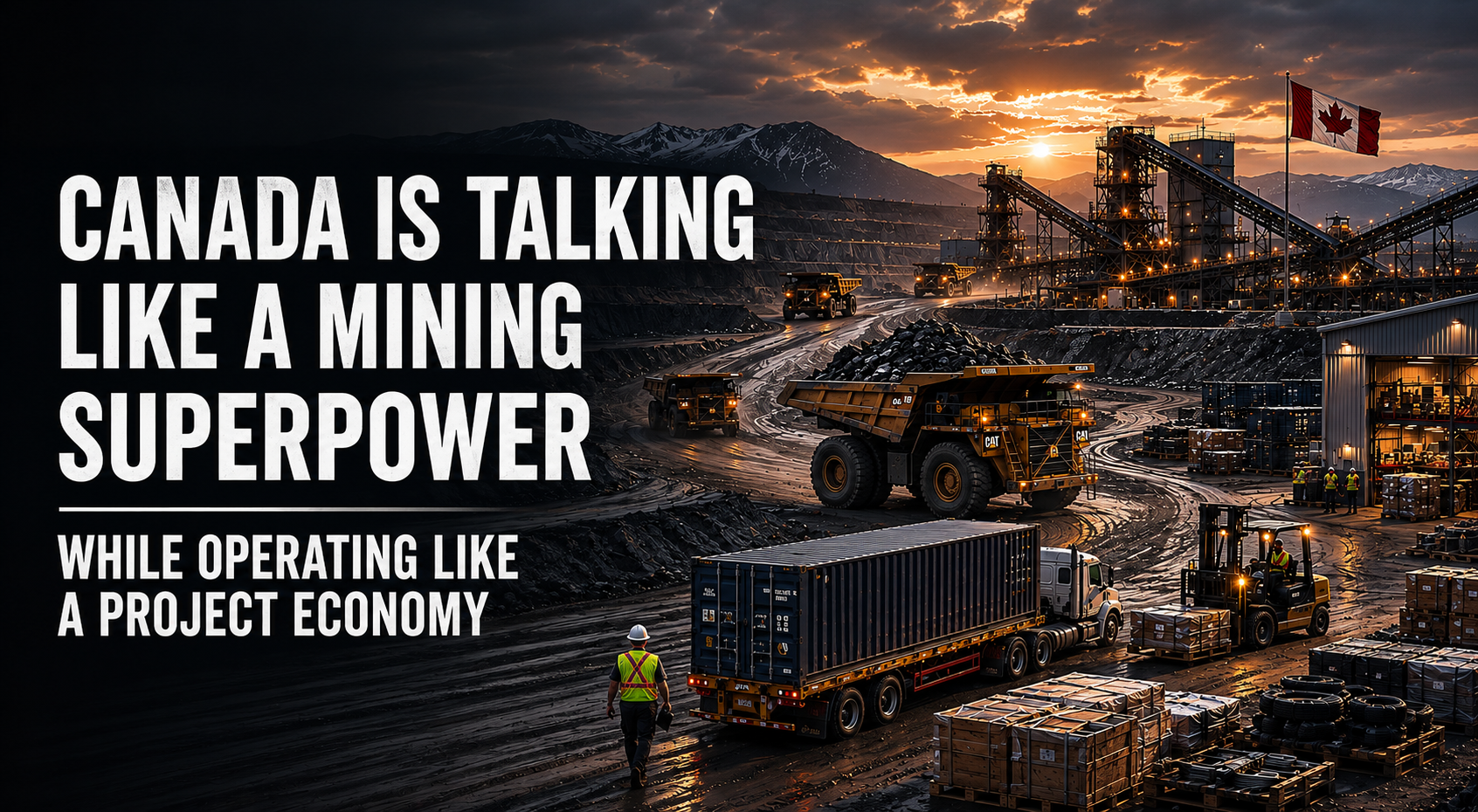
Canada wants to become a critical minerals superpower.
The language is now everywhere.
Industrial sovereignty. Critical minerals. Defence readiness. Domestic capacity. Strategic infrastructure. Energy transition. Supply chain resilience. Buy Canadian. National security.
Governments are announcing funding. Mining companies are accelerating projects. Defence procurement is being repositioned. Infrastructure spending is increasing. Provincial and federal leaders are speaking more openly about the importance of domestic industrial capability and secure supply chains.
On paper, the ambition is enormous.
The problem is that ambition alone does not create industrial strength.
Execution does.
And Canada still behaves far more like a project economy than an operational one.
That distinction matters more than most leaders currently realize.
A project economy focuses heavily on announcements, approvals, financing, construction starts, and capital deployment. An operational economy focuses on the systems required to sustain execution after the project becomes real.
That means contractor readiness.
Warehouse maturity.
Shutdown capability.
Maintenance integration.
Long-lead visibility.
Inventory governance.
Procurement discipline.
Supplier resilience.
Operational cadence.
Logistics stability.
And leadership teams capable of governing complexity long after commissioning pressure fades.
Canada talks confidently about scaling mining, industrial infrastructure, and critical minerals production.
But many of the operational systems underneath that ambition remain fragile, reactive, fragmented, and structurally underdeveloped.
That contradiction is becoming impossible to ignore.
Critical Minerals Are Not a Strategy Without Operational Capability
The global demand story is real.
Copper, nickel, lithium, cobalt, graphite, uranium, and rare earth elements are increasingly tied to electrification, semiconductor manufacturing, energy infrastructure, battery production, military systems, and industrial security.
Canada possesses enormous geological advantages.
That part of the conversation is not controversial anymore.
What remains under-discussed is whether Canada possesses the operational maturity required to convert geological potential into stable long-term industrial capability.
Those are not the same thing.
A country can possess extraordinary mineral reserves while still struggling operationally.
Mining companies can secure financing while still lacking contractor readiness.
Projects can receive approval while still carrying enormous logistics exposure.
Processing facilities can begin construction while the operational systems underneath them remain immature.
That is the danger of project-economy thinking.
The industry often behaves as though the moment capital is secured, readiness automatically follows.
It does not.
A mine does not become stable because the construction phase is complete.
In many cases, instability is only beginning.
Once production starts, the operation must suddenly sustain:
- contractor ecosystems,
- maintenance execution,
- warehousing discipline,
- inventory governance,
- procurement maturity,
- logistics reliability,
- shutdown readiness,
- operational planning,
- and Supply Chain coordination under continuous production pressure.
That transition exposes weaknesses brutally.
And many Canadian mining projects are still underestimating how difficult operational stabilization actually is.
Procurement Is Quietly Becoming a Sovereignty Issue
One of the most important changes happening in Canada right now is that procurement itself is beginning to move beyond simple cost optimization.
It is increasingly being discussed as a national capability issue.
That shift matters enormously.
Recent discussions from voices like @Ali Aboudaya have started framing procurement and capital allocation as sovereignty infrastructure rather than merely sourcing exercises.
Canada’s Financial Sovereignty at Risk in Procurement Decisions
At the same time, Canada’s evolving defence procurement discussions are now emphasizing domestic industrial participation, contractor readiness, and resilient supply capability rather than purely lowest-cost acquisition models.
@Glen Lynch recently highlighted this shift clearly in his discussion around Canada’s changing defence procurement environment.
Canada is Reshaping Defence Procurement — and Canadian Industry Must Adapt
The mining industry should be paying very close attention.
Because critical minerals are increasingly being pulled into the same strategic framework.
Once that happens, operational fragility stops being merely a company problem.
It becomes a national resilience problem.
Long-lead exposure becomes a resilience problem.
Supplier concentration becomes a resilience problem.
Emergency freight dependence becomes a resilience problem.
Contractor scarcity becomes a resilience problem.
Weak domestic manufacturing capacity becomes a resilience problem.
This is where the conversation starts changing fundamentally.
Mining is no longer just about extraction economics.
It is becoming infrastructure strategy.
Canada Is Still Underestimating Operational Readiness
This is where the discussion becomes uncomfortable.
Canada is aggressively discussing mining expansion while many organizations still operate with weak readiness architecture underneath them.
The warning signs are already visible across the sector.
Contractor shortages continue intensifying across Western Canada.
Long-lead equipment exposure remains severe.
Rail and freight reliability remain vulnerable.
Warehouse maturity varies dramatically between operations.
Shutdown governance is inconsistent.
Inventory strategies are often reactive.
Operational planning quality fluctuates heavily site-to-site.
ERP trust collapses surprisingly quickly once inventory integrity weakens.
Emergency procurement behavior becomes normalized far too easily.
These are not isolated operational irritants.
They are indicators of industrial fragility.
Many organizations still treat operational readiness as something tactical that can be solved later once production ramps stabilize.
That mindset is deeply dangerous.
Operational readiness is not the final phase of industrial development.
It is the foundation underneath it.
Without mature operational systems, scale itself becomes destabilizing.
This is one of the core realities the mining industry still struggles to confront honestly.
A mine can survive instability temporarily through effort, heroics, and workarounds.
A country attempting to scale industrial capability cannot.
Canada Still Thinks Like a Construction Economy
This may be the most important issue in the entire discussion.
Canada remains exceptionally strong at discussing projects.
Announcements receive attention.
Approvals receive attention.
Funding receives attention.
Capital deployment receives attention.
Construction milestones receive attention.
Operational maturity rarely receives the same level of scrutiny.
That is one of the defining characteristics of project economies.
The conversation remains heavily concentrated on getting projects approved and built rather than governing the systems required to operate them reliably for decades.
Mining exposes this weakness faster than most industries because mines are not passive infrastructure assets.
They are continuously stressed operational systems.
Once production begins, instability starts revealing itself quickly.
Shutdowns become more difficult than anticipated.
Contractor overlap creates coordination failures.
Critical spares become harder to govern.
Warehouse trust weakens.
Maintenance teams begin compensating for inventory uncertainty.
Emergency freight starts increasing.
Long-lead exposure compounds.
Supplier dependency becomes concentrated.
Planners begin working around ERP limitations.
Supervisors quietly create hidden inventory because operational trust has deteriorated.
Most organizations do not recognize this as systemic instability at first.
They interpret it as operational growing pains.
But over time, these conditions accumulate into something much larger.
Readiness debt.
Readiness Debt Is Becoming a National Industrial Problem
In mining, readiness debt accumulates when operational growth outpaces operational discipline.
That same dynamic is now emerging nationally.
Canada is scaling industrial ambition faster than many supporting systems are maturing underneath it.
The pressure points are increasingly visible:
- contractor depth limitations,
- skilled labour competition,
- northern logistics exposure,
- warehousing capacity,
- procurement complexity,
- domestic manufacturing dependence,
- infrastructure bottlenecks,
- regional supplier immaturity,
- and long-lead vulnerability across critical categories.
The danger is not that Canada lacks resources.
The danger is assuming resources automatically create readiness.
They do not.
Industrial capability is not geology.
It is governable execution.
This is where many mining organizations still misunderstand operational maturity completely.
A project may appear successful externally while carrying severe readiness instability internally.
Construction milestones may be achieved while operational systems remain weak.
Production may technically begin while warehousing remains unreliable.
Contractors may be mobilized while scope governance remains fragmented.
ERP systems may exist while nobody fully trusts the data.
Inventory may increase while operational confidence declines.
These are not isolated operational issues anymore.
At scale, they become national industrial weaknesses.
The Operational Reality Nobody Likes Talking About
Most mining organizations still underestimate how fragile operations become once trust in systems starts eroding.
This usually begins quietly.
A warehouse count is inaccurate.
A critical spare cannot be located quickly.
A shutdown material package arrives incomplete.
A planner discovers lead times are unreliable.
An emergency vendor bypasses normal governance.
A contractor mobilizes before scope clarity is complete.
An expedite becomes necessary.
Then another.
Then another.
Eventually, emergency behavior becomes normalized.
That is the turning point.
Because the organization is no longer operating through planning.
It is operating through compressed recovery cycles.
The mine starts surviving through heroics instead of systems.
Supervisors hoard material.
Shadow inventory appears.
Maintenance teams stop trusting ERP availability.
Duplicate purchasing increases.
Emergency freight rises.
Contractor coordination weakens.
Warehouse credibility deteriorates.
Operational meetings become reactive.
Leadership often interprets this as urgency.
It is usually readiness debt finally becoming visible.
That distinction matters enormously.
Because urgency suggests unpredictability.
Readiness debt suggests the instability was accumulating for a long time before leadership recognized it.
Most Operational Failures Are Not Sudden
This is one of the hardest truths for mining leadership to accept.
Most operational failures are not sudden.
A shutdown package missing materials three days before execution is not sudden.
Emergency freight is not sudden.
Contractor standby is not sudden.
A planner discovering inventory inaccuracies during execution is not sudden.
A critical spare unavailable during a breakdown is not sudden.
These are usually delayed consequences of decisions, governance failures, weak planning discipline, contractor ambiguity, or warehouse instability that existed long before the visible failure occurred.
The mine is simply collecting interest on operational debt accumulated over months or years.
That is why operational readiness matters so much more than most organizations currently admit.
Because operational instability compounds quietly until scale finally exposes it.
And scale is exactly what Canada is now pursuing aggressively.
This Is Where Operational Methodology Matters
One of the biggest problems in mining today is that too many organizations still discuss operational excellence conceptually instead of mechanically.
They speak about resilience.
They speak about readiness.
They speak about transformation.
But they rarely explain how operational instability is actually identified, governed, and stabilized inside real mining environments.
That is where methodology matters.
When we assess operational readiness exposure inside mining organizations, we do not begin with procurement transactions.
We begin with operational consequence.
We identify:
- production bottlenecks,
- critical assets,
- maintenance-sensitive systems,
- sole-source vendors,
- long-lead exposure,
- shutdown-critical material flows,
- contractor dependency,
- logistics vulnerability,
- and warehouse integrity risk.
Then we map where operational latency actually exists.
Where does demand originate?
How long do approvals really take?
Where does procurement stall?
Where do logistics bottlenecks appear?
How much warehouse delay exists?
Where does staging fail?
How late are readiness issues becoming visible?
This process exposes something extremely important very quickly.
Most unstable operations are compensating through human effort rather than stable systems.
That distinction changes the entire conversation.
Because if operational continuity depends on tribal knowledge, informal workarounds, hidden inventory, relationship-based vendor recovery, and specific individuals constantly rescuing the operation, then the organization does not actually possess readiness stability.
It possesses temporary survival capability.
Those are not the same thing.
Canada’s Real Competitive Advantage Will Not Be Geology Alone
This is where the conversation ultimately lands.
Canada absolutely possesses world-class mineral potential.
But geology alone will not determine who dominates critical minerals over the next twenty years.
Operational governability will.
The countries that succeed will be the ones capable of:
- stabilizing contractor ecosystems,
- governing operational complexity,
- building resilient procurement systems,
- strengthening warehouse maturity,
- controlling long-lead exposure,
- integrating Supply Chain into operational readiness,
- and sustaining execution under pressure without collapsing into reactive management.
That is a completely different competency than simply approving projects.
And right now, too much of Canada’s industrial conversation still sounds like a construction economy talking about scale while underestimating the operational systems required to sustain it.
The Real Question
Canada wants to behave like a critical minerals superpower.
The geology supports that ambition.
The question is whether the operational systems underneath the ambition are mature enough to sustain it.
Because critical minerals alone do not create industrial strength.
Governable execution does.
And until Canada begins treating operational readiness, procurement maturity, contractor governance, warehouse discipline, and Supply Chain resilience as strategic infrastructure rather than administrative support functions, the country will continue carrying a dangerous gap between industrial ambition and operational capability.
A country cannot scale industrial ambition faster than its operational systems can support.
That may become one of the defining industrial lessons of the next decade.
#Mining #CriticalMinerals #SupplyChain #OperationalReadiness #MiningLeadership #Procurement #IndustrialStrategy #CanadianMining #MineOperations #DefenceProcurement #AssetManagement #IndustrialOperations