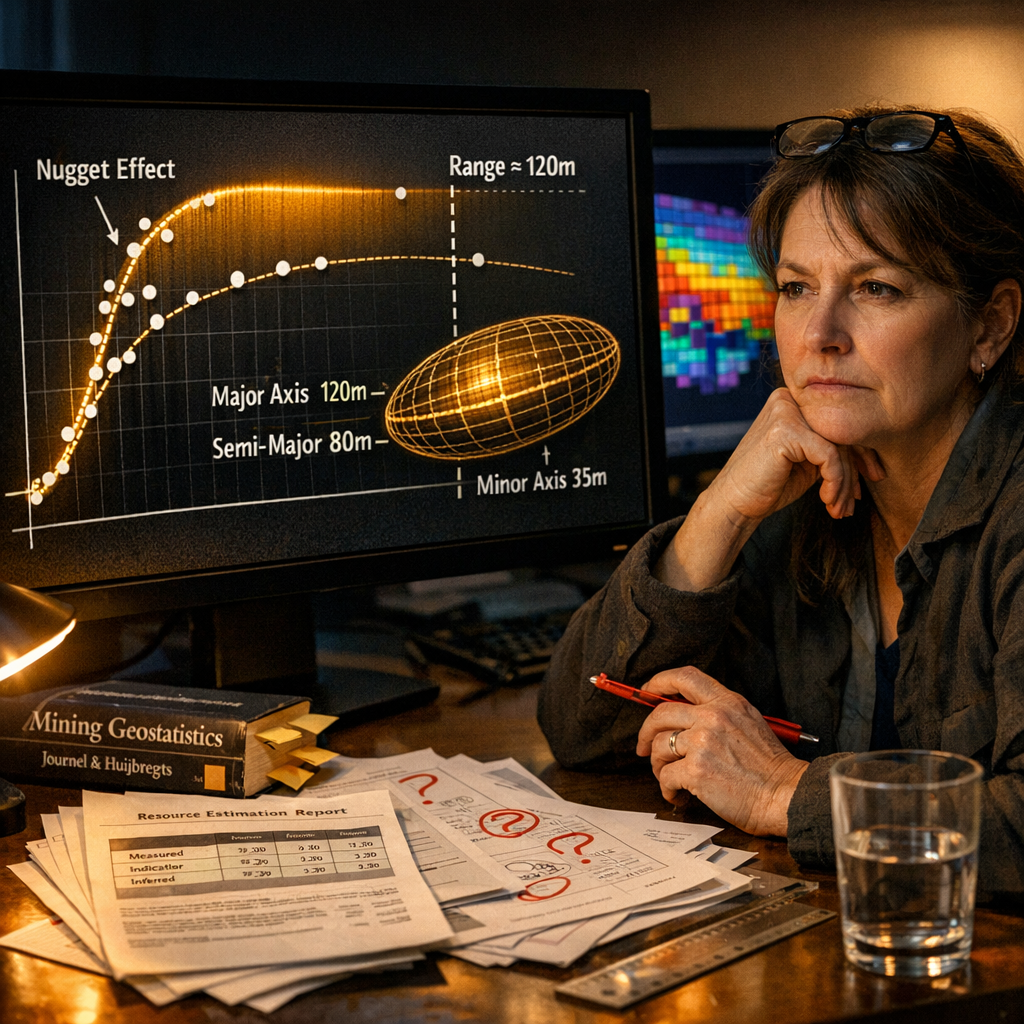
If a mine underperforms persistently relative to the reserves it holds, capital will be eroded and the operation will be subject to stoppages. Such a phenomenon happens more often than the industry would like to admit, and the science of geostatistics, which underlies all current ore estimations, quite often finds itself at the center of the debate. The issue at hand is whether the science itself is at fault or if the cultural context within which it has been used has created an unsafe degree of overconfidence.
Geostatistics, which emerged as a discipline in the 1950s and 1960s with the works of Danie Krige and Georges Matheron, revolutionized the way ore estimations were made by the application of the principles of spatial statistics, which include variograms, kriging, and conditional simulation. The traditional method of rough polygonal estimations gave way to more auditable models with the advent of geostatistics, which forms the basis for the current international codes of reporting, such as the JORC and NI 43-101 codes.
The problem lies not with the mathematics, but with the interpretation and communication of the results. There are a number of structural flaws that go unrecognized on a routine basis. For instance, the nature of the kriging interpolation technique inherently smooths the grade distribution, which minimizes extremes and promotes the illusion of uniformity, potentially misleading the mine planners with respect to the actual mill feed grades.
The variogram models, which define the spatial continuity, are typically developed from limited exploration data and rarely have ranges that reflect the true uncertainty of the model. Additionally, the majority of the methodologies assume geological stationarity within a defined domain, which is not always the case with real orebodies.
Another factor contributing to the overall problem is the inherent “black box” effect associated with the more sophisticated software packages that have made the kriging process more accessible to practitioners who have little idea of the underlying assumptions. The statistics produced by the sophisticated software have a “aura of scientific authority” that the polygon sketch would have never enjoyed.
Reconciliation studies, defined as the comparison of estimated grades against actual mined production, have consistently identified systematic biases. Both academic and review literature suggest that grade overestimation is a major problem, particularly for ore bodies where there is a large nugget effect, e.g., gold. These differences are not trivial rounding errors but rather represent multimillion-dollar misallocations of capital and erosion of investor confidence.
This proposed method does not involve discarding geostatistics, as alternative methods are found to perform suboptimally. Rather, the solution lies in changing the culture of geostatistics. Some of the reforms that can be made include the requirement for reconciliation reporting, the need for transparent communication of the range of estimation uncertainties, the requirement for conditional simulations in place of kriged estimates, and education. Uncertainties should be presented as an integral component rather than as a limitation.
It has not been the failure of geostatistics for the mining industry, but the failure of the industry to utilize it with the right degree of transparency. The end effect of utilizing a powerful tool without the right degree of transparency regarding the limitations of the tool will not be the achievement of precision, but the achievement of precision with a sense of overconfidence.