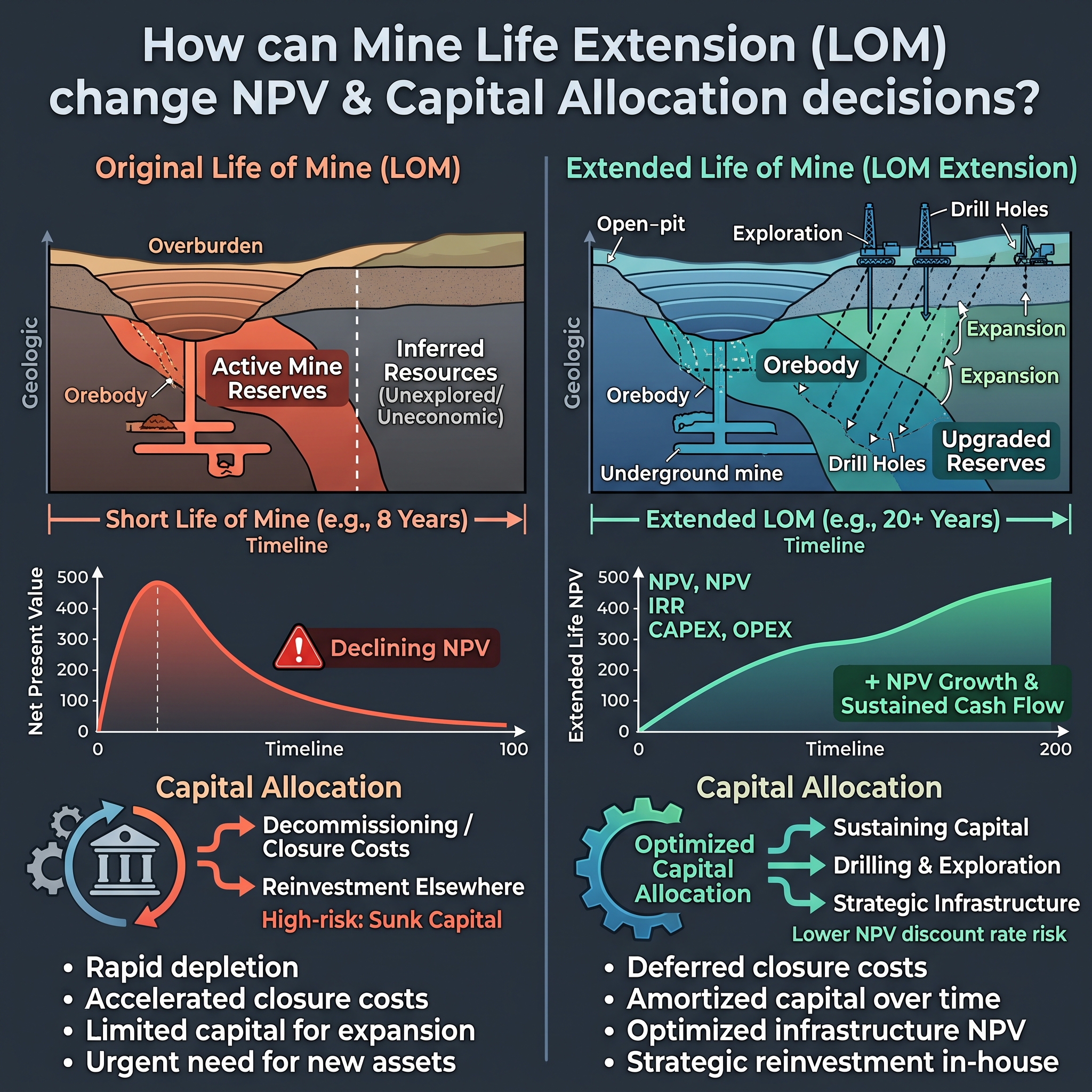


Traditional net present value (NPV) and discounted cash flow models naturally favor rapid ore extraction because the time value of money heavily discounts cash flows in distant years. This valuation bottleneck often creates a strategic bias toward aggressive short-term resource depletion. However, mine life extension has emerged as a vital financial lever in modern mineral economics. A comprehensive re-evaluation of extended operations through tailored discount rates, brownfield capital efficiency, and real option analysis fundamentally alters how mining corporations compute total project value and deploy capital across commodity cycles.
Conventional valuation frameworks apply fixed discount rates across the entire operational timeframe of a mine. These static rates disproportionately penalize cash flows generated in later years, effectively understating the total worth of long-life mineral assets. Lower, risk-adjusted discount rates applied to mature, de-risked operations unlock substantial net present value that static corporate hurdle rates obscure. Furthermore, operational adoption of break-even or operating-cost cut-off grades enables mining companies to extract lower-grade ore economically over extended periods. For instance, discount rate reductions directly expand economic reserves in block caving projects by transforming marginal footprint columns into viable reserves. Operational longevity also eliminates the massive upfront capital expenditure required to discover, permit, and construct replacement greenfield mines.
Capital allocation strategies across the mining sector have increasingly prioritized brownfield development over high-risk greenfield expansion. Brownfield extensions and debottlenecking projects consistently yield higher risk-adjusted returns and lower capital intensity than new mine construction. Modern capital frameworks require life extension projects to compete directly against alternative capital deployment options, such as share buybacks, dividends, and corporate acquisitions. Centralized capital prioritization ensures that investments achieve superior returns on capital employed while protecting corporate balance sheets. Moreover, life extension initiatives maximize return on historic capital expenditure by fully leveraging established processing plants, tailings facilities, and logistics networks.
Standard net present value calculations often fail to account for managerial flexibility across changing market environments. Real options valuation resolves this limitation by pricing the strategic capability to defer expansion, alter throughput, or process stockpiled ore during commodity price rallies. Multi-stage mine planning further enhances operational flexibility by structuring ore extraction into distinct sequential phases. Careful management of overburden placement and underground development preserves long-term extraction upside without inflating current operating expenditures. Scenario analysis combined with dynamic risk management protects cash flow stability throughout volatile commodity downcycles.
Mine life extension represents far more than a simple operational achievement; it functions as a transformative strategic and financial tool. Executives enhance corporate capital productivity and reduce portfolio volatility when they treat net present value as a dynamic decision system. Tailored discount rates, brownfield capital efficiency, and real options valuation allow resource leaders to balance immediate cash returns with long-term asset value.