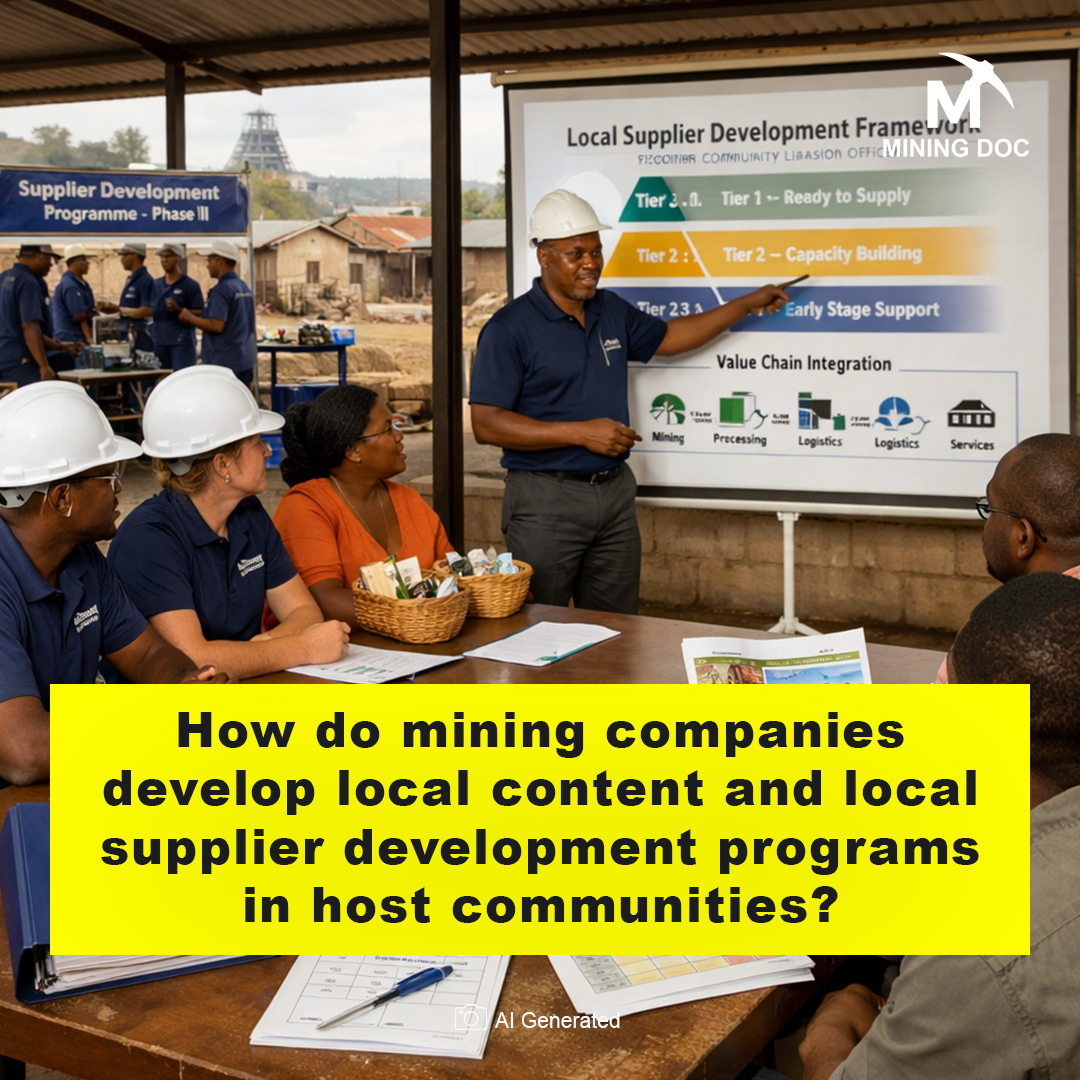
The term “local content” in the mining sector means the level at which economic activities relating to mining create value within the host country’s economy, and there are three types of local content: geographical content (creating benefits for communities surrounding mining operations), value-added content (domestic manufacturing or providing services), and ownership/content. Supplier development in mining is an initiative by mining firms where they systematically identify, develop, and procure goods and services from the local firms, thereby enabling them to meet the safety, quality, and cost requirements of the mining industry.
The process through which mining firms foster local content includes carrying out a detailed assessment of their supply chains in order to determine what goods and services can be procured locally and those which have to be imported from other countries. The next step entails setting up of local procurement targets like what has been done in Zambia where mining firms are obliged to source a minimum of 20% of all core mining goods and services from locally-owned companies.
Supplier development entails implementation of programs for building capacities where capability needs to be filled within the community’s businesses. The mining company provides technical assistance, quality assurance and safety training, mentoring as well as financing via partnership with microfinance institutions or credit guarantees. For instance, Newcrest Mining created a training and development center in Lihir in Papua New Guinea where training is done to build capabilities required in mining while at the same time creating microfinance programs for women from the nearby villages. Such programs involve business development services where local suppliers are made aware of how the mining procurement process works.
Mining companies create a systematic way of engaging with local businesses using the following approaches: establishing of databases for the suppliers, conducting pre-qualification for the local suppliers as well as having regular meetings with them. Preferential procurement policies are developed by companies giving priority to the local suppliers whenever the safety, quality as well as pricing issues are all met, such as the Mining Act of the Philippines. Many mining companies have established local content offices or have appointed local content managers.
The concept of infrastructure sharing is yet another important approach where mining firms make use of infrastructure set up for their operations, such as roads, power stations, water facilities, and communication links, to the advantage of the local community and enterprises. Through this, there exist horizontal linkages as other industries can take advantage of capabilities set up for mining firms. Vertical linkages are created through downstream linkages involving mineral processing within the country for export purposes.
The successful development of local content depends on the establishment of long-term collaborations between various stakeholders, which include government institutions, local landowner associations, community groups, and industry bodies. Firms track the performance of local content using transparency tools that include the rates of local employment, local procurement expenditures, number of developed suppliers, and skill transfers. The practice enhances the social license to operate of the mining firm, promotes industrial growth, and creates sustainable economic prospects in the host community even after the closure of the mining operation. The best-performing programs rely both on mandatory provisions and “softer” capacity building initiatives.