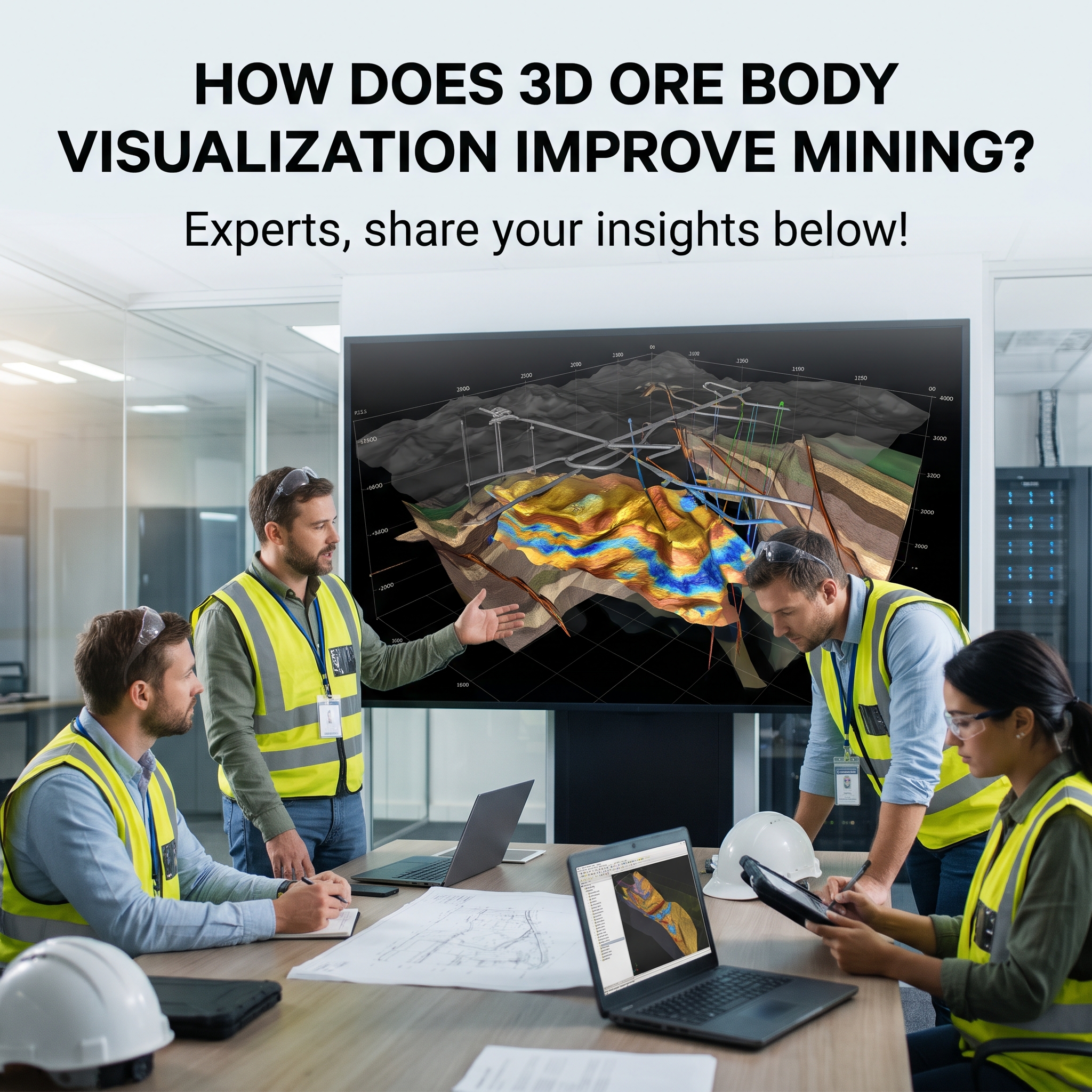


The modern extractive sector faces substantial hurdles due to deep structural complexity, escalating geological uncertainty, and vast subsurface datasets. Traditional evaluation workflows relied heavily on static two-dimensional cross-sections and manual wireframing, which introduced human bias and struggled to accommodate dynamic operational updates. Subsurface characterisation has consequently migrated toward advanced three-dimensional ore body visualisation and implicit digital twins. These interactive computational frameworks synthesise disparate drilling, structural, and geophysical measurements into continuous spatial architectures. Ultimately, three-dimensional geological visualisation enhances resource delineation, eliminates interpretive subjectivity, and establishes a robust empirical foundation that directly de-risks excavation, protects personnel, and drives operational longevity.
Modern resource assessment demands the seamless synthesis of core logs, structural mapping, and geophysical inversions into unified digital deposits. Mathematical interpolation algorithms, notably radial basis functions, automate geological boundary generation while removing practitioner subjectivity from grade shell construction. Engineers leverage these robust spatial geometries to evaluate cut-off scenarios, optimise stope sequences, and generate block models with unprecedented computational speed. Furthermore, the incorporation of measure-while-drilling records and production sampling establishes a dynamic closed-loop reconciliation environment. Operations adjust drilling patterns and blast designs in response to localized grade variations, preventing unnecessary ore dilution and mitigating costly processing of barren waste material.
Subsurface operations inherently present severe geotechnical hazards, including catastrophic slope failures, rockbursts, and underground roof collapses. High-resolution spatial models illuminate discontinuous fracture networks, shear zones, and lithological weaknesses, allowing geotechnical specialists to conduct rigorous kinematic analyses and stress simulations. Heavy surface infrastructure, such as primary crushers and tailings storage facilities, is consequently positioned upon verified competent ground. Concurrently, three-dimensional visual platforms enhance subsurface ventilation planning by accurately projecting airflow resistance, heat dissipation, and airborne contaminant dispersion. Virtual reality interfaces also allow personnel to rehearse emergency egress routes and operate automated extraction equipment remotely, removing workers from hazardous production faces.
Sustainable resource management relies on the complete recovery of economic minerals accompanied by the systematic reduction of environmental disturbance. Precise grade delineations support selective extraction strategies, which prevent unnecessary rock displacement and diminish downstream haulage expenses. Reduced material transport directly decreases diesel fuel consumption, while accurate rock hardness data allows processing facilities to adjust comminution circuits, significantly curbing electrical power demand. Detailed hydrological visualisations additionally map subterranean aquifers and groundwater migration pathways, facilitating efficient dewatering and water recycling regimes. Ultimately, accurate volumetric forecasting enables companies to design compact tailings facilities, accelerating progressive land reclamation and long-term ecological rehabilitation.
Three-dimensional ore body visualisation has progressed from a simple descriptive medium into a mission-critical digital twin that steers daily mine operations. Subsurface complexity and diminishing ore grades require unprecedented analytical agility, which legacy two-dimensional techniques cannot deliver. Advanced spatial models bridge the historical divide between exploration geologists and production engineers by uniting mathematical interpolation with real-time operational feedback. This holistic visual architecture eliminates personal interpretive bias, fortifies structural integrity, and drastically reduces ecological footprints through targeted material extraction. Modern resource enterprises that embrace continuous subsurface visualization attain superior operational resilience, combining commercial profitability with stringent environmental and human safety standards.