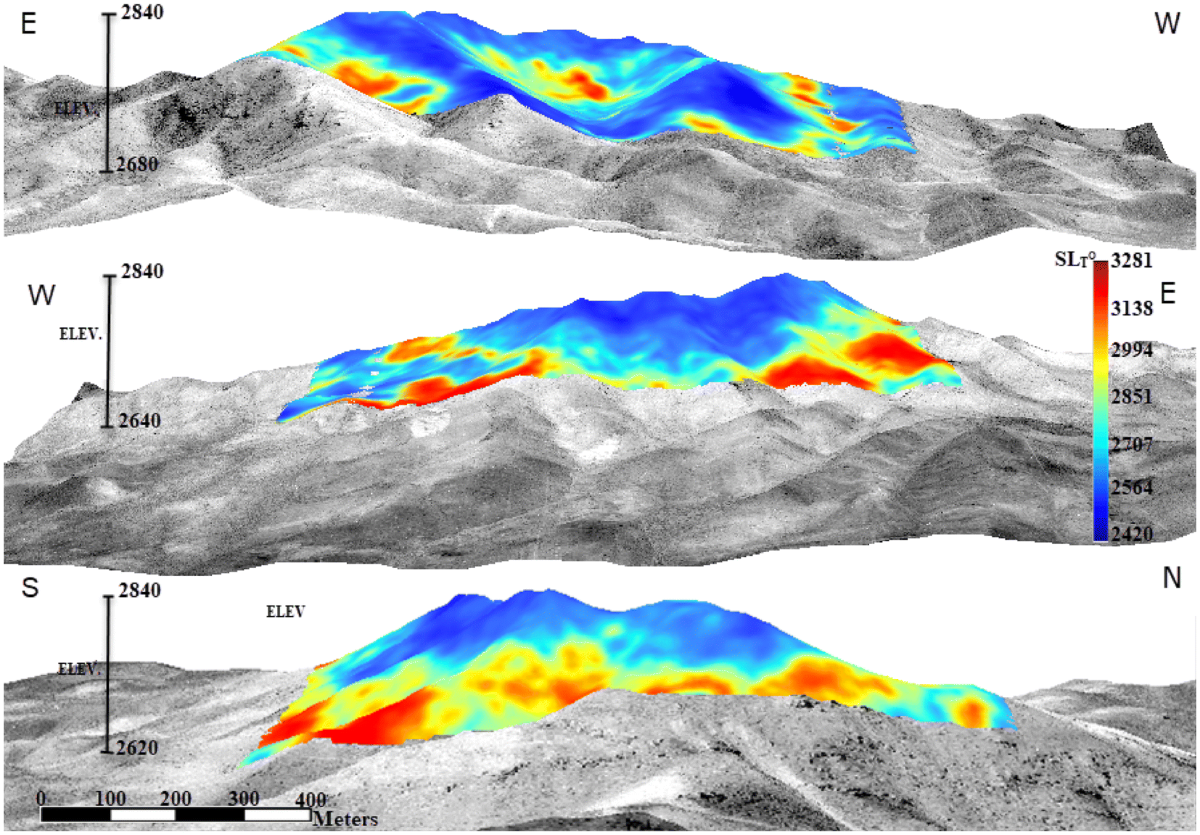
In economic geology and estimation of mineral resources, it is imperative to be able to separate hypogene mineralization from supergene enrichment blanket. Hypogene or primary mineralization is that kind of ore which formed from hot fluid emanated from magmas deep within the Earth’s crust. On the other hand, the supergene enrichment blanket is basically a secondary zone which forms when these primary ores are subjected to weathering and dissolution by flowing rainwater and then reprecipitated at the permanent ground water table.
The processes responsible for these geological formations have unique features as well. The hypogene zone is always associated with the high temperature and enormous pressure conditions at which such rocks are formed (Nopeia et al., 2023). In contrast, enrichment processes are essentially low-temperature weathering phenomena. As the downward percolating meteoroic waters cause oxidation of the primary sulfide minerals, the metal components dissolve in solution and move down. Then, due to exposure to the reducing environment, the metals precipitate, forming a highly concentrated zone of valuable elements.
Indeed, it is possible to distinguish these two areas due to the mineral composition as it is the easiest way. The mineral composition of hypogene zones is dominated by unaltered base metal sulfides including chalcopyrite, bornite, and pyrite, as they had been precipitated within deep underground conditions (Louha et al., 2021). In addition, it should be noted that the composition of the secondary enrichment area includes secondary minerals only. Depending on the degree of oxidation and location, they may range from secondary sulfides (chalcoctite, covellite) to oxide and metallic ore species (Silyanov et al., 2021).
In resource estimation, the distinction is crucial since both mineral horizons are quite different regarding metal ore grades and metallurgy. The reason for the higher metal content in the supergene mineralization is that the enrichment happens during long-term geological processes of both residual and absolute chemical concentration for millions of years (Athayde Pinto et al., 2015). Moreover, there is quite a significant difference in terms of extraction techniques for supergene oxides and primary mineralization. The former requires only an efficient heap leaching, but the latter needs a complicated and costly processing plant in terms of flotation circuit installation.
Therefore, it is inevitable that current geostatistical modeling will require the segregation of both mineral zones. In the block model estimators should see supergene mineralization and primary mineralization as different geostatistical populations; otherwise, it would make estimations inaccurate. In modern grade control, the transition zone is estimated with hyperspectral imaging technologies (Akbar et al., 2024).
In summary, the differentiation between primary and supergene enrichment blankets in geology is fundamental in mineral resource estimation. It is essential to distinguish the different geological zones by considering specific mineral content and behavior for accurate modeling. Correct classification will prevent any mistakes in geostatistical interpolation that will allow mine engineers to optimize processing according to every zone.
References
Akbar, S., Abdolmaleki, M., Ghadernejad, S., & Esmaeili, K. (2024). Applying knowledge-based and data-driven methods to improve ore grade control of blast hole drill cuttings using hyperspectral imaging. Remote Sensing, 16, 2823. https://doi.org/10.3390/rs16152823
Athayde Pinto, C. d., Paradella, W. R., Mura, J. C., Gama, F. F., Ribeiro dos Santos, A., Silva, G. G., & Hartwig, M. E. (2015). Applying persistent scatterer interferometry for surface displacement mapping in the Azul open pit manganese mine (Amazon region) with TerraSAR-X StripMap data. Journal of Applied Remote Sensing, 9, 095978. https://doi.org/10.1117/1.jrs.9.095978
Louha, H., Balassone, G., Boutaleb, A., Boni, M., Joachimski, M. M., & Mondillo, N. (2021). The Pb-Zn (Ba) nonsulfide mineralizations at Bou Caïd (Ouarsenis, Algeria): Mineralogy, isotope geochemistry, and genetic inferences. Minerals, 11, 687. https://doi.org/10.3390/min11070687
Nopeia, M., Imai, A., Takahashi, R., Yonezu, K., Manalo, P., Tindell, T., Sato, H., Jamal, D., & Agangi, A. (2023). Geology and geochemistry of gold mineralization at the Namicupo prospect, Mozambique Belt, northeastern Mozambique. Journal of Geochemical Exploration, 249, 107220. https://doi.org/10.1016/j.gexplo.2023.107220
Silyanov, S. A., Sazonov, A. M., Zvyagina, Y. A., Savichev, A. A., & Lobastov, B. M. (2021). Gold in the oxidized ores of the Olympiada deposit (Eastern Siberia, Russia). Minerals, 11, 190. https://doi.org/10.3390/min11020190