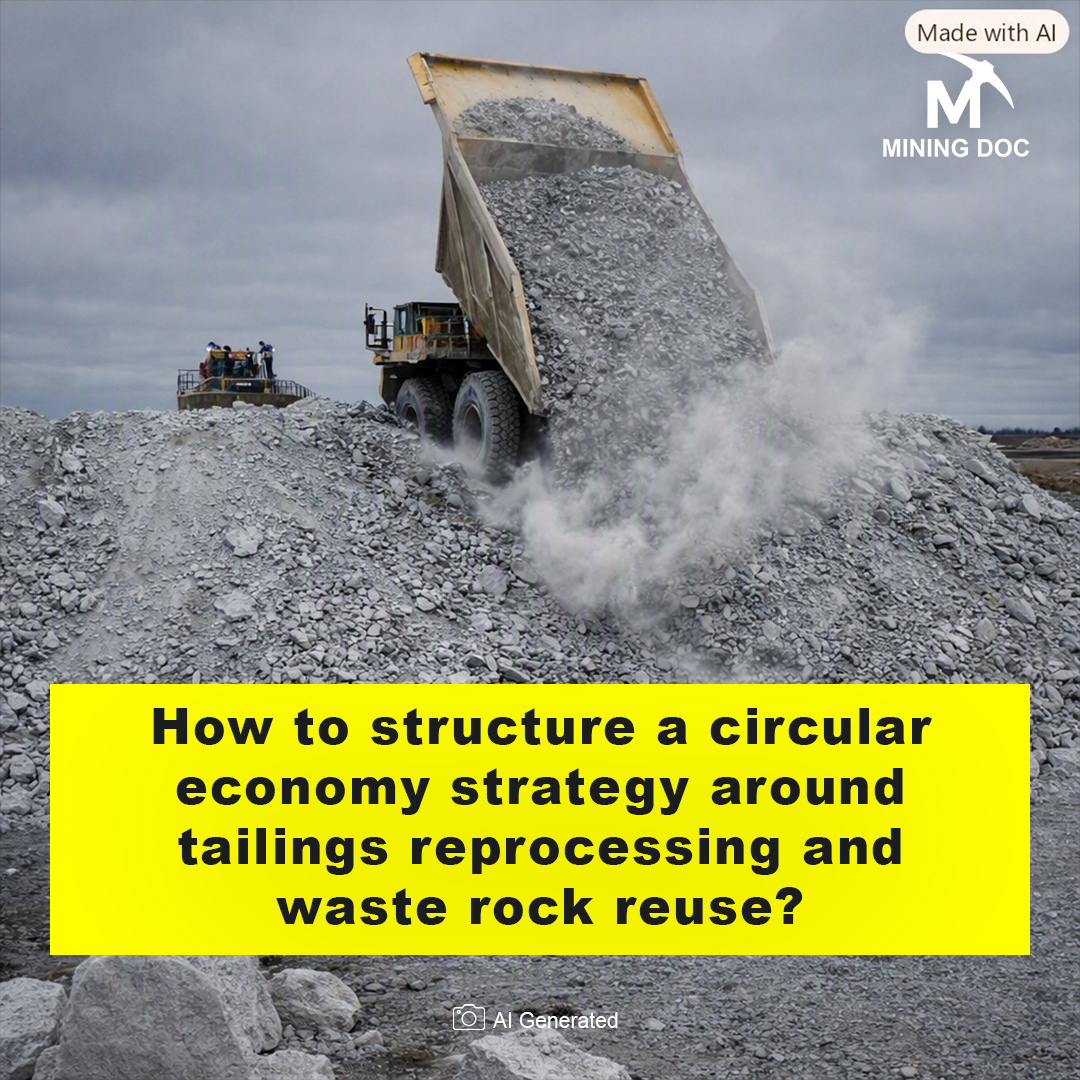
The evolution of sustainable mining requires a paradigm shift from the conventional linear approach to the circular economy. In the mining industry, the concept of circular economy is defined as a system which seeks to eliminate waste and perpetually reuse resources with a view to aligning economic development with environmental preservation (Antony Jose et al., 2024). There are two major terms that deserve to be discussed within the context of the concept: tailings and waste rocks. While tailings are defined as fine slurry residues resulting from the separation of minerals from the ore, waste rocks are represented by the rocks excavated to expose the ore body. These residues were previously viewed as liabilities but have recently gained recognition as deposits of secondary resources.
There are two major driving factors for building a circular economy strategy based on these wastes. First, while tailings dams are associated with risks like catastrophic collapses and pollution of underground water resources, second, the energy transition witnessed on a global scale has brought about the need for critical minerals. Thus, the application of a circular economy to the processing of mine tailings will enable the mitigation of the ecological risk and overcoming the supply bottleneck through the use of secondary minerals (Chowdhury & Talan, 2025).
Circular strategies that have built-in resilience begin with the recycling of tailings from mines to extract any remaining metals. Improvements in mining processing, such as hydrometallurgical leaching and bioleaching techniques, have made it easier to extract essential raw materials from old sources. Some examples include tailings that could be recycled again to obtain some copper, cobalt, and rare earth metals (Kinnunen et al., 2022). Through the adoption of such strategies, the mines will become less dependent on mining fresh ores thus sparing geological sources of these materials.
Apart from metallurgical methods of material recovery, reusing tailings that are benign as well as waste rock forms one of the core pillars of the strategy. These substances that have been depleted of toxic metals through leaching can be recycled as aggregates for road construction in case of waste rock or silicates in tailings used for brick manufacturing and supplementary cementitious material (Makhathini et al., 2023). In addition, using these materials underground as a backfill for underground mines will help to support the mine voids.
The following measures can be adopted to guarantee success. It will be necessary to conduct systematic assessments of how feasible reprocessing programs are to implement successfully. The cost of the investment needed for reprocessing vast quantities of the mine tailings can be high. As such, it will be imperative to conduct economic assessments to help cope with market uncertainties (Araya et al., 2021). Also, it will be important to conduct life cycle assessments to ascertain that the energy needed for reprocessing doesn’t eliminate the benefits accrued from reducing waste.
To recap, tailings reprocessing and waste rock recycling call for a change in paradigms that involves the utilization of the best technologies, upcycling, and effective economic planning. Recast the mining industry waste into secondary sources of metal is one way of making sure that the industry helps provide the green metal while at the same time minimizing environmental impact. Zero-waste concept requires constant innovation, good regulation, and cooperation from all stakeholders within the industry.
References
Antony Jose, S., Calhoun, J., Renteria, O. B., Mercado, P., Nakajima, S., Hope, C. N., Sotelo, M., & Menezes, P. L. (2024). Promoting a Circular Economy in Mining Practices. Sustainability, 16(24), 11016. https://doi.org/10.3390/su162411016
Araya, N., Ramírez, Y., Kraslawski, A., & Cisternas, L. A. (2021). Feasibility of re-processing mine tailings to obtain critical raw materials using real options analysis. Journal of Environmental Management, 284, 112060. https://doi.org/10.1016/j.jenvman.2021.112060
Chowdhury, M. O. S., & Talan, D. (2025). From Waste to Wealth: A Circular Economy Approach to the Sustainable Recovery of Rare Earth Elements and Battery Metals from Mine Tailings. Separations, 12(2), 52. https://doi.org/10.3390/separations12020052
Kinnunen, P., Karhu, M., Yli-Rantala, E., Kivikytö-Reponen, P., & Mäkinen, J. (2022). A review of circular economy strategies for mine tailings. Cleaner Engineering and Technology, 8, 100499. https://doi.org/10.1016/j.clet.2022.100499
Makhathini, T. P., Bwapwa, J. K., & Mtsweni, S. (2023). Various Options for Mining and Metallurgical Waste in the Circular Economy: A Review. Sustainability, 15(3), 2518. https://doi.org/10.3390/su15032518