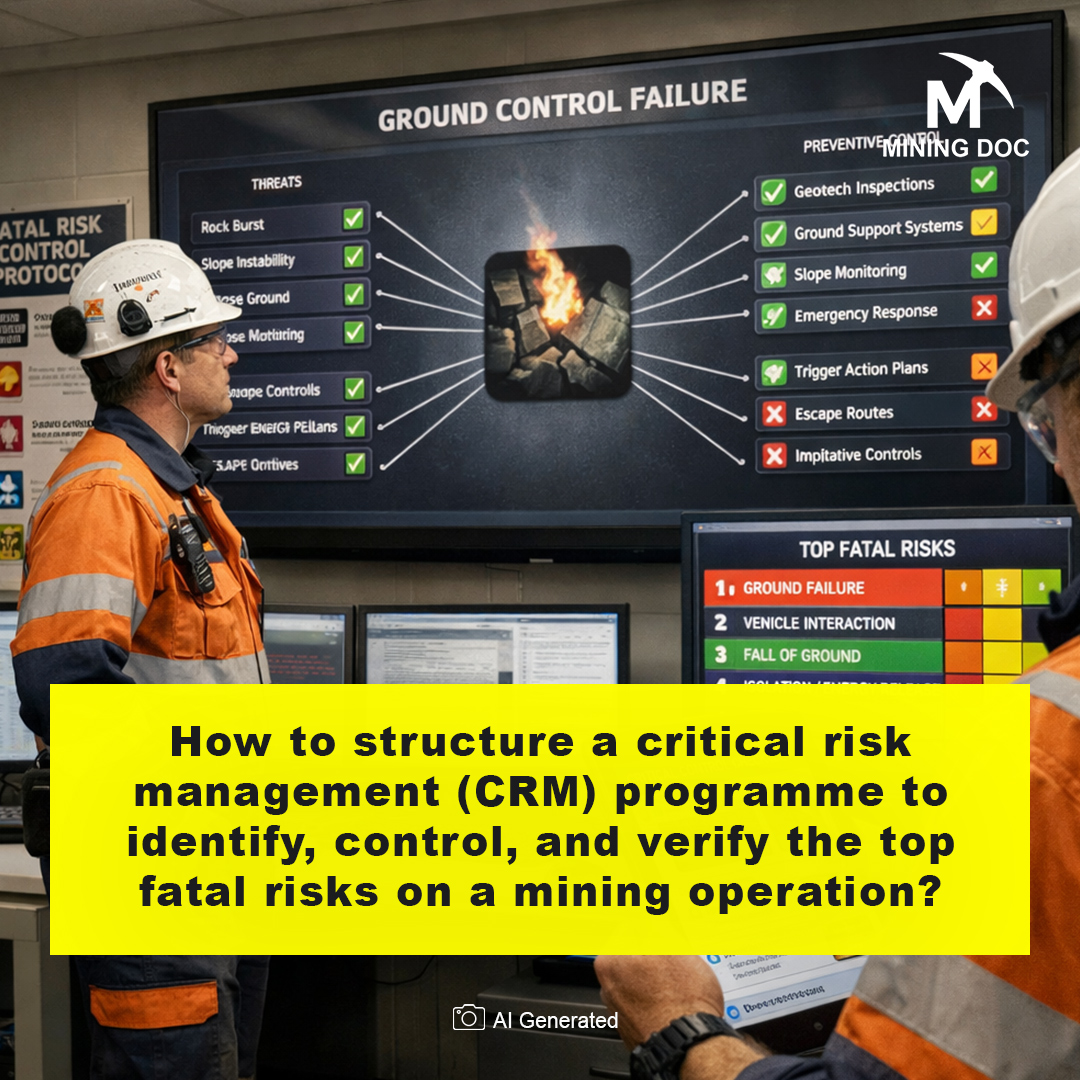
The concept of Critical Risk Management (CRM) is a safety strategy that emphasizes the prevention of catastrophic or life-threatening incidents. Contrary to the conventional assessment approach, CRM centers its attention on risk treatment by determining and validating the effectiveness of critical controls needed to prevent deaths (Selleck et al., 2022). In mining operations, life-threatening risks are high consequence risks that directly affect workers’ lives.
An effective CRM initiative begins with the correct identification of critical risks within a particular site. In mining, these would be high-risk tasks such as powered haulage; it should be noted that haul trucks constitute about 50% of fatalities among miners each year (Bellanca et al., 2021). Through the analysis of historical information and hazard maps, site managers can locate the precise operation sites.
Thus, it is necessary to build critical controls. A critical control is a particular safeguard that prevents any unforeseen energy from being released in order to mitigate consequences (Selleck et al., 2022). The design of critical controls is typically performed using the bow-tie approach, which makes it possible to develop an efficient defense-in-depth system (Selleck et al., 2023). The priority should be given to hardware rather than administrative solutions.
The next step is the implementation of critical controls with the help of rigorous verification of the fact that all measures exist and function properly. In particular, one has to set up very strict criteria for critical controls in the form of rules, allowing supervisors in the field to have standardized understanding of safety expectations (Selleck et al., 2023).
Any successful CRM system should also give due consideration to the human and organizational aspects. Though hardware constraints play a key role, human performance, decision-making behavior, and safety culture overall determine control reliability (Selleck et al., 2022). Mining organizations have to train and report on a context-based non-punitive basis, ensuring that worker performance and managerial responsibility close the gap between procedure and practice.
In essence, organizing a CRM system means engaging in an endless process of risk assessment, rigorous implementation, and strict verification of what happens in the field. Avoiding general risk assessment and focusing only on a limited number of critical controls will enable mining organizations to sharply decrease their fatality rate. The combination of strong technical barriers and safety culture centered around humans provides a robust system in which fatal risks are effectively eliminated.
References
Bellanca, J. L., Ryan, M. E., Orr, T. J., & Burgess-Limerick, R. J. (2021). Why do haul truck fatal accidents keep occurring? Mining, Metallurgy & Exploration, 38, 1019–1029. https://doi.org/10.1007/s42461-021-00410-1
Selleck, R., Cattani, M., & Hassall, M. (2023). Proposal for and validation of novel risk-based process to reduce the risk of construction site fatalities (Major Accident Prevention (MAP) program). Safety Science, 158, 105986. https://doi.org/10.1016/j.ssci.2022.105986
Selleck, R., Hassall, M., & Cattani, M. (2022). Determining the reliability of critical controls in construction projects. Safety, 8, 64. https://doi.org/10.3390/safety8030064