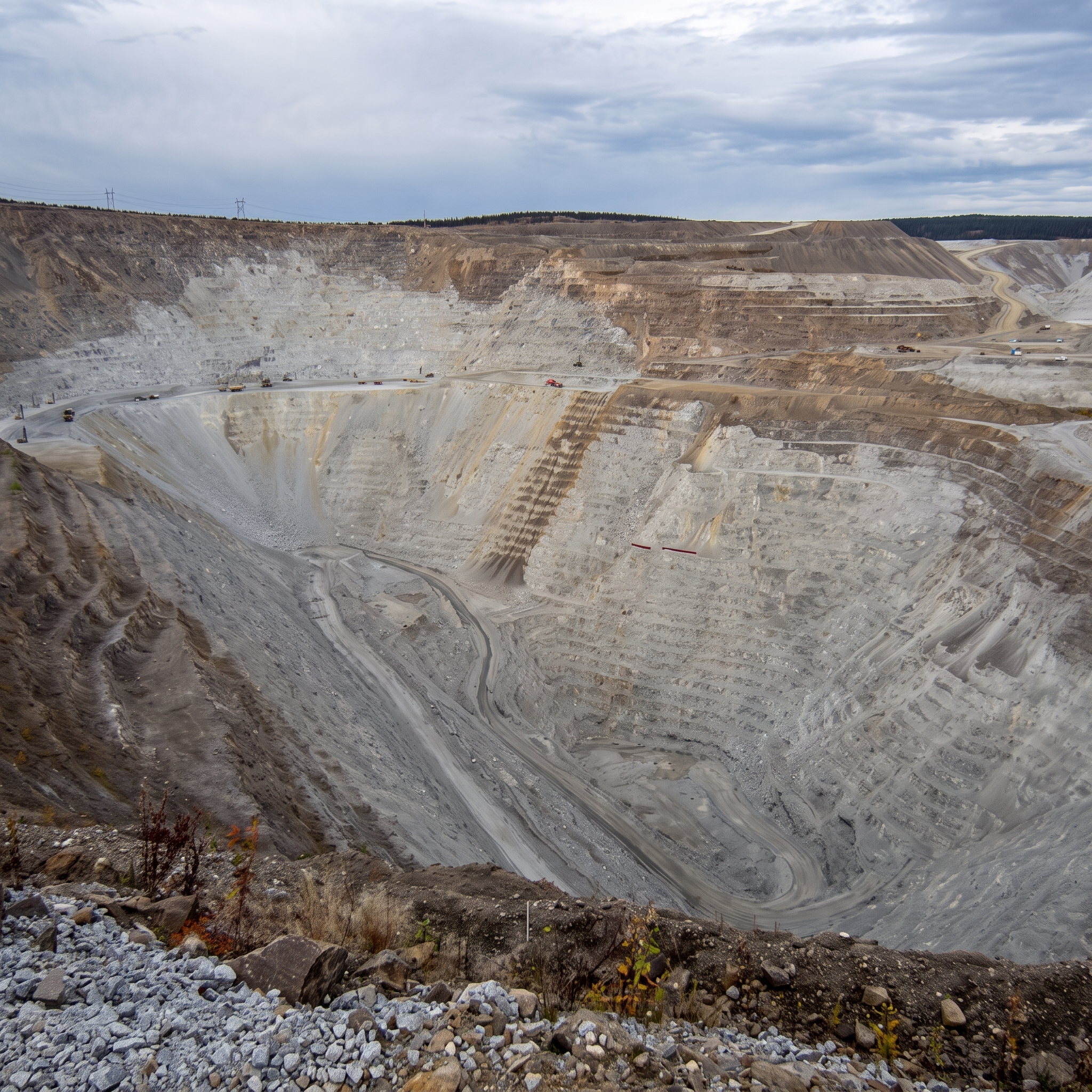
The Fort Knox Deposit forms a well-known geological feature and can be taken as an illustration of the Intrusion-Related Gold Systems (IRGS). The Intrusion-Related Gold System can be defined as a type of gold deposit which is genetically related to the crystallization of felsic and intermediate magmatic intrusions. Unlike orogenic gold deposits, IRGS features a widespread but low-grade gold dispersion associated with such chemical elements as bismuth, tungsten, and tellurium, but not copper. Fort Knox Deposit can be considered as an illustration of the magmatic-hydrothermal system.
Fort Knox deposit is located in the Tintina Gold Province of Alaska. It is set in a structurally complex, non-arc tectonic setting. Such the formation of large-sized gold-bearing provinces is always by coincidence; it needs an extraordinary combination of certain lithospheric architectures, fertile basement rocks, and certain thermal events to facilitate the flow of hydrothermal fluids (Groves et al., 2016). Mineralization at Fort Knox began in the late Cretaceous period, when metal-rich magmatic fluids were infiltrating the upper parts of the crust, using the existing extensional structures to deposit precious metals.
The main rock type hosting the mineralization is a multi-phase granitic intrusion. The petrographic features of the host rocks play a vital role in assessing the ore potential of the whole magmatic system. As can be seen from other analogous systems worldwide, such important physicochemical factors as pressure, temperature, and specific redox state of magma at its crystallization stage define whether the economic mineralization will occur (Zaitsev et al., 2019). The Fort Knox intrusion includes relatively reduced I-type granites, which allow for preserving gold solubility in hydrothermal fluids rather than trapping it in early formed silicates or oxides.
The mineralizing processes in the Fort Knox deposit are dominantly controlled by structural geology, which controls the distribution of gold within the host granite. Mineralization is highly structurally controlled instead of evenly spread out; gold occurs in complex and systematic fracture networks such as sheeted quartz veins, pegmatite veinlets, and brittle shear zones. The formation of these fractures happened when the cooling body of magma contracted due to the application of regional tectonic stresses. The creation of permeable structural pathways made it possible for late-stage gold bearing fluid to move through and precipitate metal.
Economically speaking, the Fort Knox changed the paradigm of exploration globally by showing that even low grade, high tonnage magmatic system can be highly profitable. Normally, gold exploration in Alaska concentrates on either high grade placers or very narrow quartz veins. The Fort Knox uses bulk mining methods to mine huge amounts of rock containing small concentrations of gold (below one gram per metric ton). This economic success of the system made economic geologists to rethink their approaches to exploring granitic provinces for IRGS throughout the world.
To conclude, the Fort Knox deposit is an important case study within modern economic geology which helps to define our understanding of IRGS systems. Through providing insights into the required magmatic events and the complex structural setting controlling the ore deposition, the deposit becomes an example of the complex of conditions needed to create super-class mineral deposits (Groves et al., 2016; Zaitsev et al., 2019). The models of geology proposed on the basis of the Fort Knox pluton are going to remain a practical tool for the discovery of new giant gold deposits across the world.
References
Groves, D. I., Goldfarb, R. J., & Santosh, M. (2016). The conjunction of factors that lead to formation of giant gold provinces and deposits in non-arc settings. Geoscience Frontiers, 7, 303-314. https://doi.org/10.1016/j.gsf.2015.07.001
Zaitsev, A. I., Fridovsky, V. Y., & Kudrin, M. V. (2019). Granitoids of the Ergelyakh Intrusion-Related Gold–Bismuth Deposit (Kular-Nera Slate Belt, Northeast Russia): Petrology, Physicochemical Parameters of Formation, and Ore Potential. Minerals, 9, 297. https://doi.org/10.3390/min9050297