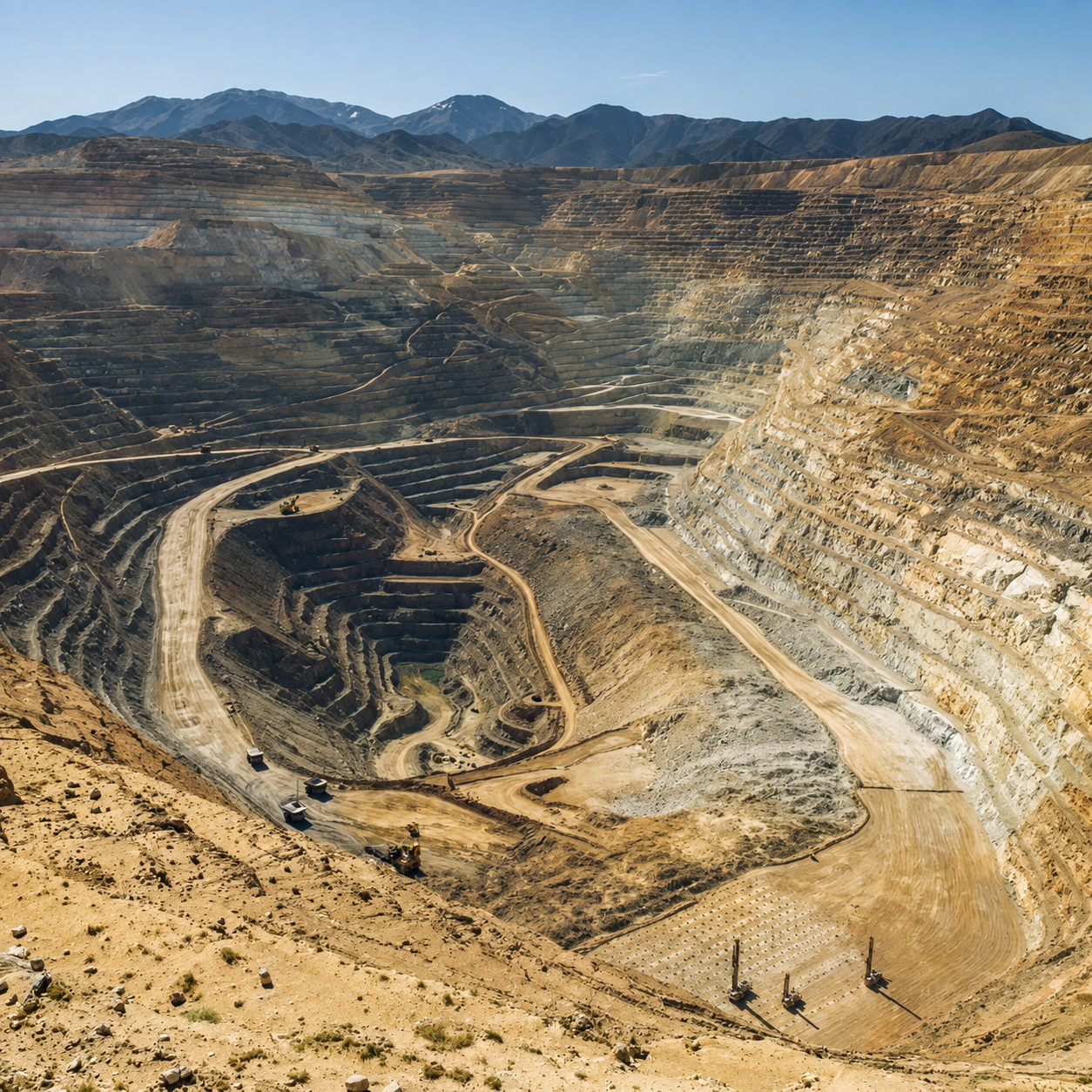
The Round Mountain Gold Mine in Nevada is an excellent open pit mine of precious metals. In order to comprehend the significance of Round Mountain, it is necessary to define certain terms – “low-sulfidation epithermal deposits” and “bulk-minable resources.” Low-sulfidation epithermal deposits emerge close to surface at relatively shallow levels in the Earth’s crust in association with hot water solutions and volcanism. A bulk-minable resource is defined as an extensive amount of scattered minerals which can be recovered only on a large scale. Therefore, Round Mountain is a true sample of the two previously stated terms – it is an extremely large bulk-minable low-sulfidation deposit.
The geological formation of Round Mountain is based on the volcanic background of Nevada. The deposit formed in rhyolitic tuff that is estimated as being about 26.8 million years old and dated back to the Oligocene period. This region is located at the edges of the ellipse that was once a caldera and now it is extinct. Explosive volcanic eruptions led to deposits of large pyroclastic and ashfall tuffs. In permeable, unwelded zones of this tuff, hydrothermal fluids rose and precipitated precious metals.
An insight into how the gold has been deposited or its mineralization process is equally important. The gold found at Round Mountain is basically strata bound. The mineralization was brought about by the upward movement of fluid that was charged with minerals through the deep fractures until it encountered the porous and unwelded tuff where it could not move any further vertically but would later spread horizontally and thereby precipitate minute particles of gold, electrum and quartz-adularia in large subsurface horizons.
Though the majority of the gold that was extracted in this area was basically dispersed, it should be noted that some amount of structurally controlled vein mineralization occurred. The deposit is heavily influenced by the occurrence of extensional fault systems and structurally controlled steep veins that have been developed in times of tectonic extension and volcanic subsidence in the region. It provided an opportunity for high grade, cross cutting quartz veins with coarse particles of gold to deposit in the local fractures.
Mining of the gold in such an environment would require technologically advanced practices. Due to the low-grade nature of the deposit and the fact that the mineralization is widespread, Round Mountain employs the large-scale practice of mining via large scale open-pit mining as well as cyanide heap leaching. The rock material is loaded onto pads with liners and then a weak solution of cyanide is passed through to extract the mineral. At the same time, with regards to mine management, the contemporary approach includes thorough environmental assessment of the geological geochemistry.
The example of Round Mountain Gold Mine demonstrates how geology is being used as an experimental ground to study such natural phenomena as the formation of the volcanic-hosted precious epithermal systems. Due to the unique nature of a caldera system, permeable tuff layers, as well as extensive structural faults within it, nature has created one of the world’s top deposits. Its further operation allows seeing the perfect symbiosis of geological studies and technological metallurgy along with the environmental concerns raised by the processes.