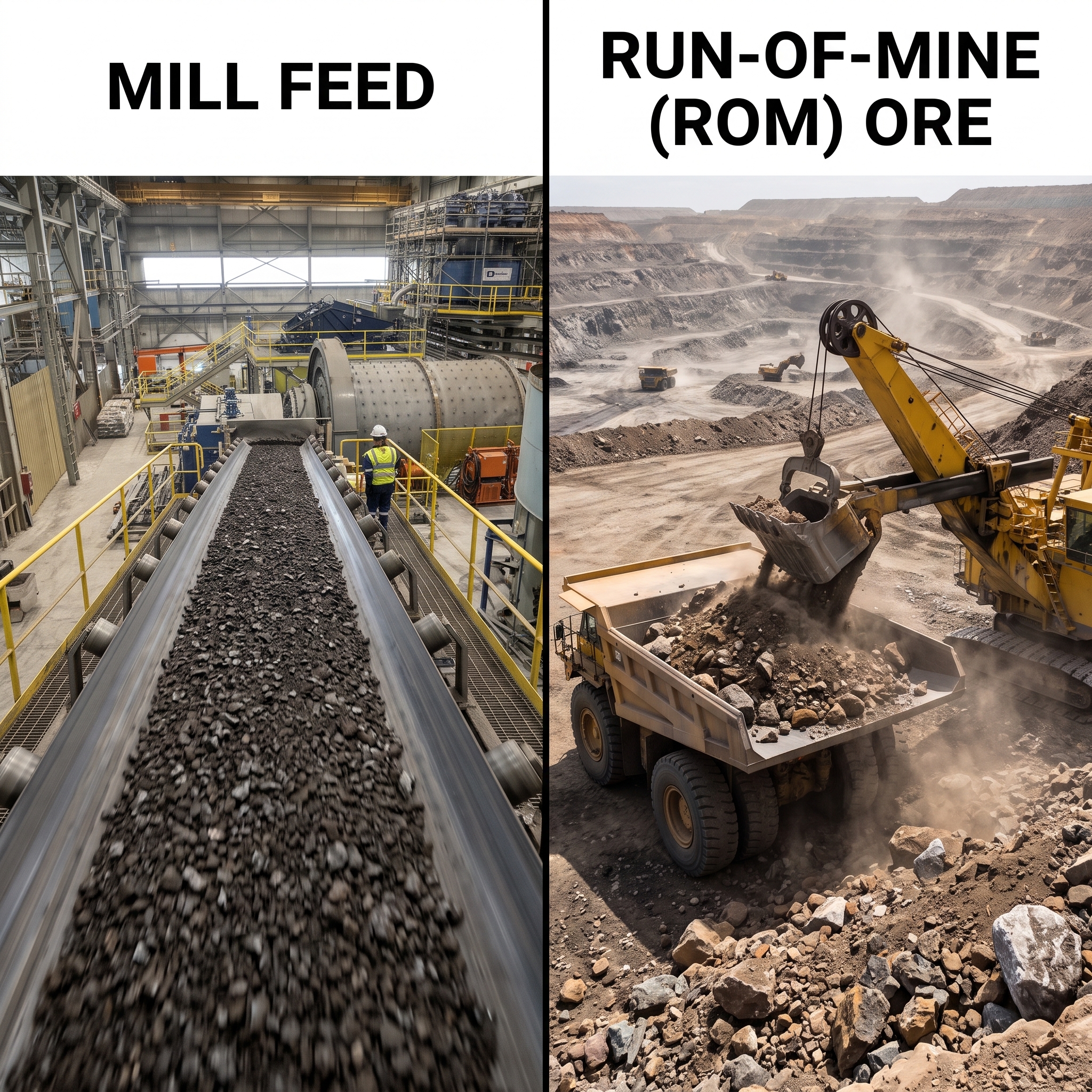
Operators and metallurgists often encounter the terms run-of-mine ore and mill feed in daily operational discussions. People occasionally treat these phrases as synonyms, yet they represent fundamentally distinct stages of extractive metallurgy. Run-of-mine ore refers to the raw, unconditioned material blasted and loaded directly from open pits, underground stopes, or historical dumps. This rock has undergone zero processing or physical modification following extraction. Conversely, mill feed constitutes the conditioned, crushed, and blended intake prepared specifically for primary grinding circuits such as autogenous, semi-autogenous, rod, or ball mills. While run-of-mine ore represents the gross volumetric output of excavation, mill feed functions as an engineered metallurgical diet designed to sustain plant throughput and maximize metal recovery.
The primary physical distinction between the two materials lies in particle fragmentation and comminution history. Run-of-mine material exhibits an erratic, uncontrolled size distribution dictated entirely by drill-and-blast patterns. Large boulders exceeding one metre can sit alongside fine blasting dust, making the material impossible to feed directly into tumbling mills without catastrophic mechanical blockages. In stark contrast, mill feed has passed through primary gyratory or jaw crushers, and frequently secondary cone crushers, reducing top particle dimensions below target thresholds such as one hundred and fifty millimetres. Furthermore, primary grinding units like autogenous and semi-autogenous mills depend heavily on precise feed geometry because the rock charges act as internal grinding media. Plant personnel must maintain a controlled balance between coarse impact media and finer fractions so that the mill grinds efficiently without packing or critical-size accumulation.
A second fundamental contrast centers on compositional consistency and blending. Natural ore deposits possess inherent spatial heterogeneity. Run-of-mine rock displays sharp fluctuations in rock hardness, moisture content, target metal grades, and deleterious contaminants from one shovel scoop to the next. Across iron ore deposits, levels of alumina, phosphorus, and silica vary widely between pit benches; across copper operations, sulfur and magnesium oxide content swings rapidly. Mill feed eliminates these pit-level shocks through deliberate stockpile homogenization and reclaim scheduling. Mine planners define stockpiles by strict metallurgical criteria rather than pit origin. Reclaim systems systematically draw material from multiple stockpile fingers to stabilize head grades and contaminant ratios. This buffering shields downstream flotation cells, gravity concentrators, and leach circuits from sudden chemical upsets that depress metallurgical recovery.
The operational function of each stream reflects differing economic priorities along the mineral supply chain. Run-of-mine stockpiles situated near pit rims serve primarily as logistical surge buffers. These stockpiles decouple haul truck cycles from primary crusher availability, allowing mining fleets to prioritize raw volumetric movement and unit extraction costs. Mill feed occupies the critical interface directly ahead of comminution, where operational economics transition from mass movement to mineral liberation. Comminution circuits represent the most energy-intensive, costly unit operations in any beneficiation plant. For this reason, mill feed is managed as an economic asset optimized for grindability and steady feed rates, ensuring that capital-intensive processing facilities operate at peak efficiency. Table 1 shows key comparison between Run-of-Mine and Mill feed.
Table 1: Key Comparison: Run-of-Mine Ore Versus Mill Feed
|
Parameter |
Run-of-Mine (ROM) Ore |
Mill Feed |
|
Origin & Stage |
Extracted directly from open pits, underground stopes, or dumps prior to treatment. |
Conditioned, crushed, and reclaimed feed delivered directly to grinding circuits. |
|
Particle Sizing |
Uncontrolled size distribution ranging from large blasted boulders down to fine dust. |
Controlled fragmentation with top-size constrained below thresholds like 150 mm. |
|
Grade & Chemistry |
Highly variable in rock hardness, moisture, head grade, and detrimental contaminants. |
Homogenized through planned stockpiling and blending to stabilize head grade and chemistry. |
|
Operational Role |
Logistical surge buffer decoupling mine fleet hauling from crusher availability. |
Engineered metallurgical diet designed to maximize mill throughput and recovery. |
The journey from pit to product hinges on transforming irregular geological deposits into predictable industrial inputs. Run-of-mine ore is the raw, variable harvest extracted directly from the ground. Mill feed is the sized, blended, and quality-controlled prescription that keeps grinding circuits and downstream concentration processes stable. Successful mine-to-mill integration treats the processing plant as the mine’s primary customer, transforming unrefined extraction into maximized mineral value.