The study of porphyry copper systems is important in terms of distinguishing between two key processes that govern the formation of ore deposits. These are hypogene and supergene mineralizations.
Hypogene mineralization is the process of ore deposition, during which sulfide metal compounds are formed through precipitation from rising magmatic-hydrothermal solutions. This process takes place at great depths of up to 5 kilometers (Dahlström et al., 2022).
Supergene enrichment is considered as a secondary process. It takes place when hypogene primary sulfides are subject to oxidation through the impact of meteoric waters, such as rainwater and groundwater, leading to the formation of oxidized copper, which is subsequently deposited as high-grade minerals due to reducing conditions at lower depths (Dahlström et al., 2022).
In order to distinguish these two zones in the context of exploration and mining, economic geologists use several key criteria:
Mineralogical assemblages
Mineralogy is the most direct criterion both in terms of composition and visualization. The defining mineral components for hypogene zones include primary copper and iron sulfides like chalcopyrite and bornite, along with gangue sulfides such as pyrite (Rivas-Romero et al., 2021). It should be noted that early hypogene pyrites can contain trace metals including cobalt, nickel, and PGEs (Robb et al., 2023).
On the other hand, supergene zones are characterized by secondary minerals. In the deep part of the enrichment zone, copper sulfides precipitate from secondary sulfides, which may increase the concentration of hypogene copper content by a factor of three or four times (Dahlström et al., 2022). The upper part of the supergene zone, which is the oxidized part (leached cap), includes copper oxides and silicates (chalcosin).
Trace elements geochemistry
The presence of particular geochemical markers in sulfide minerals provides microscale information about their source. Trace elements in hypogene sulfides include bismuth, silver, tin, and selenium, among others. Their presence is highly indicative of deep-level hydrothermal alteration such as potassic alteration (Rivas-Romero et al., 2021). However, supergene weathering drastically changes this geochemistry by removing and transporting trace elements based on their solubility in cool meteoric water.
Spacial and geomorphological setting
In terms of spacial distribution, hypogene ores have deep origins and are structurally controlled by faulting, dyking, and the host intrusion. In comparison, supergene enrichment is exclusively dependent on the landscape development and the depth of the ancient water table and needs a particular geomorphological setting characterized by low erosion rates to provide time for copper migration before erosion eliminates the deposit (Dahlström et al., 2022).
Through studying their mineralogical assemblage and trace-element chemistry, together with the structural control of these deposits, it is possible to reconstruct their history and trace mineralized ore bodies.
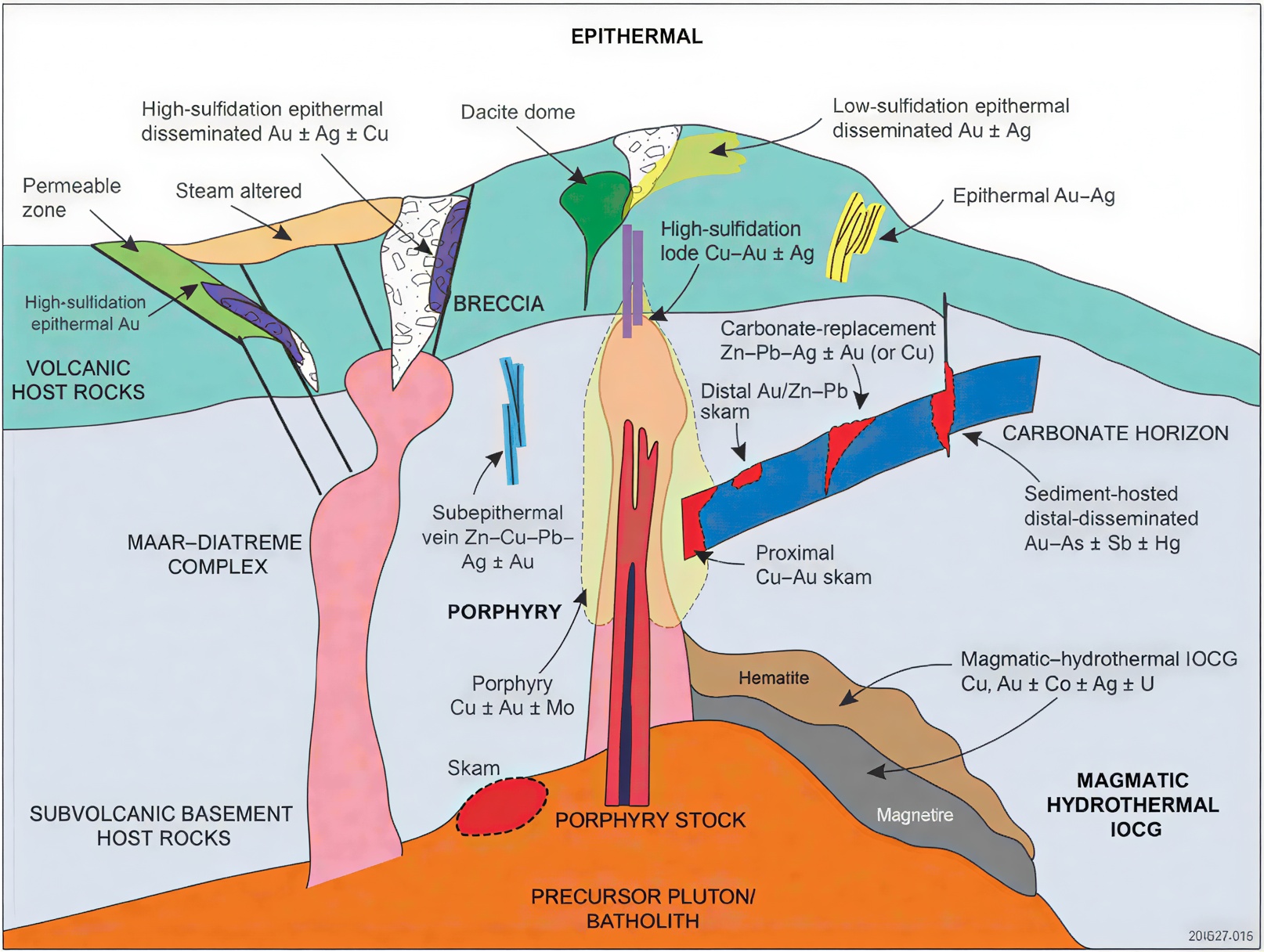
Image source: Summary diagram illustrating the relationship between IOCG, porphyry and epithermal systems, adapted from Richards and Mumin 2013, Sillitoe 2010b, and Corbett and Leach 1998.
References
Dahlström, S. I. R., Cooper, F. J., Blundy, J., Tapster, S., Yáñez, J. C., & Evenstar, L. A. (2022). Pluton Exhumation in the Precordillera of Northern Chile (17.8°–24.2°S): Implications for the Formation, Enrichment, and Preservation of Porphyry Copper Deposits. Economic Geology, 117(5), 1043–1071. https://doi.org/10.5382/econgeo.4912
Rivas-Romero, C., Reich, M., Barra, F., Gregory, D., & Pichott, S. (2021). The Relation between Trace Element Composition of Cu-(Fe) Sulfides and Hydrothermal Alteration in a Porphyry Copper Deposit: Insights from the Chuquicamata Underground Mine, Chile. Minerals, 11(7), 671. https://doi.org/10.3390/min11070671
Robb, S. J., Boucher, B. M., Mungall, J. E., & Hanley, J. J. (2023). Platinum-group elements (PGE) in the New Afton alkalic Cu-Au porphyry deposit, Canadian Cordillera, II: PGE distribution and models for the hydrothermal coprecipitation of Co-Ni-Pd-Pt in pyrite. Frontiers in Earth Science, 11. https://doi.org/10.3389/feart.2023.819109