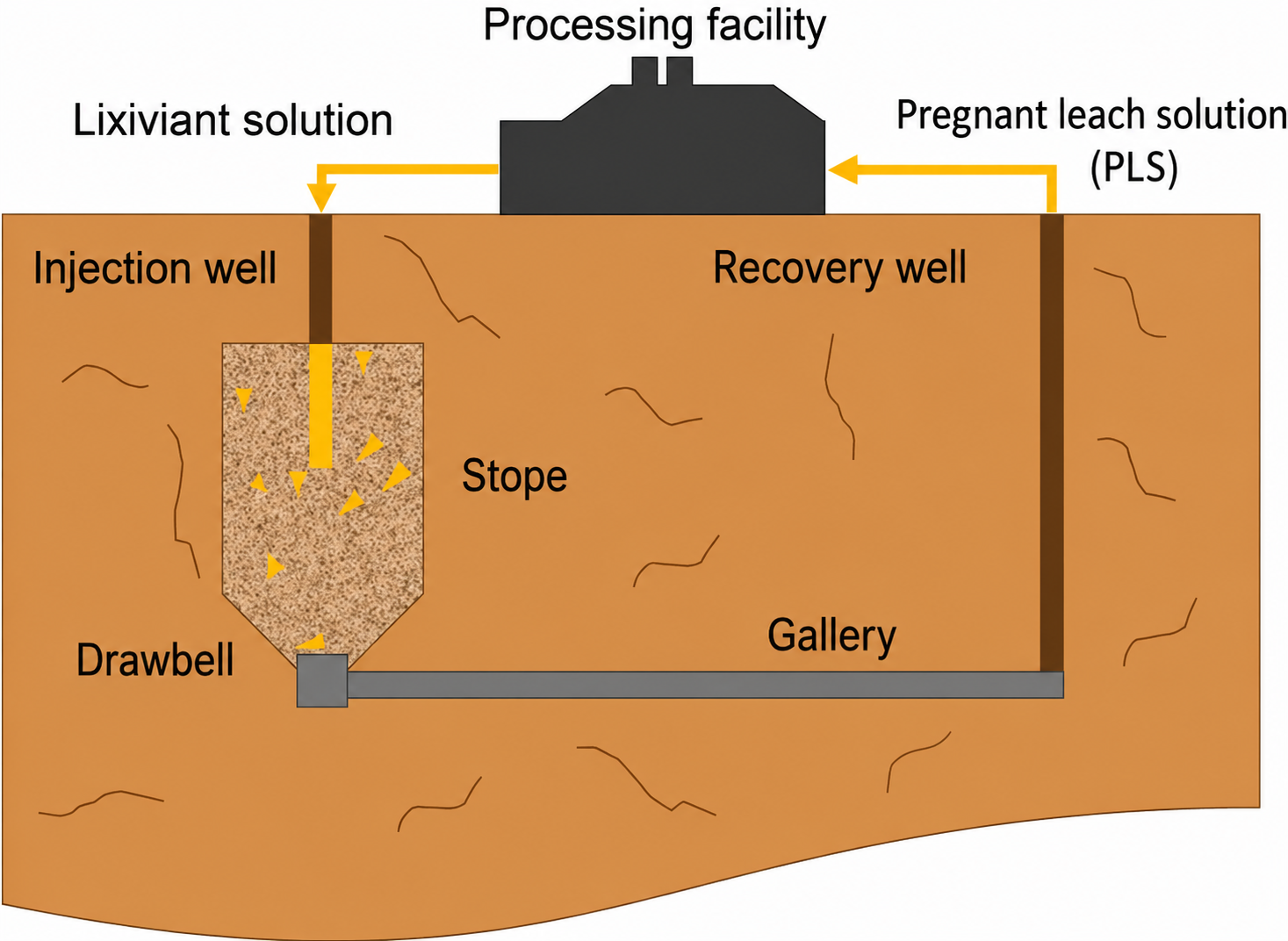
In-situ leaching (ISL), or in-situ recovery, refers to a process where the leaching agent (lixiviant) is used to dissolve the metals from an orebody and pumped out to the surface. In contrast, conventional open-pit mining of copper oxide ores requires the physical excavation of rocks and subsequent crushing and leaching on the surface. Although ISL does not require costly earthmoving and large tailings impoundments, switching to ISL from conventional open pit copper oxide extraction processes presents technical and economic challenges.
Fluid flow is the most important technical barrier to using ISL technology. While conventional open-pit mining entails crushing rocks to desired size in order to facilitate efficient lixiviant interaction, ISL depends entirely on natural or induced permeability of the orebody. There should be high feasibility, strict monitoring, and good control of fluid flow in order to make sure that lixiviant makes contact with the copper oxide minerals and is recovered safely (Jenkin et al., 2024). Without good hydraulic conductivity, the lixiviant does not flow uniformly and therefore leaves many parts of the copper deposit untouched.
In addition to fluid dynamics challenges, geochemical complexities are another obstacle. As sulfuric acid attacks copper oxide, it reacts with other mineral gangues. This additional reaction quickly eliminates the acid and increases the amount of chemicals that must be used in the process. On top of this, when gangue minerals are dissolved, secondary minerals, such as gypsum, may be precipitated and actively clog the natural pores and cracks, cutting off the fluid flow and halting the process before achieving desired results.
Economically, ISL does not require huge initial investments into heavy machinery or construction of huge tailing dams but raises the problem of uncertainties of the process below the surface. The main economic challenge is unpredictable recovery rate in conjunction with long time needed for leaching process. Open-pit mining ensures physical access to the ore and thus provides quick revenues. On the contrary, in situ processes heavily rely on kinetics which takes much time.
Environmental and regulatory factors are also intrinsically connected with the economics of the process. Even though ISL helps reduce surface scarring of the landscape, the process carries the high risk of groundwater contamination by the fluids that might leak outside the containment zone. It is crucial to have either neutral or positive impacts on the ecosystem and groundwater in order to perform the in situ process safely (Jenkin et al., 2024). Thus, there are tough and expensive monitoring regulations. The costs of groundwater remediation may discourage investments, similarly to very tight regulations that prevail in mature ISL industries, such as uranium mining (Li & Yao, 2024). Besides, the issue of subsurface microbes needs to be controlled (Roberto & Schippers, 2022).
To summarize, although in situ process is an attractive and less invasive solution than open-pit one in case of copper oxides extraction, it is limited. First of all, it is impossible to ensure even fluid movement in the underground reservoirs and the risk of pore clogging by chemicals creates unpredictable economic projections. It is very likely that open pit mining will continue being the dominating technique until there are some technical achievements in this area.
Image rights: Estay, H., Díaz-Quezada, S., Arancibia, E. et al. Economic Assessment of an In Situ Leaching Operation with Ore Preconditioning Using Sublevel Stoping Techniques. Mining, Metallurgy & Exploration 40, 493–504 (2023). https://doi.org/10.1007/s42461-023-00736-y
References
Jenkin, G., Arcilla, C., Abbott, A., Bateson, L., Bautista VII, A., Chambers, J., Devanadera, M. C., Duddigan, S., Fernando, E., Gervasio, J. H., Gibaga, C., Lazaro, J. E., Menor, T., Naden, J., Newsome, L., Pan, Y., Quierrez, R., Quimado, M., Samaniego, J., Selvaraj, V., Smith, D., Swift, R., Symons, J., Tanciongco, A., & Tibbett, M. (2024). Recent developments in the science and technology of in situ solvent leaching of tailings for reprocessing, rehabilitation and closure. Proceedings of the International Conference on Mine Closure, 29–44. https://doi.org/10.36487/acg_repo/2415_0.03
Li, G., & Yao, J. (2024). A Review of In Situ Leaching (ISL) for Uranium Mining. Mining, 4, 120–148. https://doi.org/10.3390/mining4010009
Roberto, F. F., & Schippers, A. (2022). Progress in bioleaching: part B, applications of microbial processes by the minerals industries. Applied Microbiology and Biotechnology, 106, 5913–5928. https://doi.org/10.1007/s00253-022-12085-9