A mineral discovery does not automatically become an operational mine. The transition from a raw geological occurrence into an active, cash-generating project requires clear proof that target minerals can be extracted and processed at a commercial profit. Geologists and investment analysts distinguish between a general mineral resource and an economically recoverable ore deposit based on concentration levels, accessibility, and total extraction expenses. Ultimately, comprehensive project feasibility rests upon three foundational pillars: geological deposit characteristics, market and financial mechanics, and regulatory, geopolitical, and environmental risk factors.
Physical and geological parameters set the fundamental baseline for any potential mining venture. Ore grade; defined as the concentration of valuable mineral contained within host rock, serves as a primary driver of profitability, as higher grades yield greater gross revenue per mined tonne. Deposit tonnage and overall deposit scale allow operators to achieve crucial economies of scale, which justify substantial capital investments and secure a long mine lifespan.
Furthermore, the depth, spatial geometry, and structural accessibility of the ore body determine whether low-cost open-pit extraction applies or if complex underground shaft infrastructure becomes necessary. Finally, metallurgical recovery rates govern processing efficiency, dictating how effectively target valuable metals can be separated from gangue waste rock.
Financial models transform raw geological data into actionable economic forecasts. Long-term projected commodity prices and forward market demand curves establish expected cash flows, shaping critical investment valuation metrics such as Net Present Value and Internal Rate of Return. Upfront capital expenditures for equipment, processing plants, and mine development, combined with ongoing operating expenses, establish the operational break-even threshold and economic cut-off grade. In addition, host-government fiscal terms and royalty structures, whether unit-based, ad valorem, or profit-based; directly reduce net cash flows, directly influencing the effective economic life of the mine.
External operating conditions can severely disrupt or invalidate even the richest geological deposits. Stable land tenure, secure mineral rights, and predictable legal frameworks protect heavy capital commitments against political instability, unexpected policy shifts, or asset expropriation. Local infrastructure access; including power generation, water supplies, and transportation networks, prevents severe cost overruns and supply chain bottlenecks. Environmental sustainability requirements, particularly tailings storage management and water stewardship, dictate major long-term liabilities. Active engagement with local communities and adherence to international guidelines secure a social license to operate, preventing costly labor disputes, blockades, and project delays.
Economic viability relies on an interconnected balance of high geological quality, disciplined cost control, favourable market pricing, and strong regulatory compliance. Project evaluators must continuously analyze cut-off grade strategies and operational trade-offs to protect asset value throughout changing market cycles. A modern exploration project succeeds only when rigorous technical geology aligns seamlessly with thorough financial modeling and proactive risk management.
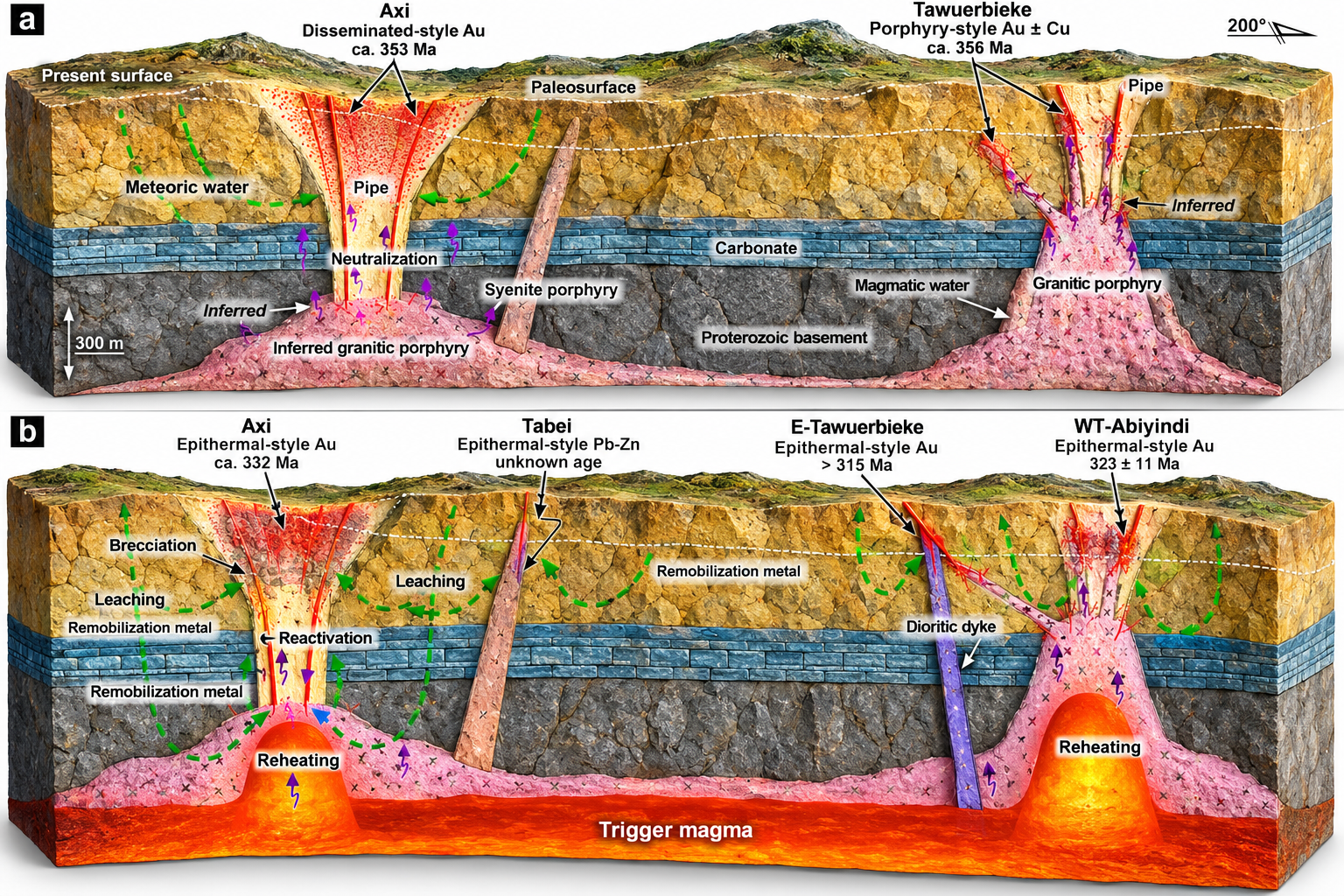
Image rights: Liu, Z., Mao, X., Ackerman, L. et al. Two-stage gold mineralization of the Axi epithermal Au deposit, Western Tianshan, NW China: Evidence from Re–Os dating, S isotope, and trace elements of pyrite. Miner Deposita 55, 863–880 (2020). https://doi.org/10.1007/s00126-019-00903-6