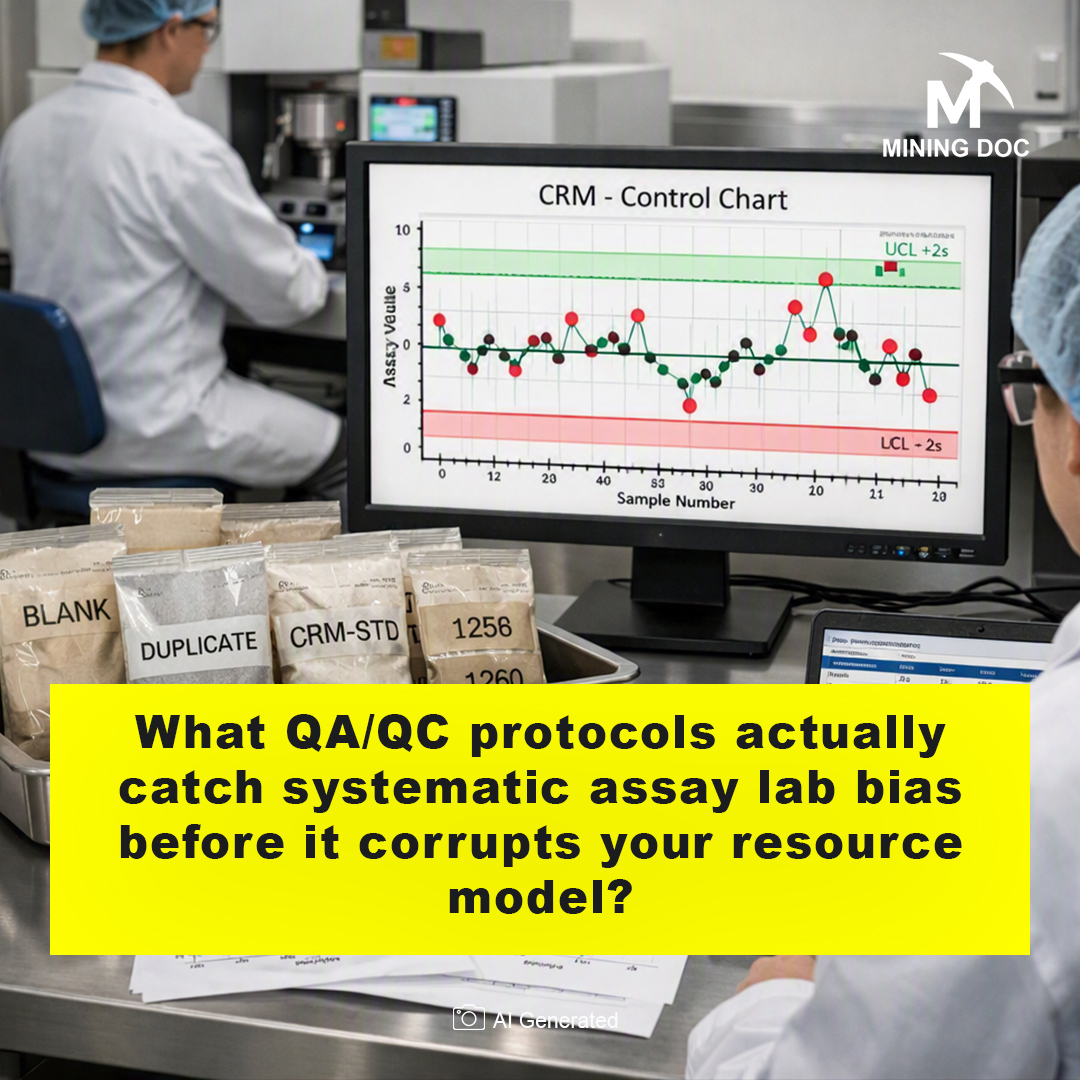
Proactive actions that aim to prevent possible mistakes are associated with QA, while the reactive measures intended for detecting problems belong to QC (Piercey, 2014). Assay laboratory bias is a systemic deviation of the analytical value from the true grade that creates a considerable danger. The presence of undetected bias leads to an incorrect assessment of the deposit since this process distorts the resource model. In turn, the early detection of biases is the key idea in QA/QC (Dominy et al., 2018).
One of the most efficient ways to reveal any systematic bias is the usage of Certified Reference Materials (CRMs). CRMs are standards produced with certified consensus values (Piercey, 2014). With the help of randomly inserting CRMs into the sample stream in about 5% of cases, geologists constantly check the lab’s accuracy (Dominy et al., 2020). In case the laboratory values are always higher/lower than the CRMs’ one, it may be considered that the bias exists. It is important to note that CRMs should resemble the mineralogical matrix of the ore.
Although CRM analysis tests the accuracy of data, blank substances are crucial for contamination assessment, since contamination often leads to positive analytical bias. Blank substances represent inert substance with analyte content below the detection limit. In the process of preparation of samples, equipment can transfer residues of samples with high grade to next low-grade samples. This will result in an artificially raised grade of low-grade samples. The introduction of coarse blank samples directly after the high-grade zones helps managers detect sample contamination before obtaining distorted geological model (Ghorbani et al., 2020).
Another method for the exposure of systematic bias is the use of umpire laboratories. Although primary laboratories may be effective at analyzing CRMs, internal procedures of laboratories may still contain unknown biases. It is recommended to send 5% of pulp duplicate samples to second laboratory that is trustworthy (Piercey, 2014). Comparison of primary sample test results and umpire laboratory tests will provide assurance of system biasing differences between laboratories and ensure objectivity of the results of primary laboratories.
The mere generation of QA/QC data without proper statistical monitoring is inadequate. Current practices make use of modern methods such as Shewhart control charts to monitor CRMs, and Thompson-Howarth plots to measure duplicate precision (Piercey, 2014). The control chart monitors drift in analytical measurements and alerts immediately if the current batch analysis has gone beyond the pre-established limits of the standard deviation of the analysis. In cases where statistical analysis indicates bias, the current batch will be held in isolation, and the laboratory conducts investigations before recalibrating the instruments and performing another analysis on the samples before entering the data in the database.
To conclude, the dependability of a resource model depends on the quality of its underlying assay data. Laboratory bias may jeopardize feasibility because it causes miscalculations of the grade estimates. However, the implementation of QA/QC practices such as using CRMs, blanks, umpire checks, and statistics is a solid defense framework. With the implementation of these methods, mining experts can detect any analytical errors and thus, ensure the final mineral resource estimate is defensible and commercially viable (Dominy et al., 2018).
References
Dominy, S., Glass, H., O’Connor, L., Lam, C., Purevgerel, S., & Minnitt, R. (2018). Integrating the Theory of Sampling into Underground Mine Grade Control Strategies. Minerals, 8(6), 232. https://doi.org/10.3390/min8060232
Dominy, S., Purevgerel, S., & Esbensen, K. (2020). Quality and sampling error quantification for gold mineral resource estimation. Spectroscopy Europe, 21. https://doi.org/10.1255/sew.2020.a2
Ghorbani, Y., Nwaila, G. T., & Chirisa, M. (2020). Systematic Framework toward a Highly Reliable Approach in Metal Accounting. Mineral Processing and Extractive Metallurgy Review, 43, 664–678. https://doi.org/10.1080/08827508.2020.1784164
Piercey, S. J. (2014). Modern Analytical Facilities 2. A Review of Quality Assurance and Quality Control (QA/QC) Procedures for Lithogeochemical Data. Geoscience Canada, 41, 75. https://doi.org/10.12789/geocanj.2014.41.035