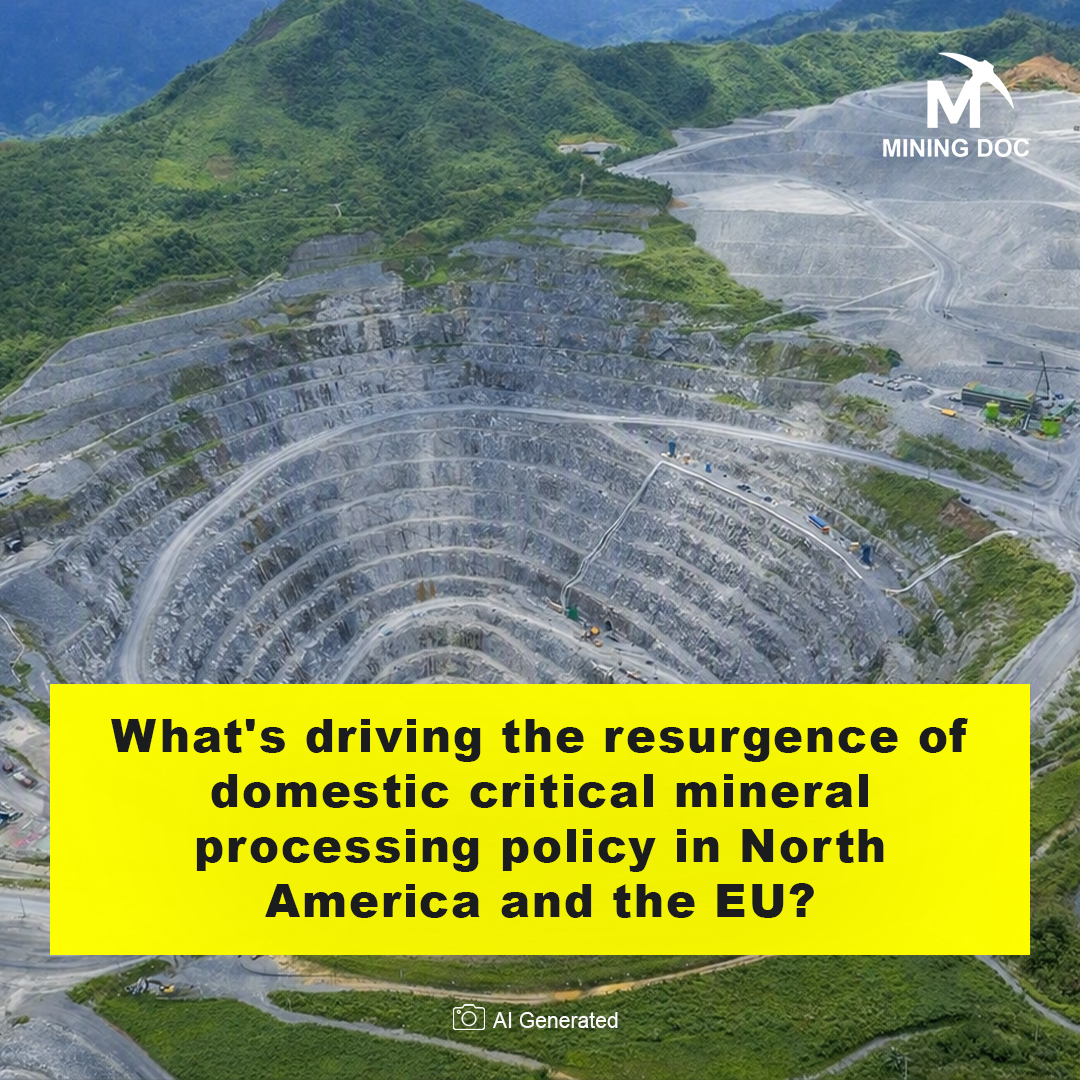
A paradigm shift is currently happening in the domain of industrial policy about an increasing amount of attention paid to the domestic processing policy of critical minerals in North America and EU. It is necessary to define a term like “paradigm shift” clearly first. Critical minerals, including lithium, cobalt, rare earth elements, etc., are natural assets that are important for economic activities but are sensitive to supply problems, especially with the emergence of new cleantech (Czerwinski, 2022). “Domestic processing policy” refers to governmental strategies including taxation, trade and other policies aimed at creating a domestic environment for the processing of critical minerals.
The core reason for this is the transition to clean energy on the part of many countries, who take active steps towards reaching net zero levels of greenhouse gases emissions to mitigate the effects of climate change. Thus, as there is an ever-growing demand for various technologies including EVs, wind turbines, solar panels and others, the role of critical minerals grows, since they are mineral-intensive technologies (Berthet et al., 2023). Therefore, the western states find it essential to process those resources domestically.
The situation is compounded by both deep supply chain vulnerabilities and rising geopolitical issues. Presently, both the extraction of and, even more significantly, the processing of critical minerals occurs in relatively few areas of the world, with China having near monopoly in the global processing of rare earth minerals and other critical minerals such as cobalt (Giese, 2022). The ongoing COVID-19 crisis also made evident the frailties of globalization as an economic strategy, in terms of securing raw materials. As a result, policymakers in North America and Europe understand that reliance on external parties for critical materials presents serious national security risks.
The following can be said to be a way of dealing with the situation whereby North America is taking policy-based actions to develop local capacity within the industry. This will happen in the US where such policies include the Inflation Reduction Act, which offers massive tax cuts for EVs made by using the critical minerals from North American local or ally nations’ (Leonelli, 2025). Other policies include executive orders to reduce dependency of foreign processing plants.
On the other side of the Atlantic, similar trends have been occurring. The European Union enacted a law entitled the Critical Raw Materials Act (CRMA) to eliminate dependencies and create a resilient supply chain. The CRMA requires, through legislative measures, that a certain share of annual usage of critical raw materials of the European Union needs to be processed and recycled inside the jurisdiction (Leonelli, 2025). Creating the infrastructure for local processing plants together with strategic international cooperation will allow the EU to keep their internal market safe from any external political pressure and to create the economy of circularity.
In conclusion, the rise of policies aimed at the localization of critical mineral processing indicates a new paradigm wherein free-market globalization gives way to strategic independence. It is important to understand that the main factors pushing the United States and the EU in that direction are the necessity to achieve set climate goals and to protect themselves from the threat to their national security posed by a monopoly on supply chains (Giese, 2022). Onshoring of these industries comes with its difficulties but remains inevitable for the future.
References
Berthet, E., Lavalley, J., Anquetil-Deck, C., et al. (2023). Assessing the Social and Environmental Impacts of Critical Mineral Supply Chains for the Energy Transition in Europe. https://doi.org/10.2139/ssrn.4610350
Czerwinski, F. (2022). Critical Minerals for Zero-Emission Transportation. Materials, 15, 5539. https://doi.org/10.3390/ma15165539
Giese, E. C. (2022). Strategic minerals: Global challenges post-COVID-19. The Extractive Industries and Society, 12, 101113. https://doi.org/10.1016/j.exis.2022.101113
Leonelli, G. C. (2025). Critical Raw Materials, the Net-Zero Transition and the ‘Securitization’ of the Trade and Climate Change Mitigation Nexus: Pinpointing Environmental Risks and Charting a New Path for Transnational Decarbonization. World Trade Review, 1–20. https://doi.org/10.1017/s1474745624000430