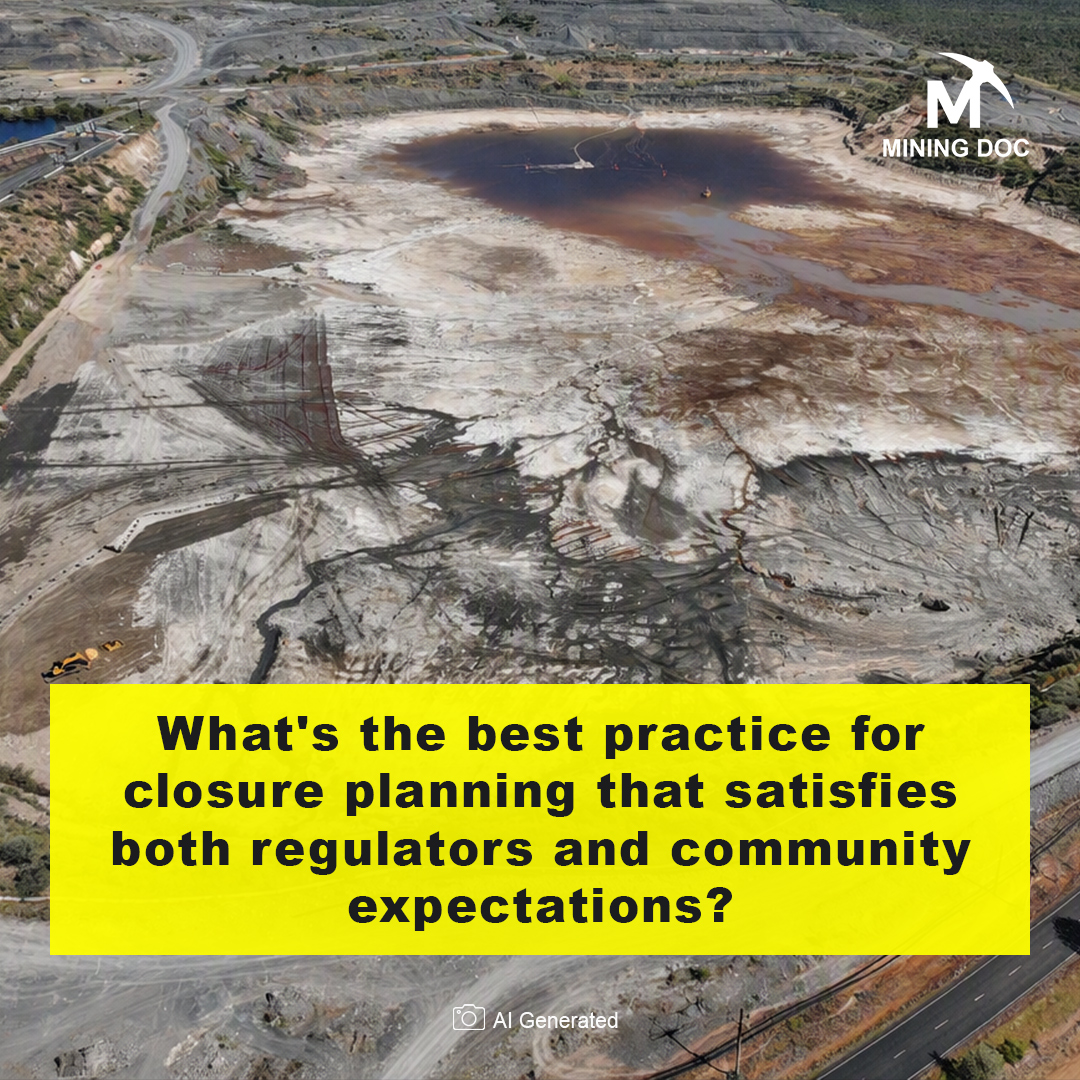
Planning for closure means a continuous process of designing the cessation of activities and land rehabilitation. Regulatory expectations are legal standards set out by governments for ensuring ecological restoration. Community expectations are the social license to operate, where there are expectations from the community on the need for economic stability and sustainable land use. These are the fundamental principles upon which any modern closure strategy must be developed (Streit et al., 2023).
The widely acknowledged best practice in this area is to undertake planning for closure of activities during the conceptual stage of the project and not at the latter stages. The combination of closure plans together with early EIAs enables the operator to know potential risks to the environment and develop the financial arrangements to deal with them. This will minimize any environmental degradation and ensure that enough money is available for the restoration of degraded environment.
The requirement to meet the standards from the regulatory agencies means that the metrics to define the completion of the task must be included in the plan. The classic method is very strict and prescriptive and does not provide for any changes in the environment. Contemporary methods of regulating the environment imply outcome-based regulation. It means that the emphasis is placed not on the usage of certain methods but on achieving particular environmental results (Gimber & Shade, 2024).
Although regulators are mainly concerned about environmental issues, the expectations of the community are linked with socio-economic transitions. The inappropriate planning of closure may cause serious damage to the local economy and result in job losses. For maintaining social license, it is critical to engage the community continuously during the life cycle of the mine. Best practice in this regard implies that local community should be engaged in the planning of post-mining uses of land (Tibby et al., 2024).
However, effective closure planning should also involve comprehensive revitalization. In the absence of further mining, the terrain must be changed to be used for some different purposes – ranging from ecological restoration to agricultural use or infrastructure for renewable energy production. Such an approach seeks to make the post-extraction landscape stable from economic, environmental, and social points of view. The companies will thus manage to create a legacy, turning degraded extraction sites into valuable resources of the region (Streit et al., 2023).
To conclude, the ideal method for closure planning includes a holistic strategy that considers ecological restoration and social transition from the very beginning. Through the development of clearly defined outcome-based criteria for completion, the company will be able to satisfy rigorous regulatory requirements. On top of that, through integration with environmental assessment and community consultation, the company will fulfill its social obligations. Closure must not be seen as the end of operations, but as the transition that brings sustainability and vitality.
References
Gimber, C., & Shade, N. (2024). Completion criteria: the tension between certainty and flexibility. Proceedings of the International Conference on Mine Closure, 1261–1268. https://doi.org/10.36487/acg_repo/2415_91
Morrison-Saunders, A., McHenry, M. P., Rita Sequeira, A., Gorey, P., Mtegha, H., & Doepel, D. (2016). Integrating mine closure planning with environmental impact assessment: challenges and opportunities drawn from African and Australian practice. Impact Assessment and Project Appraisal, 34, 117–128. https://doi.org/10.1080/14615517.2016.1176407
Streit, S., Tost, M., & Gugerell, K. (2023). Perspectives on Closure and Revitalisation of Extraction Sites and Sustainability: A Q-Methodology Study. Resources, 12(2), 23. https://doi.org/10.3390/resources12020023
Tibby, J., Marshall, J. C., Short, J., Cadd, H. R., Hansen, J., Lewis, T. M., Schulz, C., Negus, P. M., McGregor, G. B., & Donnellan, C. (2024). Retrospective assessment of mine impacts: a case study using palaeoecology, aerial photography and maps from North Stradbroke Island (Minjerribah), Australia. Australasian Journal of Environmental Management, 31, 310–338. https://doi.org/10.1080/14486563.2024.2324719