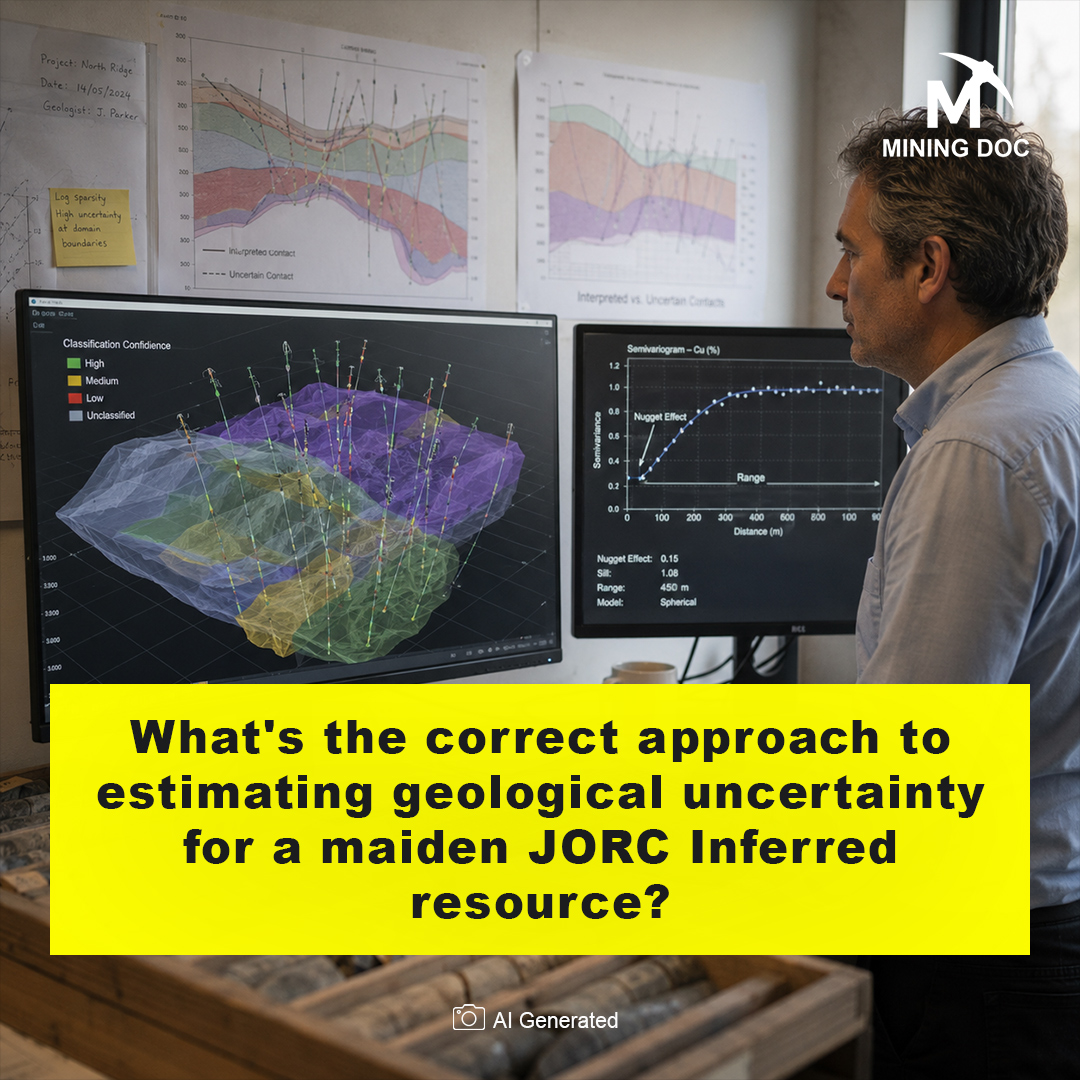
In mineral deposits evaluation, the first step begins with creating a solid base. It is necessary to highlight the basic principles to understand the right approach to estimation of the geological uncertainty of the maiden JORC Inferred resource. This mineral reserve is described by the standard that is set by Joint Ore Reserves Committee (JORC). The “maiden Inferred resource” implies the first estimation at the lowest confidence level based on the limited amount of data. The term “geological uncertainty” refers to the lack of knowledge about the exact grade, tonnage, and continuity of a deposit.
This estimation is important because the maiden resource depends on the sparse drilling pattern. During the preliminary stage of analysis, geologists rely on the structural model and not continuous data. The sources of geological uncertainty are connected with natural mineralization variability, possible nugget effect, and limitations of interpolation approaches. Thus, the first estimation is greatly affected by anomalies and subjective interpretation.
The most appropriate methodology for estimating the uncertainty level changes from a deterministic process to a stochastic one. Whereas deterministic processes lead to just one block model, they fail to represent all the uncertainties inherent in spatial distribution. The best practice is therefore geostatistical simulations, which help in creating more than one equiprobable scenarios for a deposit. Using such methods, people would be able to measure the grades and boundaries of a particular material grade without leaving any geological uncertainties unmeasured (Quigley & Dimitrakopoulos, 2019).
The use of such simulations allows experts to have confidence intervals for both tonnage and grade. For an Inferred resource on maiden production, the proper method would be to use the uncertainty limits obtained through the process in order to continue with further exploration works. Geologists would use probability maps generated during simulations to scientifically validate boundaries for Inferred resources. This helps ensure JORC compliances with regards to the classification of this resource.
A sound assessment of the geological uncertainty during the early phase is critical for the long-term sustainability of the project. The maiden inferred resource is typically used as the basis for the early economic assessments and can attract funding for such purposes. Undervaluation of the geological uncertainty can cause serious mistakes during subsequent metallurgy and mining operations. Accurate assessment of metal uncertainty during the early stage ensures optimal design of the minerals’ value chain and investment into proper infill drilling programs that would enable the increase of the resource quality category (Lamghari & Dimitrakopoulos, 2021).
To sum up, the process of geological uncertainty evaluation for the maiden JORC Inferred resource must be transparent and use some methods of probabilistic evaluation of geological uncertainty. One must bear in mind that there is no sense in trying to avoid it since it is impossible due to the nature of the task; it is required to identify and properly assess it. The geostatistical simulations are the tools of achieving the compliance.
References
Lamghari, A., & Dimitrakopoulos, R. (2021). An adaptive large neighborhood search heuristic to optimize mineral value chains under metal and material type uncertainty. International Journal of Mining, Reclamation and Environment, 36, 1–25. https://doi.org/10.1080/17480930.2021.1949858
Quigley, M., & Dimitrakopoulos, R. (2019). Incorporating geological and equipment performance uncertainty while optimising short-term mine production schedules. International Journal of Mining, Reclamation and Environment, 34, 362–383. https://doi.org/10.1080/17480930.2019.1658923