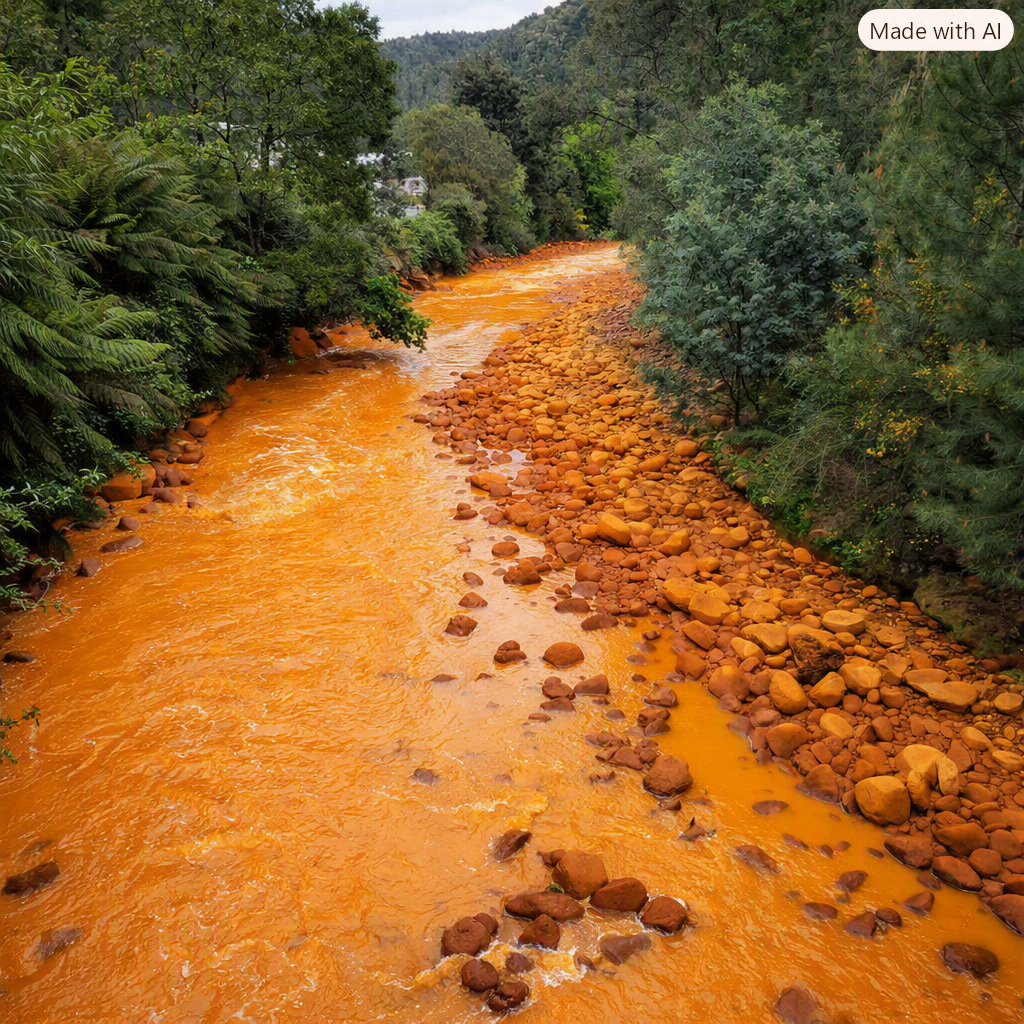
Acid Mine Drainage (AMD) is among the most difficult eco-hydrological problems confronting the worldwide mining industry. Essentially, Acid mine drainage is the highly acidic, sulphate and metal-laden water resulting from the exposure of sulfide-rich minerals to the atmosphere. Regarding the mining process, a major contributor to this problem is the sulphide-rich waste rock dump. This is basically the huge pile of excavated rock materials that have no ore value and are rich in reactive minerals, especially pyrite.
The formation of AMD in the Waste Rock Material is Caused by the Complex Set of Biogeochemical Weathering Processes. As a result of interaction between sulfide ores and oxygen with water, fast oxidation occurs with release of dissolved iron, sulfate, and high concentration of protons, thereby decreasing significantly pH of the aqueous solution (Dold, 2014). Acid conditions contribute to the leaching and dissolution of harmful metals into the nearby underground waters. Besides, acid-loving microorganisms speed up this process exponentially.
The appropriate methodology for dealing with the risks related to the generation of AMD has to start much earlier during the planning stages prior to waste deposition. By assessing the acid-generating capabilities of the rocks in question and their natural neutralization capabilities, one can create customized solutions on how to manage the waste at that particular location. For example, selective management and separation of highly reactive fines will greatly decrease the amount of acid-generating waste and allow the use of remaining non-reactive waste in construction work at the site (Sylvain et al., 2024).
In cases involving reactive sulfides, modern treatments, including desulfurization, have shown to be very efficient. Desulfurization is an elaborate procedure that starts with segregation of the reactive pyrite from the rest of the tailings by using flotation. The segregation is followed by safe neutralization of the separated sulfide concentrates by placing the same in underground cavities filled with cemented paste backfill (Mafra et al., 2022). This helps to seal the reactive gangue with solid, alkaline material so that oxidation cannot occur.
As far as waste rock which has to be stored permanently in surface dumps is concerned, it is the most dependable way of managing this resource through engineered barriers. The dry cover method, which involves the placement of clays along with low permeable soils in multiple layers (and sometimes even with the use of geomembranes), is intended to sharply reduce the amount of precipitation and atmospheric oxygen from getting inside the waste rock dump (Lazo, 2020). Since this method prevents the necessary reactions in forming AMD, it is an effective method of prevention.
To sum up, the best way to manage AMD is through vigilance and control of the source rather than treating water infinitely. Despite all the innovations for segregation, encapsulation and the use of a dry cover system, monitoring the waste site is inevitable. The continuous environmental monitoring will ensure that the physical structures are intact and even if there are seepages, they are detected early enough. Through proper geochemical planning and physical structures, the mining industry can prevent the environment from carrying the intergenerational burden of AMD.
References
Dold, B. (2014). Evolution of Acid Mine Drainage Formation in Sulphidic Mine Tailings. Minerals, 4, 621–641. https://doi.org/10.3390/min4030621
Lazo, D. (2020). Acid mine drainage mitigation: A review. Ingeniería Industrial, 97–118. https://doi.org/10.26439/ing.ind2020.n039.4917
Mafra, C., Bouzahzah, H., Stamenov, L., & Gaydardzhiev, S. (2022). An integrated management strategy for acid mine drainage control of sulfidic tailings. Minerals Engineering, 185, 107709. https://doi.org/10.1016/j.mineng.2022.107709
Sylvain, K., Pabst, T., & Demers, I. (2024). Improving the re-use potential of reactive waste rock using sieving: a laboratory geochemical study. Environmental Science and Pollution Research, 31, 55490–55506. https://doi.org/10.1007/s11356-024-34679-8