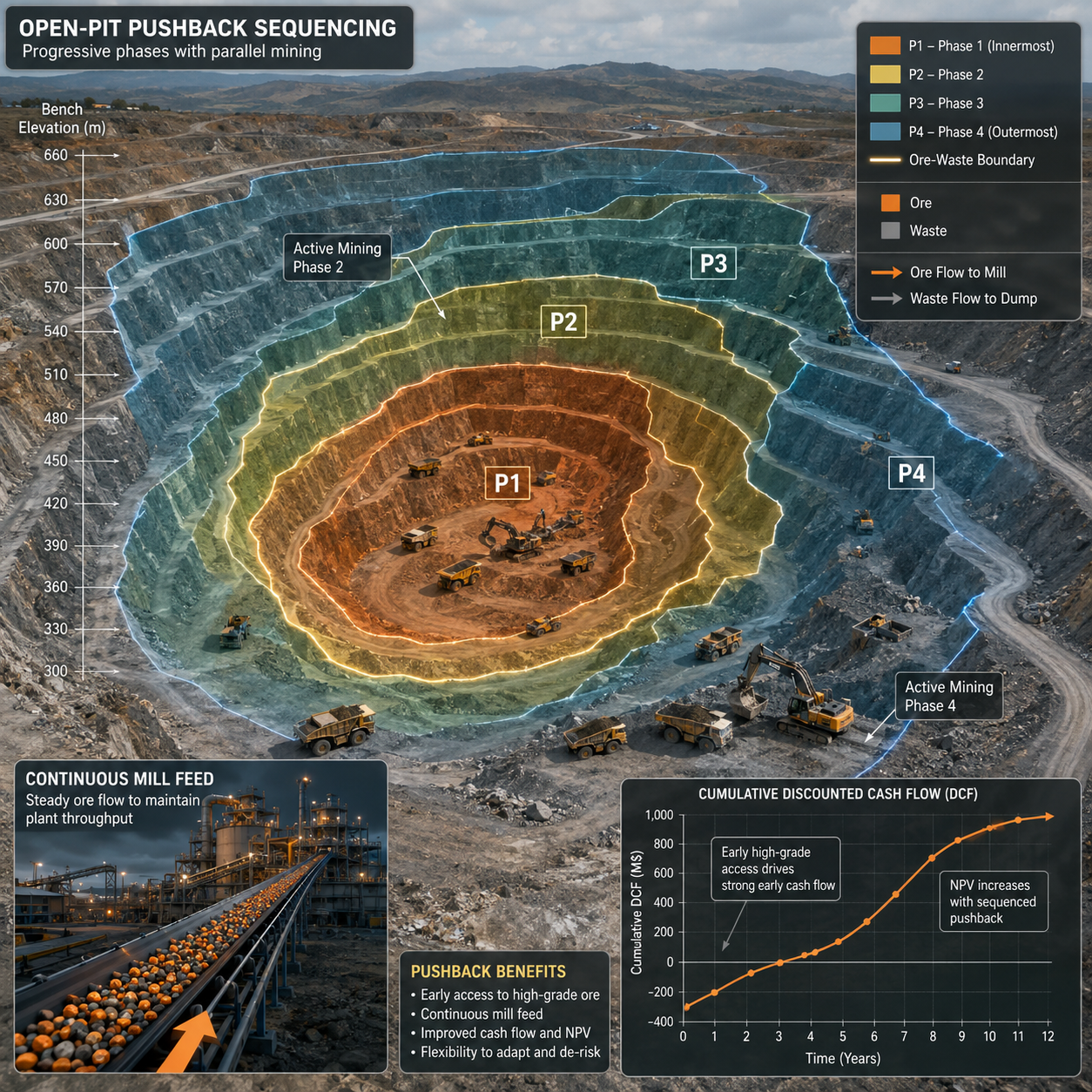
In open pit mining, three important considerations guide the success of such ventures, and these include pushbacks, Net Present Value (NPV), and mill feed. A pushback refers to an adjacent area of material scheduled to be removed to reach the final pit limits. NPV stands for the discounting of cash flows in the future as the main criterion for project valuation, whereas mill feed refers to the continuous supply of ore to the processing mill.
The major problem in sequence scheduling involves balancing between quick extraction of the ore to optimize the NPV on one side and providing a steady flow of mill feed on the other. Optimizing the NPV will require the postponement of the waste stripping in order to get valuable ore earlier. But doing so may lead to the loss of valuable future time because of the large stripping of the waste.
In general, sequences were obtained through deterministic algorithms, concentrating solely on geometric growth. Standard methods often result in inability to keep mill feed since they lack consideration of geological heterogeneity and processing limits. As a consequence of neglecting these limitations at the design stage, sequences require highly variable extraction rates that make it necessary to modify cut-off grades or stop processing, which drastically reduces expected NPV (Consuegra & Dimitrakopoulos, 2010).
The right way to deal with this problem involves algorithmic integration that optimizes sequencing, scheduling, and stockpiling at the same time. Instead of using already known nested pits, current approaches employ integer programming to create schedules according to processing limitations. With regard to the use of the milling capabilities as hard constraints, designers provide the precise schedule for waste stripping that exposes the needed amount of ore (Agosti et al., 2021).
Moreover, to absolutely ensure that there is no starving, sequencing should use stochastic programming to cope with uncertainties in grades. Using one deterministic program would mean that any drop in grade will interrupt the feed. Multi-stage approaches in dealing with uncertainty will help planners construct schedules to obtain maximum NPV in different simulations (Jelvez et al., 2023). The approach ensures enough reserves are left available to offset geological impacts (Goodfellow & Dimitrakopoulos, 2013).
In summary, sequencing a push back to get maximum NPV without starving the mill calls for abandoning geometric sequencing and adopting more flexible approaches. Stockpiling flows along with stochastic simulation can be used together with mathematical models to ensure that an ongoing stream of ores is secured.
References
Agosti, A., Utili, S., Gregory, D., Lapworth, A., Samardzic, J., & Prawasono, A. (2021). Design of an open-pit gold mine by optimal pitwall profiles. CIM Journal, 12(3), 149–168. https://doi.org/10.1080/19236026.2021.1979382
Consuegra, F. R. A., & Dimitrakopoulos, R. (2010). Algorithmic approach to pushback design based on stochastic programming: method, application and comparisons. Mining Technology, 119(2), 88–101. https://doi.org/10.1179/037178410×12780655704761
Goodfellow, R., & Dimitrakopoulos, R. (2013). Algorithmic integration of geological uncertainty in pushback designs for complex multiprocess open pit mines. Mining Technology, 122(2), 67–77. https://doi.org/10.1179/147490013×13639459465736
Jelvez, E., Ortiz, J., Varela, N. M., Askari-Nasab, H., & Nelis, G. (2023). A Multi-Stage Methodology for Long-Term Open-Pit Mine Production Planning under Ore Grade Uncertainty. Mathematics, 11(18), 3907. https://doi.org/10.3390/math11183907