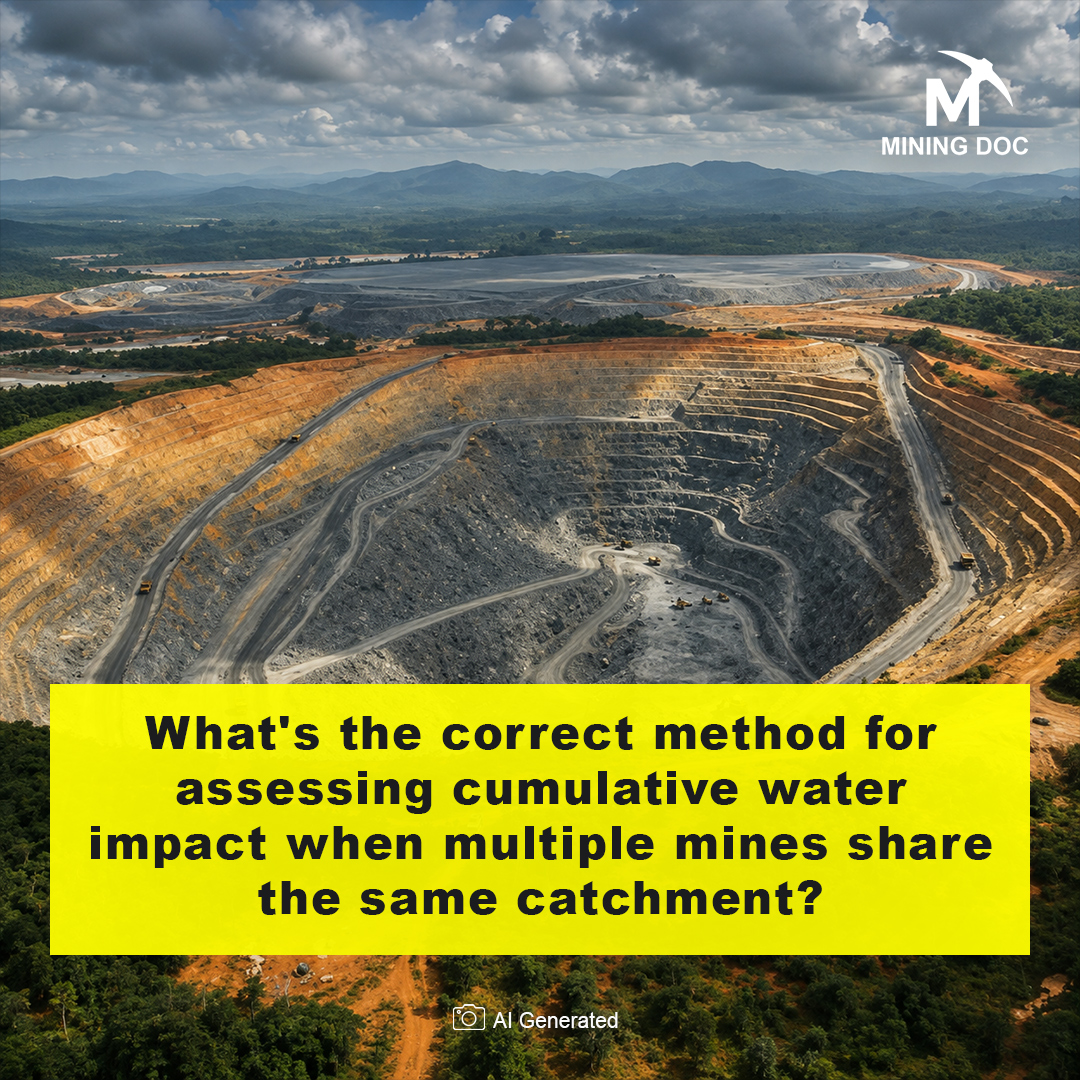
Cumulative water impact refers to the cumulative impact of multiple stressors on a shared aquatic system over time. A catchment, which is defined as the topographic region in which precipitation is collected and drains into a common outlet, usually harbors several mining projects. The presence of more than one mining project in the same catchment calls for the identification of an effective methodology for evaluating their collective environmental impact.
The evaluation of individual mining projects systematically undervalues environmental degradation. In order to counteract this trend, the researchers use Cumulative Effects Assessment (CEA), switching from fragmented environmental evaluation to holistic watershed-level management. Effectively conducting CEA on the watershed scale depends on ecological modeling and ongoing measurement of shared parameters like water quality, flow quantity, and land use changes (Bristow et al., 2025).
Assessment of the cumulative impacts on surface water requires the spatial monitoring of the area along with mass balance modeling. Analyzing the water quality downstream allows researchers to establish the total pollutant load coming from all upstream projects. It was established that the concentration of solutes in downstream areas is increasing in proportion to the total areal extent of mining upstream (Lindberg et al., 2011).
The evaluation of the cumulative impacts on groundwater requires advanced hydrogeological modeling. The simultaneous dewatering of the pits by several mines located next to each other causes the overlapping cones of depression which may significantly deplete a shared aquifer. The methodology of assessment includes the development of hydrogeological concept that will allow developing a predictive regional groundwater flow model capable of assessing deep aquifer interconnections and regional drawdown of the water table (Pandey et al., 2021).
Combination of the surface and groundwater models into a risk-based strategic framework is the optimal way of conducting assessment. This framework utilizes biophysical characteristics of the basin and uses scenario-based modeling of long-term interaction between mine dewatering, seepage of waste rock and toxic discharges (McIntyre et al., 2018). Adherence to transparent data protocols ensures scientific validity and flexibility of the cumulative risk analysis.
To conclude, evaluation of cumulative water impact of multiple mines is impossible without abandoning the idea of isolated project assessment. The appropriate methodology of assessment is a spatial and quantitative framework combining regional hydrogeological modeling and monitoring of the surface water. Using this watershed-scale methodologies allows protecting aquatic ecosystems from the cumulative effects of the intensive resource extraction.
References
Bristow, E., Mian, H. R., Chhipi-Shrestha, G. K., Hewage, K., & Sadiq, R. (2025). Cumulative effects assessment in community watersheds at different spatial scales: A review of indicators. Environmental Reviews, 33, 1–26. https://doi.org/10.1139/er-2023-0117
Lindberg, T. T., Bernhardt, E. S., Bier, R., Helton, A. M., Merola, R. B., Vengosh, A., & Di Giulio, R. T. (2011). Cumulative impacts of mountaintop mining on an Appalachian watershed. Proceedings of the National Academy of Sciences, 108, 20929–20934. https://doi.org/10.1073/pnas.1112381108
McIntyre, N., Angarita, M., Fernandez, N., Camacho, L., Pearse, J., Huguet, C., Restrepo Baena, O., & Ossa-Moreno, J. (2018). A Framework for Assessing the Impacts of Mining Development on Regional Water Resources in Colombia. Water, 10, 268. https://doi.org/10.3390/w10030268
Pandey, S., Cox, R., & Flook, S. (2021). Cumulative Groundwater Impact Assessment and Management – An Example in Practice. Groundwater Management and Resources. https://doi.org/10.5772/intechopen.95278