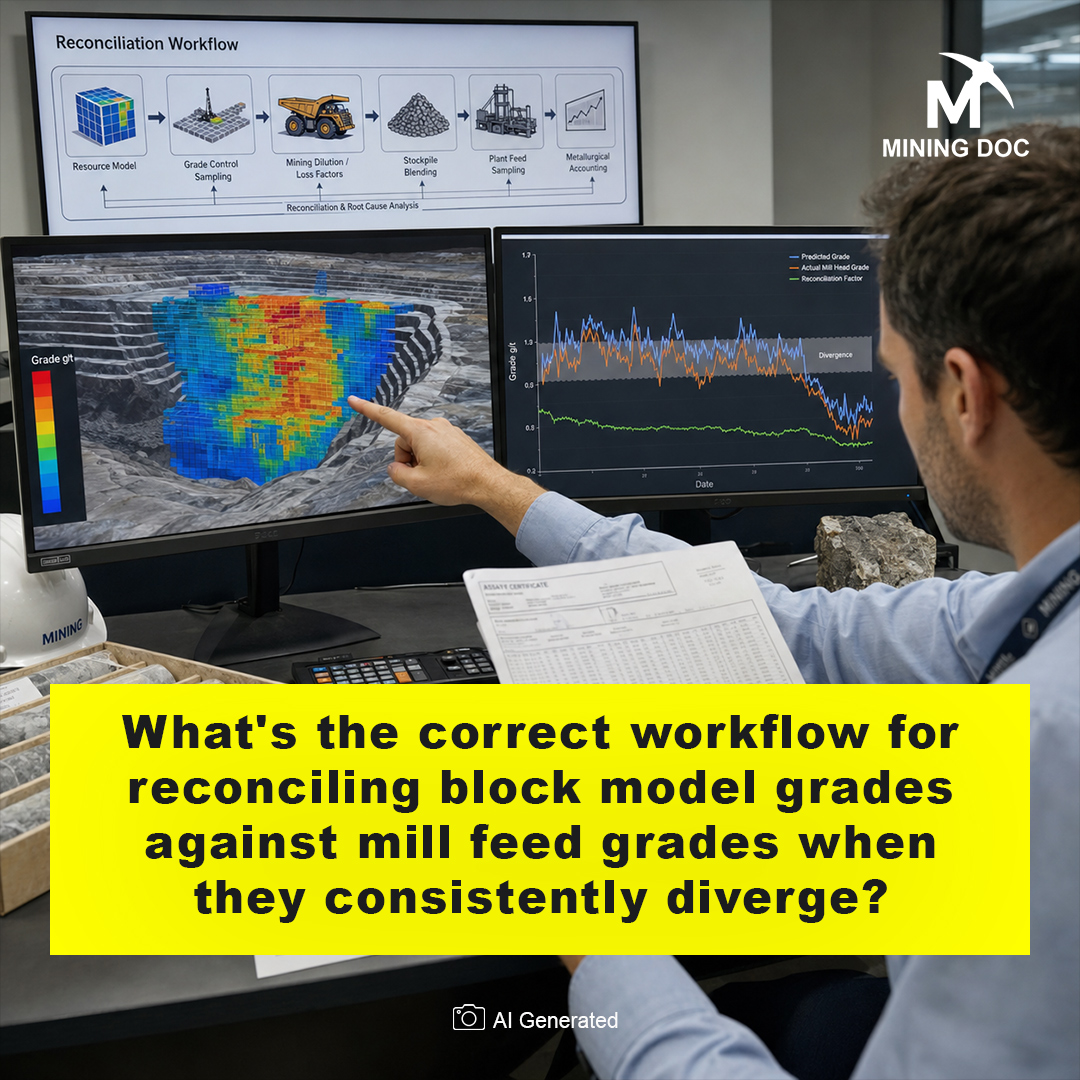
Block model is defined as a three-dimensional geometric representation of an ore deposit designed to estimate geological parameters such as mineral grades before mining. On the other hand, mill feed grade can be viewed as an actual grade of crushed ore entering the processing plant. Such inconsistency poses challenges regarding operational efficiency and profitability of operations in question. Thus, one needs to design a proper mine-to-mill reconciliation process, connecting geological estimation and metallurgy in a way ensuring reliable operations (Dominy et al., 2018).
The rigorous procedure begins by developing a methodology that is characterized by the adoption of standardized reconciliation factors F1, F2, and F3. The F1 reconciliation factor is instrumental in carrying out a comparison between the original long-term block model and grade control model in order to guarantee that the spatial estimation has been carried out successfully. The F2 reconciliation factor is utilized to carry out comparisons between the estimates obtained using grade control model with the true mill feed grade in order to determine the level of handling of materials. The F3 factor is used in measuring the whole mine to mill variance.
If there is an indication of any discrepancy by factor F1, then there is a need to assess the model for resources and grade controls. There is a need for geologists to check the basic assumption related to drilling density, data compositing, as well as various geostatistical estimation parameters that include Kriging neighborhoods. Any discrepancy will normally result from the fact that the spatial model of deposits does not have proper description in relation to the definition of boundaries between ore and waste bodies; this may result in the improper smoothing of high-grade zones within the neighboring blocks of wastes, resulting in discrepancies that may require adjustment.
When there is indication of the F2 factor in relation to the main source of the problem, then it would be necessary to focus on mine operation practices. This will mainly include ore losses and unexpected dilution as the process of moving ore from blasting to excavating and even to the stockpile tends to change the characteristics of the initial ore grade (Marinin et al., 2021). This can occur due to lack of selective mining or blast movements that can mix barren waste and valuable ore leading to dilution before getting into the crushing plant.
Furthermore, there must be an extensive process of verifying the measurement systems of the processing plant because the block model can be entirely accurate, whereas the mill figures may contain errors. It is necessary to regularly audit the weightometers, automatic cross-belt samplers, lab assays, and moisture determinations. A mere miscalculation in the mill sampling circuit can generate incorrect reports regarding the variance. Proper metallurgical accounting ensures that errors will not make one modify the correct block model using false mill measurements.
In conclusion, reconciling two different block models and grades in the mill is a well-defined process that involves analyzing all phases of the mining operation process. In doing this by systematically using the variance factor to evaluate the geological model, extraction processes, and plant instruments, the actual source of the problem is easily identified. The process of reconciliation cannot be limited to a simple process of accounting; on the contrary, it is actually an active process of feedback and analysis. This process helps refine the resource and operational models.
References
Dominy, S. C., O’Connor, L., Parbhakar-Fox, A., Glass, H. J., & Purevgerel, S. (2018). Geometallurgy—A Route to More Resilient Mine Operations. Minerals, 8(12), 560. https://doi.org/10.3390/min8120560
Marinin, M., Marinina, O., & Wolniak, R. (2021). Assessing of Losses and Dilution Impact on the Cost Chain: Case Study of Gold Ore Deposits. Sustainability, 13(7), 3830. https://doi.org/10.3390/su13073830
Saldana, M., Gallegos, S., Arias, D., Salazar, I., Castillo, J., Salinas-Rodríguez, E., Navarra, A., Toro, N., & Cisternas, L. A. (2024). Applications of Kuz–Ram Models in Mine-to-Mill Integration and Optimization—A Review. Minerals, 14(11), 1162. https://doi.org/10.3390/min14111162