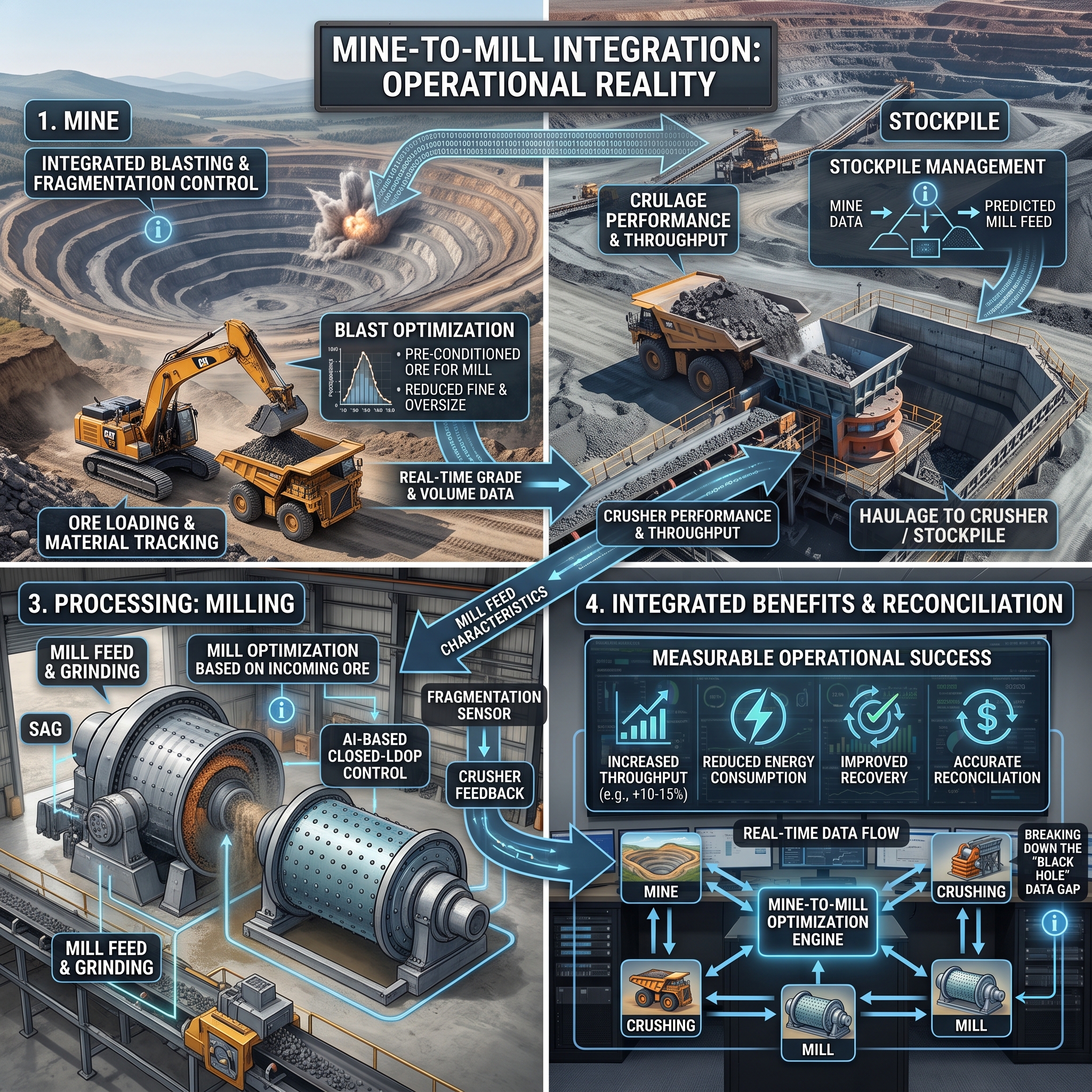
M2M integration is a holistic operational model which effectively ties together upstream activities such as geology, drilling, blasting, and hauling with downstream activities of crushing, grinding, and flotation. Conventionally, all these processes operate in isolation from each other as separate departmental silos which create significant inefficiencies in the overall process. There is an inherent irony in modern mining operations. Several decades of studies show that there could be efficiency gains in the range of 10% to 20% with significant energy savings through integrated rock breakage. However, such benefits have not been harnessed to their full extent. In today’s mining operations, the challenge to integrate is no longer about deciphering complex equations and building predictive models. Rather, bottlenecks and silos created by organizational challenges, coupled with poor data management, are the real hurdles to integration.
There is ample documentation on operational cases proving that proper blast fragmentation can result in an increased milling throughput of 5-20%, while lowering the power draw in the mills by around 10%. In large copper Tier-1 mines, such improvements have brought about an additional $200 million in added value to enterprises. Efficiency gains add further credibility to the economic rationale. Comminution is responsible for up to 30-40% of total energy usage at hard-rock mining sites. High blasting powder factors make it possible to pre-condition the rock mass, which causes the energy consumption to shift from expensive grinding operations to less energy-intensive explosive fragmenting. The technologies that underlie the mine-to-mill approach have long been developed and implemented.
Fragmentation of data across the site software systems represents a considerable problem. Data is usually trapped inside six or more separate software systems including geological block modeling, drill and blast software, fleet management, SCADA and plant historian systems. The organizational structure together with uncoordinated KPIs adds to the friction that is not solely connected to the data isolation issue. The mine managers traditionally get assessed based on cost efficiency per ton of pit operations where it does not encourage greater use of explosives even though smaller fragment size would improve recovery and profitability for mills. Turnover of staff and change in priorities often lead to backslides of the initiatives at the site.
Today’s implementations include use of metallurgical digital twins along with machine learning pipelines to create dynamic feedback loops within systems. Systems like Metso Geminex, as well as Rovjok or NTWIST’s predictive system, make automatic changes to mill feeds based on the features of ore coming in. The two-way flow of information enables information on the performance of the mill to shape the mine planning and stockpiling operations at the shift level. Advanced neural networks predict the hardness of ore based on the information collected via sensors prior to the ore arriving at the primary crusher. Modern mining companies develop new assets using a systems-oriented approach from the very beginning of the feasibility study process.
Mine-to-mill is an idea that has moved beyond being a theory into becoming a basic requirement for competitive advantage. Though technologies can help, they will not be able to bridge the pit-processing chasm in the presence of organizational silos and conflicting incentives. The executives must focus on three major operational imperatives for value creation:
- Create uniform data structure for geology, mining, and milling to create a single version of the truth.
- Make the remuneration systems of the company tied to the bottom line and not to local cost-per-tonne metrics.
- Create change management initiatives and governance that ensure that integrated decision making is part of normal shift operations.
The mine-to-mill process becomes the key process that drives the safety and sustainability agenda of the company.