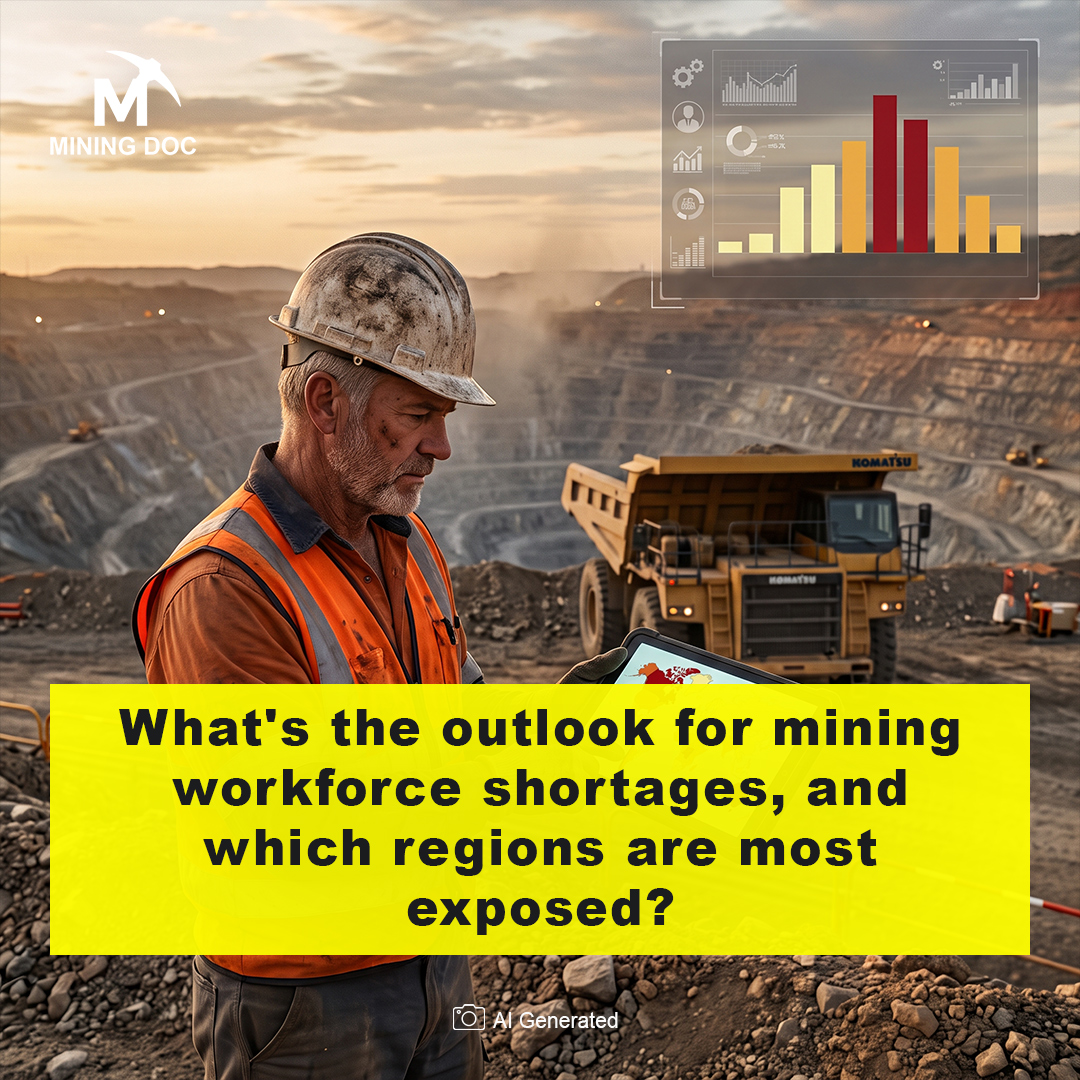
The mining industry faces a significant problem with regard to its operations: an increasing shortage of workforce. This means the increasing difference between the demand for qualified people in terms of their profession and skills and the supply of labor force. Simultaneously, the idea of regional exposure in this situation implies the vulnerability of particular geographical centers in terms of mining due to their susceptibility to labor shortages because of particular conditions.
The main reason of the described issue can be seen in the rapid adaptation of new Industry 4.0 technologies. With the implementation of automated systems, robotics, and artificial intelligence, labor force demand changes and becomes oriented on high digital skills. This results in a great discrepancy between the manual skills of the present-day labor force and the skills needed for the operation of such advanced facilities (Song, Brown, & Murry, 2026).
The current discourse brings into focus an associated technological revolution amid a clear demographic transition. With generations of old employees retiring, Generation Z joins the workforce with very different perceptions regarding work-life balance, immediate feedback, and company culture (Song et al., 2026). Further, a persisting problem of lack of talent results in an overloaded workforce. In total, it causes increased stress and burnout, leading to faster attrition of talented engineers and artisans (Thasi & van der Walt, 2020).
Geographically, advanced countries with legacy mining operations, such as Australia and Canada, experience considerable risk related to such a situation. It is aggravated with remote-operational business model based on cumbersome “fly-in fly-out” practice. Besides, with automation becoming more common in the mining industry, there are fears of obsolescence of traditional jobs, which affects Indigenous communities disproportionally since they make up a significant share of manual and semiskilled workforce (Holcombe & Kemp, 2019).
Conversely, the situation in emerging markets – for example, in South Africa – features its own kind of regional vulnerability related to the problem of economic migration and inequality. In South Africa, the mining industry faces serious shortage of key professional skills, namely among specialists like artisans and engineers. This skill shortage results in serious pressure on the existing work force which leads to stress in one’s profession and creates an endless loop which prevents keeping best talents due to severe international competition (Thasi & van der Walt, 2020).
To conclude, the prospects of workforce shortage in mining globally appear quite grim owing to the impact of digitalization and aging employees. Traditional centers in Australia and Canada, along with emerging markets, such as South Africa, are some of the most vulnerable areas which are facing different geographic and demographic challenges. Mining companies need to develop localized workforce strategies and take care of workers’ health and invest in constant digital education of workers in order to keep productivity in the future.
References
Holcombe, S., & Kemp, D. (2019). Indigenous peoples and mine automation: An issues paper. Resources Policy, 63, 101420. https://doi.org/10.1016/j.resourpol.2019.101420
Song, B., Brown, R., & Murry, L. (2026). Digital transformation, regional labour markets, and the Generation Z workforce in mining: a comparative analysis of the Bowen Basin and Queensland. Mineral Economics. https://doi.org/10.1007/s13563-026-00632-z
Thasi, M., & van der Walt, F. (2020). Work stress of employees affected by skills shortages in the South African mining industry. The Journal of the Southern African Institute of Mining and Metallurgy, 120(3), 243-250. https://doi.org/10.17159/2411-9717/666/2020